Bashaer Al Khair — Water Leak Detection & Waterproofing
Active Service Coverage:Jeddah & Makkahالعربية
Bashaer Al Khair Waterproofing & Water Leak Detection
Bashaer Al KhairWaterproofing & Leak Detection
Specialized Water Leak Detection & Moisture Diagnostics Hub

Complete Water Leak Detection System in Jeddah & Makkah — Precision Engineering Diagnostics Before Any Repair or Waterproofing

At Bashaer Al Khair, we replace guesswork and random tile demolition with a rigorous multi-instrument engineering protocol—combining acoustic ground listening, thermal delta-T imaging, dielectric moisture mapping, and hydraulic pressure isolation across residential and commercial properties in Jeddah and Makkah.

Illustrative photo of a Bashaer Al Khair technician inspecting water leaks with non-destructive digital instruments
Multi-instrument engineering diagnostics to isolate leak originsIllustrative
Interactive Technical Triage Tool

Find Your Service — Help Us Identify the Issue

Select the symptom you observe, your city, and your property type to view preliminary engineering guidance and prepare your inspection request.

1. What Is the Observed Problem or Symptom?

2. Select City

3. Select Property Type

4. Preliminary Service RecommendationJeddah · Villa
Recommended Technical Path:

High Water Bill Diagnostics (Tank, Float Valves, Cisterns & Buried Supply Lines)

Sudden spikes in water consumption are frequently linked to silent internal leaks in the underground water tank (faulty float valve or neck cracks), the main meter-to-tank supply line, or leaking toilet cisterns. A step-by-step isolation check starting at the meter and tank is recommended before any interior breaking.

What does the on-site assessment cover?

  • •Conducting meter isolation tests and checking the meter-to-tank supply line
  • •Inspecting all tank float valves and toilet flush mechanisms across the property
  • •Mapping lower-wall dampness and distinguishing rising damp from active pipe leaks

Professional Notice: This interactive selector provides preliminary orientation to help identify the relevant service track. It does not replace an on-site technical inspection, which is required for a definitive diagnosis.

5. Request Inspection & Contact Options

Open Dedicated Diagnostic Guide for Jeddah
10 Specialized Leak Detection Services

Select the Exact Diagnostic Service & City (Jeddah or Makkah)

Each of our 10 diagnostic services uses a dedicated testing protocol and instrument combination tailored to the specific building system in Jeddah and Makkah:

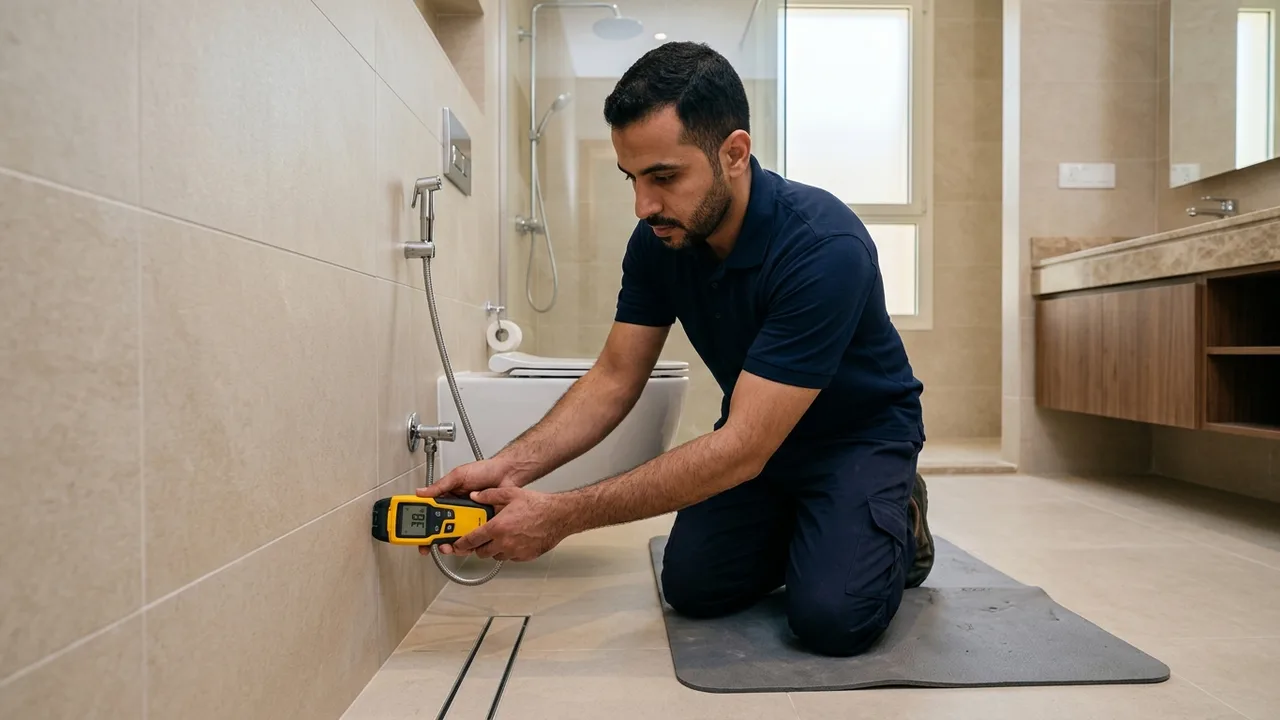
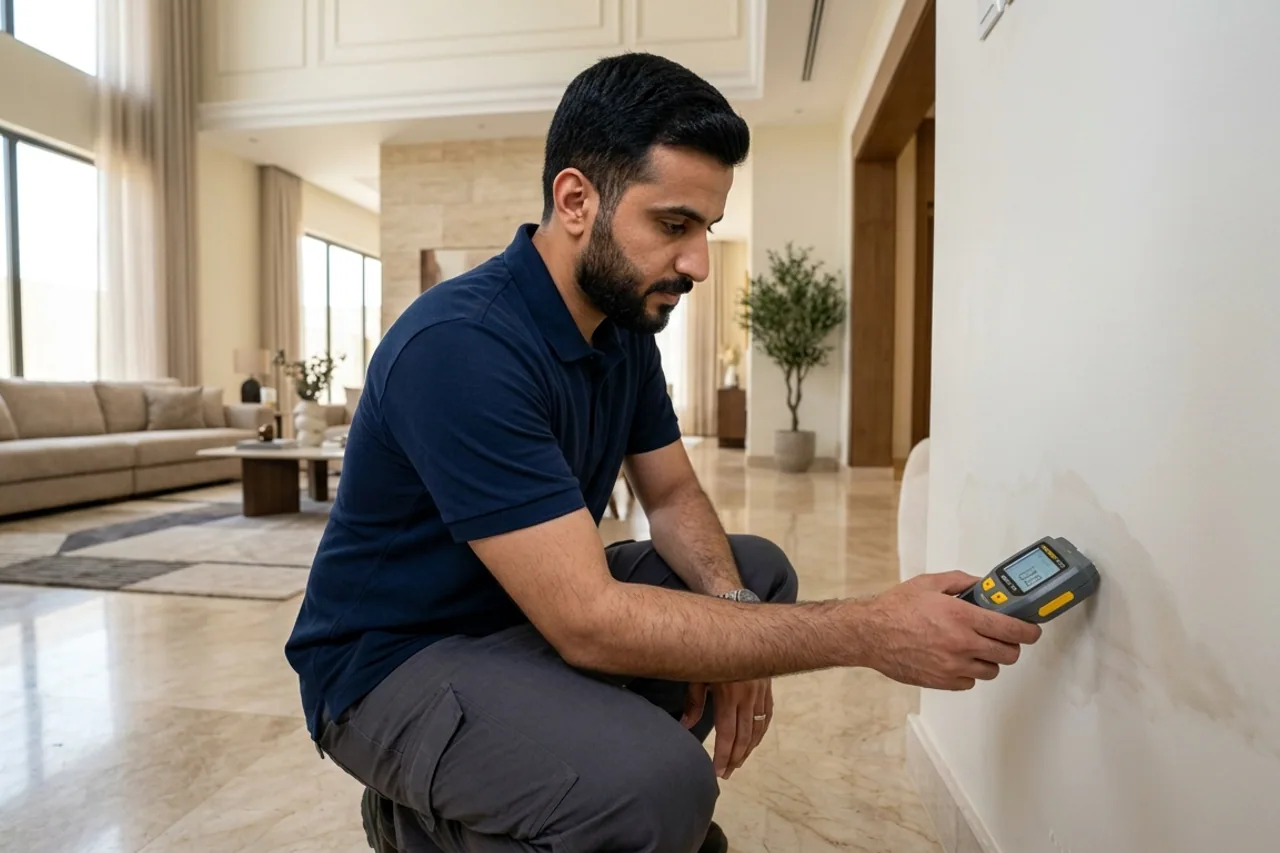
Illustrative photograph of a Bashaer Al Khair technician inspecting hidden wall moisture with a non-invasive meter01
Concealed Leak Diagnostics • Non-Invasive Inspection

Hidden & Non-Invasive Leak Detection

We locate invisible water leaks behind walls, under porcelain tiles, and across buried villa pipelines in Jeddah by combining hydrostatic pressure isolation, acoustic sensors, thermal ΔT mapping, and deep moisture readings.

Key Diagnostic Highlights:
  • 4-way non-destructive correlation (Pressure Isolation + Acoustic + Thermal ΔT + Moisture Meter)
  • Narrowing pipe defects to a localized spot (1–2 tiles) instead of demolishing entire rooms
Illustrative photograph of a Bashaer Al Khair technician inspecting a bathroom shower drain and wall tile joint with a moisture meter02
Wet-Area Diagnostics • Supply, Drain & Grout

Bathroom Leak Detection

A single bathroom contains over 6 distinct leak sources (cold supply, hot supply, concealed mixers, floor drains, toilet seals, and tile grout). In Jeddah, we isolate each system methodically so you never demolish an entire bathroom unnecessarily.

Key Diagnostic Highlights:
  • Definitive separation between pressurized supply leaks and drainage/grout seepage
  • Objective multi-floor diagnostics resolving upstairs vs. downstairs apartment disputes
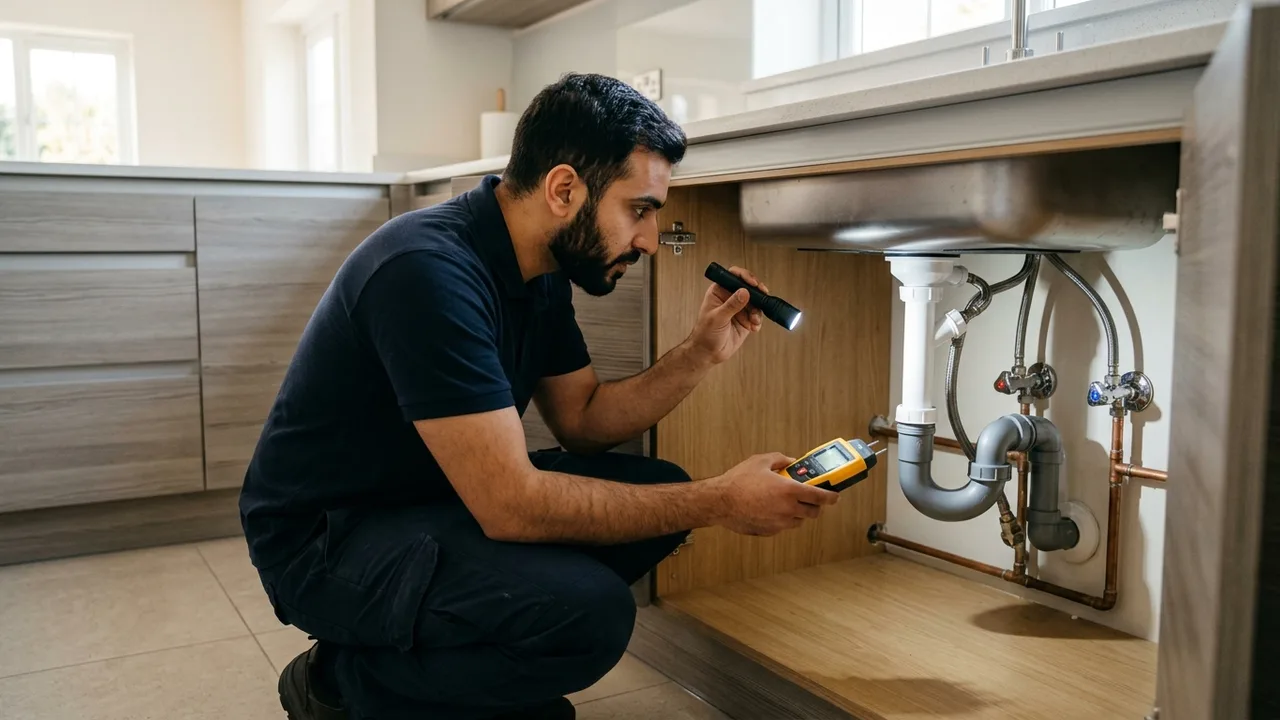
Illustrative photograph of a Bashaer Al Khair technician inspecting under-sink kitchen plumbing valves and drain trap with a moisture meter03
Kitchen Plumbing Diagnostics • Cabinet & Floor Protection

Kitchen Leak Detection

Fitted aluminum, wood, and marble kitchen cabinets conceal a dense network of supply lines, water heaters, RO filters, and dishwasher drains. In Jeddah, we pinpoint kitchen leaks using thermal, acoustic, and pressure testing without tearing out cabinetry.

Key Diagnostic Highlights:
  • Inspecting concealed zones behind and beneath kitchen cabinetry without dismantling full units
  • Auditing RO water filter tubing, dishwasher hoses, washing machines, and instant heaters
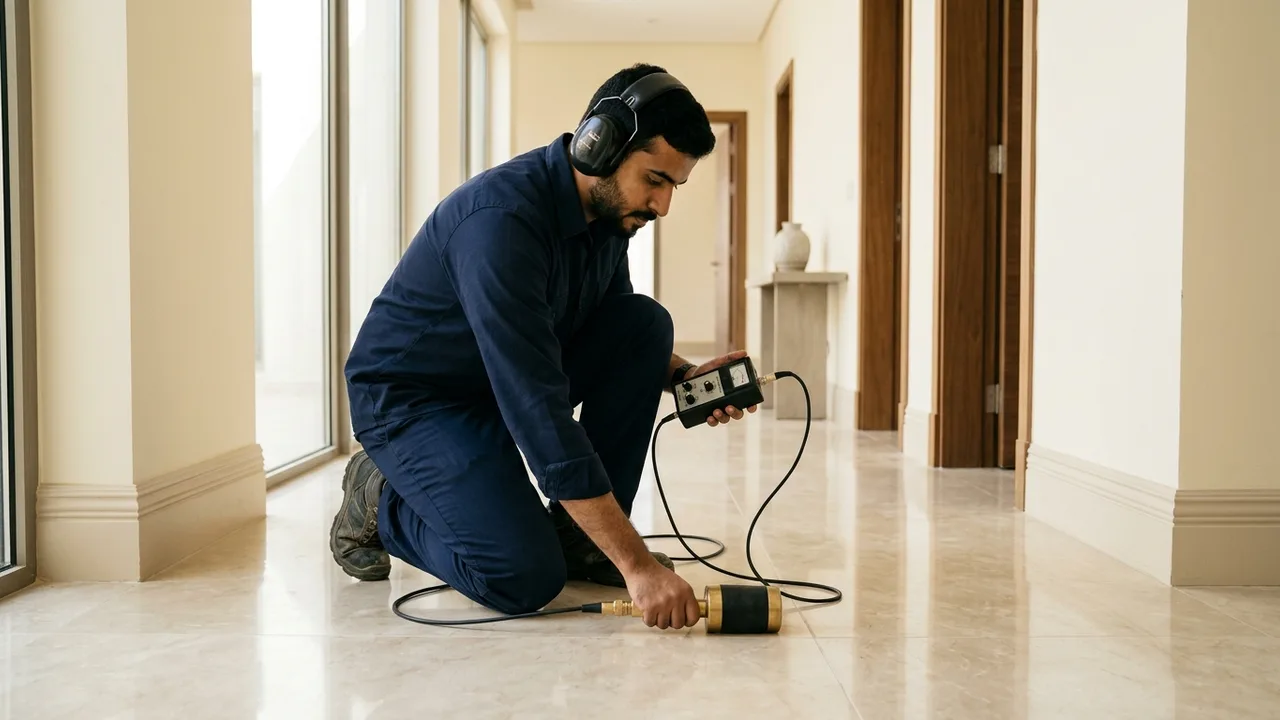
Illustrative photograph of a Bashaer Al Khair technician using an acoustic ground microphone sensor on porcelain floor tiles04
Sub-Floor Diagnostics • Acoustic & Thermal Pinpointing

Under-Tile Leak Detection

When water leaks beneath porcelain or marble flooring in Jeddah, it spreads laterally across the underlying sand bed before surfacing. We combine hydrostatic pressure testing, ground microphones, and thermal ΔT imaging to locate the exact origin.

Key Diagnostic Highlights:
  • Distinguishing the true pipe breach epicenter from lateral sand-bed moisture spread
  • Independent hydrostatic pressure testing of hot and cold sub-floor supply manifolds
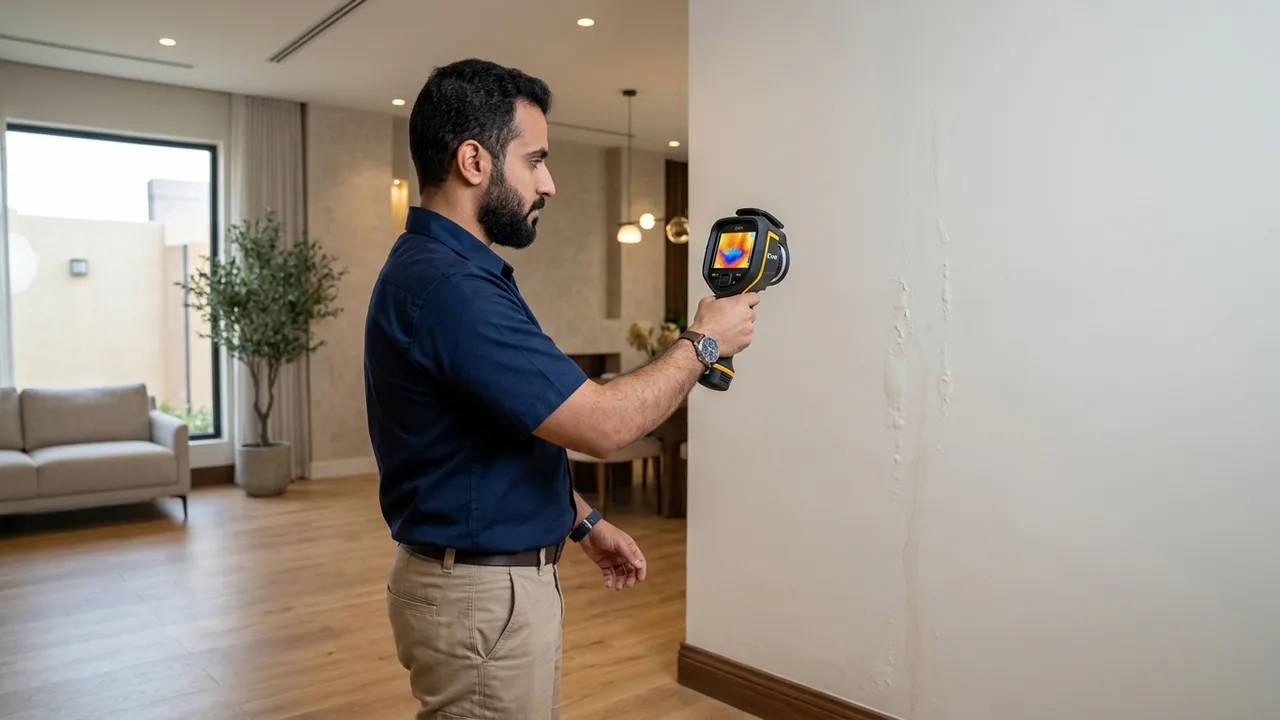
Illustrative photograph of a Bashaer Al Khair engineer inspecting concealed in-wall pipe dampness with a thermal imaging camera05
Concealed Wall & Riser Diagnostics • Thermal & Acoustic

In-Wall Pipe Leak Detection

When paint blisters, plaster crumbles, or dampness emerges mid-wall or behind decorative panels in Jeddah, we trace the concealed pipe path inside the masonry block and pinpoint the leaking joint using thermal ΔT imaging, moisture mapping, and acoustic sensors.

Key Diagnostic Highlights:
  • Mapping concealed hot and cold pipe trajectories inside plastered walls without demolition
  • Locating the primary moisture epicenter versus secondary capillary spread across masonry blocks
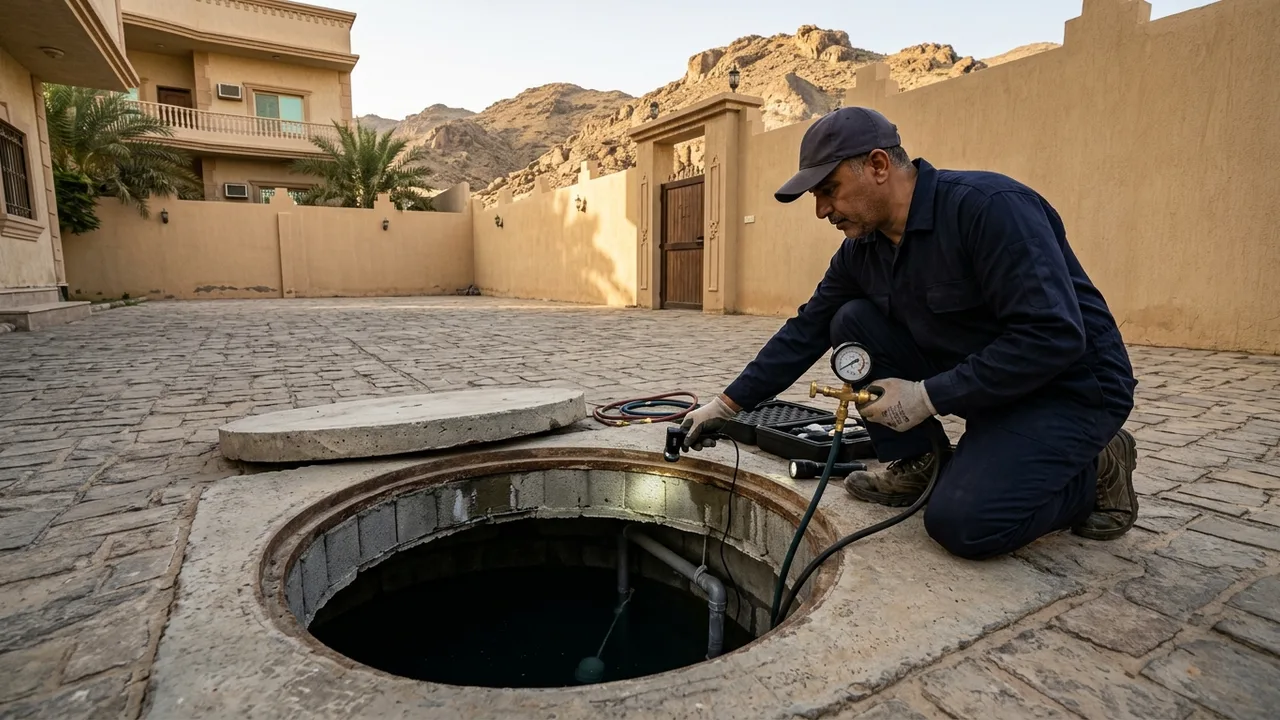
Illustrative photograph of a Bashaer Al Khair technician inspecting an underground concrete water tank neck, float valve, and pressure gauge06
Tank Diagnostics • Float Valve, Neck Joint & Concrete Shell

Water Tank Leak Detection

Your underground concrete water tank in Jeddah is the primary reservoir for your property; any defect in its meter supply line, float valve, masonry neck, or concrete shell triggers severe bill spikes or coastal groundwater contamination. We audit all 4 zones methodically.

Key Diagnostic Highlights:
  • 4-Zone Tank Audit: Meter-to-Tank Line + Float Valve + Tank Neck Joint + Concrete Walls/Floor
  • Clear differentiation between outward treated-water loss and inward saline groundwater infiltration
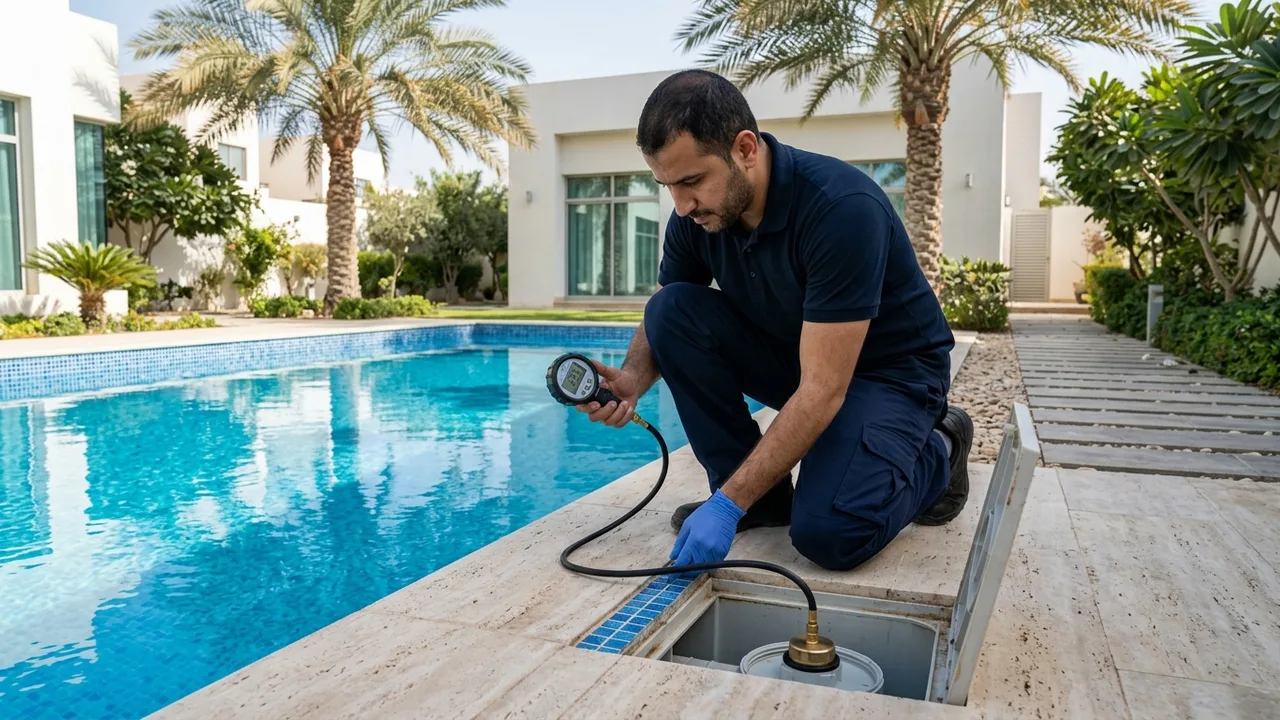
Illustrative photograph of a Bashaer Al Khair technician pressure-testing swimming pool circulation lines at the skimmer box07
Pool Diagnostics • Plumbing Lines, Skimmer & Concrete Shell

Swimming Pool Leak Detection

When your villa or compound swimming pool in Jeddah loses water faster than normal evaporation, the fault lies either in the buried circulation plumbing (skimmer, return jets, vacuum line, main drain) or the pool shell (skimmer throat, light conduits, mosaic joints). We test both methodically.

Key Diagnostic Highlights:
  • First separating normal climate evaporation from true structural/plumbing loss (Bucket Test)
  • Independent manometer pressure testing of Return, Skimmer, Vacuum, and Main Drain lines
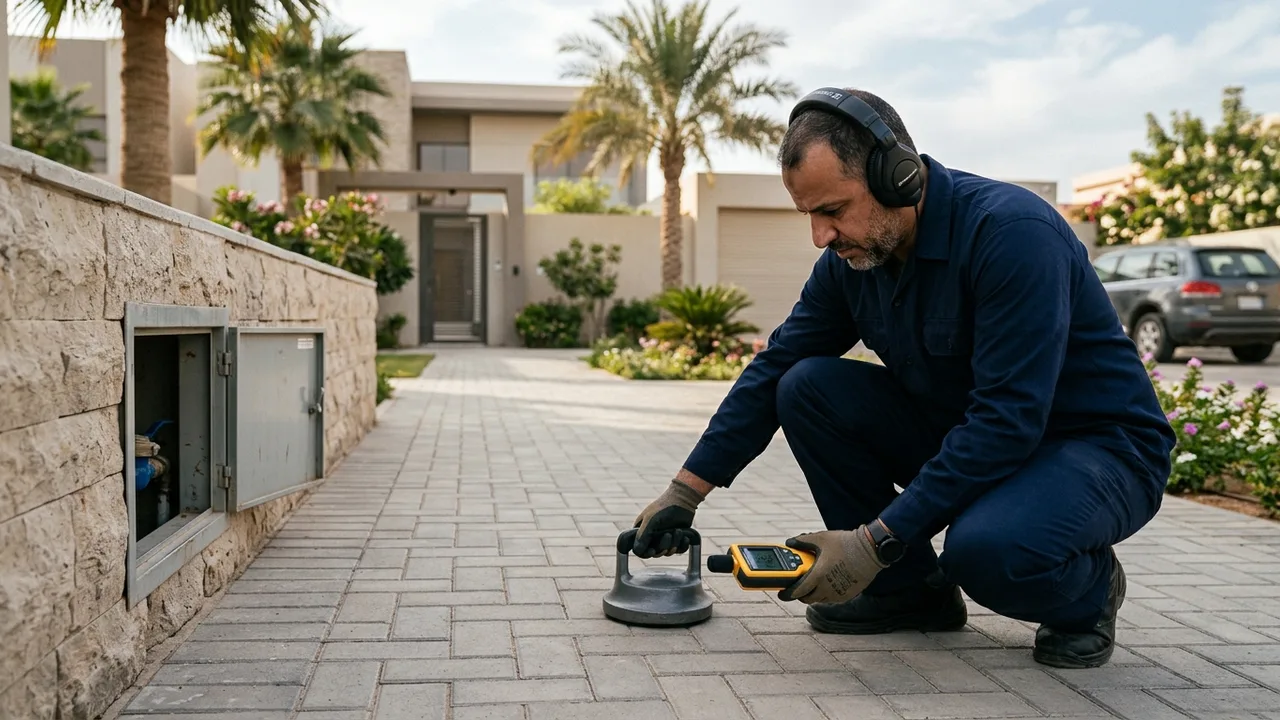
Illustrative photograph of a Bashaer Al Khair technician tracing a buried external water line beneath interlocking courtyard pavers with a ground microphone08
Buried Yard & Main Line Diagnostics • Acoustic, Pressure & Tracer Gas

Underground & External Pipe Leak Detection

Buried water pipes beneath villa courtyards and walkways in Jeddah face vehicle wheel loads, sandy sub-base settlement, and coastal fitting corrosion. We test meter-to-tank mains, suction/delivery lines, and yard branches to pinpoint breaches without excavating your entire yard.

Key Diagnostic Highlights:
  • Precision testing of the primary buried service line between the street water meter and ground tank
  • Tracing buried suction and delivery pipelines beneath courtyard tiles, interlock pavers, and concrete
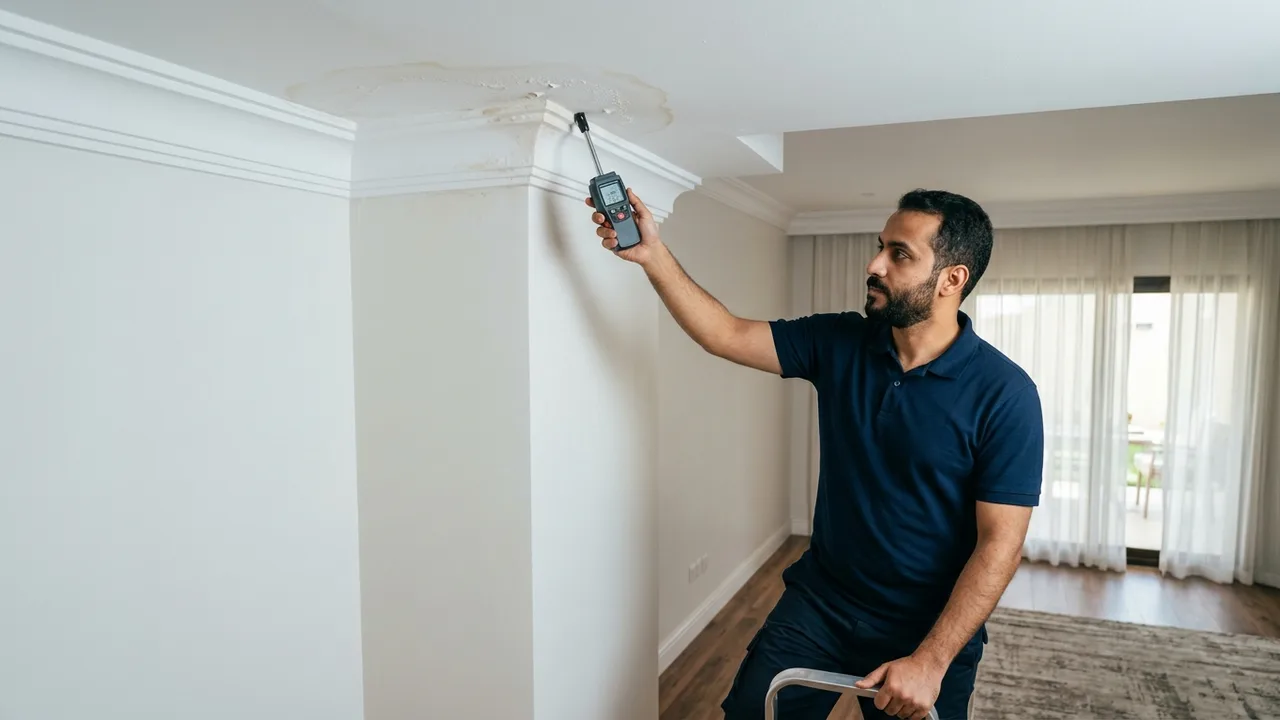
Illustrative photograph of a Bashaer Al Khair technician inspecting ceiling water ingress using a thermal camera and moisture meter09
Ceiling & Roof Diagnostics • Rain, Upper Plumbing or HVAC

Ceiling & Roof Water Ingress Inspection

Yellow stains, peeling paint, or active dripping on a ceiling in Jeddah do not automatically mean you need a full roof re-waterproofing! The source could be a leaking rooftop tank manifold soaking under the tiles, a blocked rainwater scupper, an upper-floor bathroom leak, or an AC condensate line above the gypsum ceiling. We test all sources before you spend.

Key Diagnostic Highlights:
  • Decisively separating 4 sources: roof membrane/rain, rooftop tank piping, upper-floor bathroom, and AC condensate
  • Thermal and dielectric moisture mapping of the ceiling slab to locate the actual concrete entry point
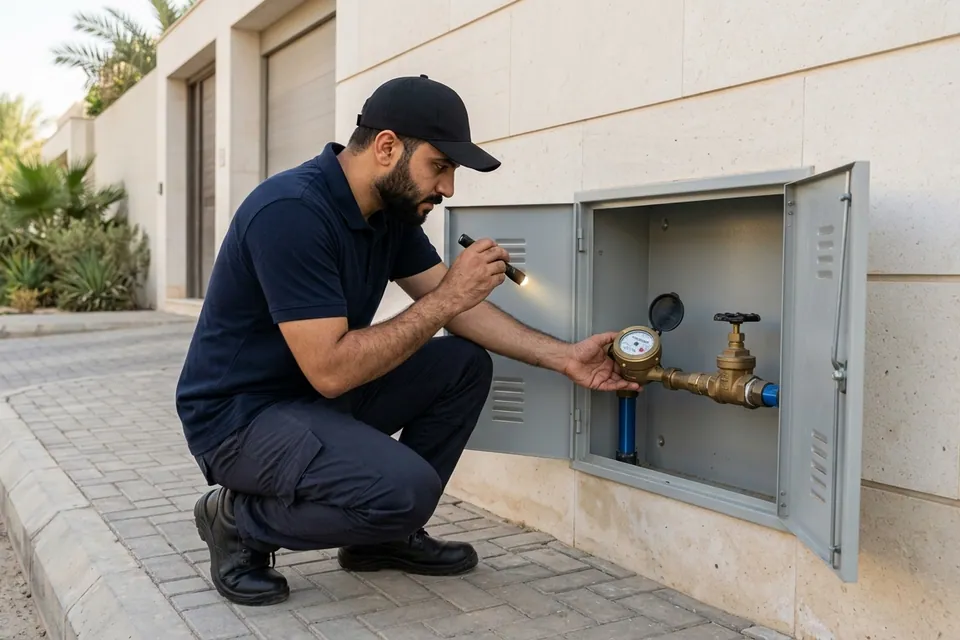
Illustrative photograph of a Bashaer Al Khair technician inspecting the exterior water meter and main shut-off line to diagnose a high water bill10
High Bill Audit • End-to-End Meter, Tank & Network Diagnostics

High Water Bill Investigation

In many Jeddah properties, a sudden spike in your monthly water bill is the first and only warning sign of a major underground leak beneath the courtyard or inside the ground tank—with zero dampness visible indoors! We execute an end-to-end hydraulic audit from the street meter to every tank and fixture to stop the waste.

Key Diagnostic Highlights:
  • Complete 6-point audit: Meter, Meter-to-Tank Line, Tank Float/Neck, Tank Shell, Check Valves, and Internal Network
  • Uncovering "Silent Leaks" that dump десятки of cubic meters into soil or drains with zero visible indoor stains
Detection vs. Repair vs. Waterproofing

The Bashaer Al Khair Engineering Rule: Why Leak Detection Must Precede Plumbing Repair or Waterproofing

One of the costliest mistakes in property maintenance is applying waterproofing over active pressurized pipe leaks—or demolishing an entire bathroom floor when the issue is simply eroded tile grout. Here is how our three disciplines work together:

1. Water Leak Detection (Diagnostic Engineering)

Non-destructive testing that identifies the exact physical water source (pressurized supply pipe, gravity drain, tile grout, structural crack, groundwater, or rain) and isolates its coordinates.

When Is It Needed?Whenever you notice wall dampness, ceiling stains, tank/pool level drops, or a sudden spike in your monthly water bill.

2. Targeted Mechanical & Plumbing Repair

Fixing the specific mechanical fault identified by diagnostics: replacing a tank float valve, check valve, or cistern seal, or repairing a pinpointed pipe fitting.

When Is It Needed?When pressure gauges or acoustic sensors confirm a breach in a pipe, valve, or plumbing fixture.

3. Waterproofing & Thermal Insulation (Structural Protection)

Constructing an impervious barrier across concrete tanks, roofs, bathrooms, and swimming pools once pressurized plumbing lines are verified sound.

When Is It Needed?When testing proves pipes hold pressure and leakage is driven by failed membranes, concrete cracks, or open tile joints.
Multi-Instrument Diagnostic Matrix

Comparison of Leak Detection Instruments & Why We Combine Them in Jeddah & Makkah

Diagnostic InstrumentPrimary TargetEffective Depth / ScopeWhy We Pair It With Other Tools
Digital Acoustic Ground SensorPressurized supply pipes beneath tiles & courtyardsUp to 1.5–2.0 m through screed & soilCannot hear non-pressurized gravity drains; paired with pressure & borescope.
Thermal Imaging Camera (ΔT)Hot-water PPR lines, ceiling ingress & sub-tile dampnessSurface thermal profile & immediate sub-tile zoneReads surface ΔT rather than deep buried water; verified with moisture & pressure gauges.
Dielectric Moisture MeterLocating peak moisture saturation behind tiles & paintUp to 40–50 mm into plaster, screed & concreteQuantifies dampness but not which pipe is leaking; combined with line isolation.
Hydrostatic Pressure ManometerProving tightness of cold, hot & pool pipe circuitsTests the entire isolated pipe run regardless of depthProves a line is leaking; acoustic & thermal tools then pinpoint the exact coordinate.

Illustrative engineering diagram only — exact leak coordinates and remediation scope are confirmed following on-site instrument inspection.

7 Non-Destructive Inspection Technologies & Their Real Physics

How Bashaer Al Khair’s Leak Detection Instruments Work — And Their Honest Physical Limits

We never rely on a single gadget or unscientific claims. Each diagnostic modality below is deployed according to pipe material, burial depth, and physical boundary conditions:

01Verified Field Modality

Acoustic Listening & Ground Microphones

Scientific Principle: Ground microphones and contact acoustic sensors amplify specific frequency vibrations generated when pressurized water escapes through a pipe crack or fitting joint, filtering ambient noise to locate the peak decibel point.

Best Applications:
  • • Pressurized water supply lines beneath ceramic and porcelain floor tiles
  • • Buried external supply pipes under courtyard pavers and walkways
  • • Pinpointing active leaks in pressurized PPR and metallic pipes inside walls
Physical Limitations:
  • • Requires sufficient internal line pressure to generate acoustic turbulence; it cannot detect unpressurized gravity drainage leaks on its own
  • • Ambient noise from booster pumps, AC compressors, or street traffic must be isolated during measurement
  • • Deep burial or thick insulation layers can attenuate acoustic signals, requiring correlation with pressure testing
02Verified Field Modality

Infrared Thermal Imaging (ΔT Mapping)

Scientific Principle: Infrared cameras measure surface temperature differentials (ΔT) across walls, ceilings, and floors caused by evaporative cooling of moisture or heat transfer from hot water lines—they do not "see water through solid concrete" like X-rays.

Best Applications:
  • • Tracing concealed hot water supply lines beneath tiles or inside plastered walls
  • • Mapping the spatial spread of evaporative dampness across ceilings and walls
  • • Identifying moisture-cooled zones prior to pinpointed dielectric moisture readings
Physical Limitations:
  • • If leaking water is at thermal equilibrium with the surrounding slab, thermal contrast is minimal unless hot water flow is induced
  • • Polished porcelain, marble, or glass surfaces reflect ambient radiation and require careful emissivity interpretation
  • • Thermal imaging serves as a spatial mapping tool and must always be confirmed with moisture meters or pressure gauges
03Verified Field Modality

Dielectric & Pin Moisture Meters

Scientific Principle: Non-invasive dielectric meters measure changes in the electrical permittivity of building materials (concrete, plaster, gypsum, tile beds) up to 20–40 mm deep to quantify relative moisture saturation against dry baseline zones.

Best Applications:
  • • Locating the highest moisture concentration point along peeling lower walls and skirting boards
  • • Distinguishing historic dried stains from active ongoing leaks in ceilings
  • • Checking sub-tile saturation around shower drains, bathtubs, and bathroom thresholds
Physical Limitations:
  • • Dense steel rebar or shallow electrical conduits can influence capacitance readings, requiring dry-wall baseline calibration
  • • Confirms moisture presence and gradient direction, but must be paired with line isolation to distinguish supply vs. drainage sources
04Verified Field Modality

Hydrostatic & Pneumatic Line Pressure Testing

Scientific Principle: A specific supply branch (cold, hot, or pool circulation line) is isolated and capped, then pressurized with a calibrated manometer gauge; any pressure decay over the holding period confirms a breach in that exact circuit.

Best Applications:
  • • Definitively separating pressurized supply pipe failures from drainage or grout seepage in bathrooms and kitchens
  • • Verifying the integrity of the main buried line between the water meter and underground tank
  • • Independently testing swimming pool skimmer, return, and main drain lines apart from the concrete shell
Physical Limitations:
  • • Test pressure must never exceed safe operating limits for aging pipes to avoid stressing intact joints
  • • Worn angle valves or mixer cartridges can cause false pressure drops unless outlets are properly plugged during the test
05Verified Field Modality

Water Meter Flow & Staged Valve Isolation Audit

Scientific Principle: Monitors the low-flow indicator on the water meter while sequentially closing isolation valves (main tank inlet, float valve, booster pump, floor manifolds) to isolate silent consumption to a specific building zone.

Best Applications:
  • • Investigating sudden high water bill spikes where no indoor dampness is visible
  • • Detecting underground leaks in the service pipe between the external meter and ground tank
  • • Identifying silent continuous overflow from tank float valves and toilet cisterns
Physical Limitations:
  • • Requires temporary cessation of household water use during the isolation window
  • • Leaks occurring through the concrete walls of the ground tank after the float valve require static water-level drop measurement inside the tank itself
06Verified Field Modality

Engineering Visual Inspection, Borescope & Flood Testing

Scientific Principle: Combines systematic inspection of grout joints, drain throats, tank necks, and plumbing shafts with flexible borescope cameras for concealed cavities and controlled flood/dye testing for unpressurized floor drains.

Best Applications:
  • • Inspecting above suspended gypsum ceilings and inside narrow pipe chases without demolition
  • • Testing shower pan grout, floor drain seals, and toilet base connections
  • • Examining concrete cracks, honeycombing, and neck joints inside water tanks and pools
Physical Limitations:
  • • Borescope cameras require an existing small aperture (e.g., spotlight cutout or access hatch) and cannot penetrate solid mortar
  • • Controlled flood testing of wet-area floors requires sufficient observation time to confirm seepage migration
07Verified Field Modality

Safe Tracer Gas Inspection for Deep Buried Lines

Scientific Principle: For deeply buried external pipelines or thick slabs where acoustic signals are muffled, the drained line is charged with a safe, non-toxic inert gas blend (95% nitrogen / 5% hydrogen); lightweight molecules escape the breach and rise to the surface detector.

Best Applications:
  • • Long exterior supply runs buried beneath thick courtyard concrete or paving
  • • Deeply buried swimming pool manifolds where acoustic listening is inconclusive
  • • Micro-leaks causing slow pressure decay without audible acoustic turbulence
Physical Limitations:
  • • Not required for routine indoor fixture leaks; reserved for complex buried lines that must first be drained of water
  • • Subsurface vapor barriers can cause lateral gas migration toward the nearest tile joint, requiring experienced correlation with pipe routing
7-Step Field Diagnostic Protocol

What Happens Step-by-Step During a Bashaer Al Khair Inspection Visit?

01

Inquiry Intake & Initial Symptom Triage

We document the observed symptoms (bill spike, ceiling drip, peeling paint, or tank drop), property type in Jeddah or Makkah, and approximate plumbing age to prepare the right diagnostic kit.

Establishing initial diagnostic hypotheses and scheduling the field visit.
02

Site Walkthrough & Safety Verification

The technician inspects visible dampness zones and checks that moisture has not compromised electrical panels, wall switches, or structural ceiling slab integrity.

Securing the inspection zone and establishing dry baseline reference points.
03

Network Isolation, Meter & Pressure Testing

We isolate cold and hot supply branches and tank lines, monitoring pressure gauges and meter flow to determine whether the fault lies in a pressurized line or unpressurized drainage/grout.

Identifying the exact defective system (cold supply, hot supply, drainage, waterproofing, or tank).
04

Multi-Instrument Acoustic, Thermal & Moisture Mapping

We deploy the appropriate instruments (acoustic sensors for pressurized lines, thermal cameras for ΔT mapping, and dielectric moisture meters for saturation peaks) to narrow the fault to the smallest footprint.

Pinpointing the localized fault zone to prevent blind full-room demolition.
05

Cross-Verification & Differential Diagnosis

We cross-check instrument readings to rule out non-pipe causes such as AC duct condensation, coastal capillary rising damp in Jeddah, or degraded shower tile grout.

Verified differential diagnosis separating plumbing leaks from insulation failure or condensation.
06

Transparent On-Site Findings Briefing

We walk the client through the exact fault location, root cause, and whether remediation requires localized plumbing access (e.g., 1–2 tiles) or surface waterproofing treatment.

Clear, documented technical clarity before the client commits to any repair work.
07

Actionable Remediation & Waterproofing Roadmap

We outline a prioritized remediation plan: stopping the active water source first, allowing substrate drying where required, and applying targeted waterproofing or plumbing repair.

A practical execution roadmap that protects the structure and prevents recurring damage.
Local Engineering Specialization

Why Our Leak Detection Methodology Differs Between Jeddah and Makkah

Water Leak Detection in Jeddah

Open City Hub

Bashaer Al Khair delivers systematic water leak detection across Jeddah, engineered around the city’s coastal humidity, high subsurface water table, and soil salinity affecting underground tanks and sub-tile piping.

High Coastal Water Table & Soil Salinity

In districts like Obhur, Al-Shati, Al-Hamra, Al-Marjan, and Al-Salamah, saline subsurface water exerts hydrostatic pressure on underground tank necks and lower walls, requiring careful differentiation from pipe leaks.

Booster Pump Cycling & Internal Line Pressure

Automated pressure booster pumps generate frequent pressure spikes (water hammer) that stress thermal welds in PPR pipes and concealed brass mixer elbows behind bathroom and kitchen tiles.

High Humidity Condensation & Thermal Expansion

Jeddah’s coastal humidity accelerates condensation on uninsulated chilled lines and AC ducts, while intense solar heat stresses roof screed expansion joints and external pipe fittings.

Water Leak Detection in Makkah

Open City Hub

Bashaer Al Khair delivers precision water leak detection across Makkah, engineered for the city’s rocky mountainous foundations, high-pressure multi-story booster systems, and intense summer thermal loads.

Rocky Foundations & Perched Water Accumulation

When an underground tank or buried pipe leaks over Makkah’s impervious rock strata, water cannot percolate downward easily; instead, it migrates laterally along the rock shelf into basements, retaining walls, and elevator pits.

High Booster-Pump Pressures in Multi-Story Buildings

Multi-floor elevation in Makkah requires high pump discharge pressures in vertical risers and bathroom branches, making concealed wall elbows and mixer joints vulnerable to pressure surges.

Extreme Summer Heat & Peak Seasonal Turnover

Intense solar radiation in Makkah accelerates thermal expansion in rooftop pipes, overhead tanks, and tile joints, while peak seasonal water turnover exposes latent float-valve and cistern defects.

Verified Geotechnical & District Coverage Intelligence — 42 Core Districts

Engineering Coverage, Soil & Building Matrix in Jeddah

Coastal environment with high relative humidity (65%–85%), elevated saline groundwater table (coastal Sabkha) along the western corridor and Obhur, and alluvial/clay soils in eastern districts, amplifying negative hydrostatic pressure on underground tanks, basements, and reinforcement steel corrosion.

North Coastal & Obhur Corridor

Soil & Water Table: Coastal sandy Sabkha soil saturated with highly saline, sulfate-rich groundwater at 1.2m to 2.5m depth

  • •Negative hydrostatic pressure on underground tanks, swimming pools, and basements
  • •Capillary rising damp, salt efflorescence, and lower-wall paint peeling
  • •Corrosion of buried supply lines and rebar oxidation in water tank necks
North Jeddah Residential Villa Districts

Soil & Water Table: Mixed coastal calcareous sandy soil with pockets of elevated surface water table

  • •Concrete swimming pool shell, skimmer throat, and return line leaks
  • •Courtyard irrigation and external pipe leaks driving sudden high water bills
  • •Thermal expansion stress on wide flat villa roofs and tiled roof decks
North-Central Residential & Commercial Corridor

Soil & Water Table: Relatively stable sandy-silty soil with dense urban water and drainage infrastructure

  • •Inter-floor bathroom and kitchen leaks in residential buildings and villas
  • •Degraded tile grout joints and aging roof waterproofing membranes
  • •Float valve malfunctions and shared underground water tank leaks
Central-West Established & Coastal Districts

Soil & Water Table: Humid coastal soil near the Red Sea with established structures requiring restorative maintenance

  • •Cracking of aged bituminous rolls and rainwater ponding on roofs
  • •Concealed internal supply pipe leaks behind walls and under tiles
  • •Deterioration of internal cementitious render inside underground tanks
East & North-East Jeddah Expansion Corridor

Soil & Water Table: Clay/alluvial soil along historical wadi beds and engineered backfill in newer subdivisions

  • •Differential soil settlement stressing courtyard pipes and tank necks
  • •Construction joint cracks in newly built underground concrete tanks
  • •High demand for dual thermal and waterproofing spray foam systems on roofs
South Jeddah Residential & Logistic Corridor

Soil & Water Table: Saline coastal clay-sandy Sabkha soil

  • •Underground tank water loss and saline groundwater infiltration
  • •Metal deck (Shinko) and concrete roof waterproofing
  • •Ground-beam and foundation dampness in ground floors

North Obhur District

Jeddah
Confirmed Coverage

Building Profile: Modern coastal villas and compounds featuring swimming pools and underground tanks near sea level

Soil & Environment: Very high, saline groundwater table (coastal Sabkha)

Common Local Issues:
  • Underground tank level drop or salinity spikes from negative pressure
  • Lower-wall rising damp and paint peeling on ground floors
  • Swimming pool shell and skimmer pipe leaks

South Obhur District

Jeddah
Confirmed Coverage

Building Profile: Private coastal villas and residences with wide courtyards, pools, and basements

Soil & Environment: Moisture- and salt-saturated coastal sandy soil

Common Local Issues:
  • Concrete pool shell and ceramic joint leaks
  • Buried courtyard supply pipe leaks
  • Groundwater seepage into basements and underground tanks

Al Murjan District

Jeddah
Confirmed Coverage

Building Profile: Upscale villas with expansive roofs, swimming pools, and landscaped courtyards

Soil & Environment: Direct marine environment with high humidity and salinity

Common Local Issues:
  • Rainwater seepage through tiled roofs and annexes
  • High water bills from irrigation networks and float valves
  • Degradation of pool and tank waterproofing

Al Basateen District

Jeddah
Confirmed Coverage

Building Profile: Modern standalone residential villas and duplexes

Soil & Environment: Calcareous sandy soil with pockets of shallow groundwater

Common Local Issues:
  • Concealed under-tile bathroom leaks
  • Residential pool water level drop
  • Demand for combined thermal and waterproofing roof insulation

Al Mohammadiyah District

Jeddah
Confirmed Coverage

Building Profile: Established and modern residential villas with courtyards and large underground tanks

Soil & Environment: Medium-salinity coastal sandy soil

Common Local Issues:
  • Courtyard pipe and main meter-to-tank line leaks
  • Cracking of aged roof waterproofing
  • Bathroom ceiling leaks into lower floors

Al Shati District

Jeddah
Confirmed Coverage

Building Profile: Coastal villas and residential/commercial buildings near the Corniche

Soil & Environment: High-salinity coastal Sabkha soil

Common Local Issues:
  • Groundwater seepage into underground tanks and basements
  • Lower-wall dampness and plaster salt efflorescence
  • Roof waterproofing against coastal humidity and rain

Al Naeem District

Jeddah
Confirmed Coverage

Building Profile: Modern and mid-age residential villas and apartment buildings

Soil & Environment: Urban sandy-silty soil

Common Local Issues:
  • Sudden high water bills
  • Bathroom and kitchen plumbing leaks
  • Epoxy or cementitious underground tank waterproofing

Al Nahdah District

Jeddah
Confirmed Coverage

Building Profile: Residential villas and ownership apartments

Soil & Environment: Compact urban sandy soil

Common Local Issues:
  • Inter-apartment bathroom ceiling water leaks
  • In-wall pipe leaks
  • Tiled roof waterproofing

Al Zahra District

Jeddah
Confirmed Coverage

Building Profile: Upscale residential villas and commercial-residential buildings

Soil & Environment: Inland coastal soil with moderate moisture

Common Local Issues:
  • Swimming pool and underground tank leaks
  • Non-destructive leak detection under porcelain and marble
  • Roof waterproofing repair and restoration

Al Salamah District

Jeddah
Confirmed Coverage

Building Profile: High-density apartment buildings and mid-age villas

Soil & Environment: Urban soil with mixed legacy and modern plumbing networks

Common Local Issues:
  • Aging bathroom supply pipes and floor drains
  • High water bills in multi-unit buildings
  • Cracked underground tank waterproofing

Al Rawdah District

Jeddah
Confirmed Coverage

Building Profile: Established residential villas and commercial buildings

Soil & Environment: Coastal sandy soil near shallow groundwater

Common Local Issues:
  • Lower-wall dampness and peeling paint
  • Concealed kitchen and bathroom leaks
  • Restoration of roof waterproofing and bituminous membranes

Al Khalidiyah District

Jeddah
Confirmed Coverage

Building Profile: Palaces, villas, and residential compounds in West Jeddah

Soil & Environment: Humid, high-salinity coastal soil

Common Local Issues:
  • Large pool and underground tank leaks
  • Basement and foundation dampness
  • External supply line leaks

Al Hamra District

Jeddah
Confirmed Coverage

Building Profile: Established residential, hospitality, and villa structures near the sea

Soil & Environment: Humid marine environment with high groundwater table

Common Local Issues:
  • Underground tank concrete spalling and rebar corrosion
  • Rainwater ingress through older roofs
  • Buried pipe leaks

Al Faisaliyah District

Jeddah
Confirmed Coverage

Building Profile: Mid-age apartment buildings and villas

Soil & Environment: Central Jeddah urban soil

Common Local Issues:
  • Inter-floor bathroom leaks
  • High water bills caused by underground tanks
  • Roof waterproofing and thermal insulation

Al Safa District

Jeddah
Confirmed Coverage

Building Profile: High density of apartment buildings and residential units

Soil & Environment: Densely occupied urban sandy-silty soil

Common Local Issues:
  • Bathroom ceiling water leaks into lower apartments
  • High shared water bills
  • Underground tank cracks in apartment buildings

Al Marwah District

Jeddah
Confirmed Coverage

Building Profile: Modern apartment buildings and duplex villas

Soil & Environment: Mixed sandy-rocky and silty soil

Common Local Issues:
  • Tank neck and float valve leaks
  • Bathroom and kitchen leaks
  • Polyurethane spray foam roof insulation

Al Harazat District

Jeddah
Confirmed Coverage

Building Profile: Villas, rest houses (Istirahat), and residential buildings with large ground tanks

Soil & Environment: Alluvial wadi and rocky terrain with varying elevations

Common Local Issues:
  • Underground tank cracks from soil movement
  • Pool leaks in rest houses and villas
  • Concrete and metal (Shinko) roof insulation

Al Samer District

Jeddah
Confirmed Coverage

Building Profile: Apartment buildings and villas east of the highway

Soil & Environment: Alluvial silty soil retaining moisture after rainy seasons

Common Local Issues:
  • Rainwater seepage through roofs
  • Ground-floor and tank dampness
  • Supply pipe leaks

Al Hamdaniyah District

Jeddah
Confirmed Coverage

Building Profile: Duplex villas and newly constructed residential projects

Soil & Environment: Engineered backfill and clay soil prone to differential settlement

Common Local Issues:
  • Courtyard pipe and tank neck fractures due to slab settlement
  • Primary waterproofing defects in new bathrooms and roofs
  • High water bills shortly after occupancy

Taibah District

Jeddah
Confirmed Coverage

Building Profile: Newly built or under-construction villas and residential buildings in North-East Jeddah

Soil & Environment: Sandy-rocky desert soil with recent construction backfill

Common Local Issues:
  • Foundational underground tank and basement waterproofing for new builds
  • Thermal and waterproofing spray foam for roofs
  • Plumbing network pressure testing before and after occupancy

Al Sanabel District

Jeddah
Confirmed Coverage

Building Profile: Residential villas and modern apartment buildings in South Jeddah

Soil & Environment: Sandy-clay soil near the southern coastal belt

Common Local Issues:
  • Underground tank leaks and high water bills
  • Ground-floor lower-wall dampness
  • Tiled and concrete roof waterproofing

Al Khumrah District

Jeddah
Confirmed Coverage

Building Profile: Residential structures, warehouses, and metal-roof (Shinko) facilities in South Jeddah

Soil & Environment: High-salinity coastal Sabkha soil

Common Local Issues:
  • Polyurethane spray foam insulation for Shinko metal roofs
  • Protecting tanks and foundations from saline dampness
  • External supply line leaks

Field Dispatch Note: Mobile diagnostic and waterproofing engineering crews operate daily across all verified Jeddah and Makkah districts listed above via scheduled appointments.

Read Full Jeddah & Makkah Soil & Building Engineering Guide
Engineering Guides, Symptom Diagnosis & Material Comparisons

Diagnostic & Engineering Comparison Guides to Help You Decide

Browse All 12 Engineering Guides
Moisture Symptom Diagnostic Guide11 min

Lower Wall Dampness & Peeling Paint Causes: How to Distinguish Plumbing Leaks from Rising Damp

Paint blistering or white crystalline salt deposits 15 to 60 cm above floor skirting boards are never a cosmetic issue solved by repainting—they are physical indicators of active moisture migration that must be traced at the source.

Read Engineering Guide & Comparison
Bathroom Ceiling Leak Diagnostic Guide11 min

Water Leaking from the Bathroom Ceiling: How to Pinpoint the Exact Source Upstairs Without Random Demolition

When yellow stains or active water drops appear on your bathroom ceiling or gypsum soffit, the source lies in the wet area directly above—but is the culprit a pressurized supply pipe, a drainage elbow, eroded tile grout, or a breached slab membrane?

Read Engineering Guide & Comparison
High Water Bill Diagnostic Guide12 min

Sudden High Water Bill Causes in Jeddah & Makkah: Step-by-Step Meter, Float Valve & Underground Tank Diagnostic Guide

When your monthly water bill doubles or triples with no change in household occupancy and zero visible dampness indoors, water is almost certainly escaping silently underground or directly into a drain line—here is how to isolate the culprit step by step.

Read Engineering Guide & Comparison
Pool Water Loss Diagnostic Guide11 min

Swimming Pool Water Level Drop in Jeddah & Makkah: How to Scientifically Separate Evaporation from Plumbing & Shell Leaks

Every outdoor pool loses water to evaporation under the intense heat of Jeddah and Makkah—but when does daily water loss cross the engineering threshold into an active skimmer, light conduit, filtration pipe, or structural shell leak?

Read Engineering Guide & Comparison
Roof Rain Ingress Diagnostic Guide11 min

Roof Rainwater Ponding & Top-Floor Ceiling Seepage: Why Rain Penetrates Flat Roofs & How to Engineer a Permanent Fix

Following heavy seasonal rainstorms in Jeddah or Makkah, damp stains and active leaks appear across top-floor ceilings and annexes—is the root failure poor screed slope, blocked roof drains, cracked parapet flashing, or a breached waterproofing membrane?

Read Engineering Guide & Comparison
Underground Tank Diagnostic Guide12 min

Underground Water Tank Level Drop & Salinity Intrusion in Jeddah & Makkah: Engineering Diagnosis & Permanent Remediation

Whether your underground tank empties rapidly forcing frequent water-tanker deliveries, or your household tap water in coastal Jeddah suddenly turns brackish and corrodes fixtures—the root cause lies in underground tank structural cracks and waterproofing failure.

Read Engineering Guide & Comparison
Frequently Asked Questions

Engineering Answers Before You Book a Water Leak Inspection

How do I choose the right leak detection service for my issue in Jeddah or Makkah?

If your bill spiked with no visible water, select "High Water Bill Investigation." If dampness is in a bathroom, kitchen, tank, pool, or ceiling, choose that dedicated service. For unexplained wall/floor moisture, choose "Hidden Leak Detection."

Does "non-destructive leak detection" mean repairs never require breaking tiles?

The diagnostic inspection itself is 100% non-destructive. If the fault lies in float valves, cisterns, grout joints, or exposed valves, repair is also non-destructive. If a buried pipe inside a wall or floor is cracked, our pinpointing limits opening to a single tile directly over the break.

Do water leak patterns in Jeddah differ from those in Makkah?

Yes. In Jeddah, porous coastal sand and saline groundwater (Sabkha) cause silent courtyard/tank seepage and lower-wall capillary dampness. In Makkah, rocky terrain, steep elevation pressure differentials, and multi-story shared buildings stress pipe fittings and channel leaked water laterally along rock shelves into basements and elevator pits.

Is a thermal camera alone sufficient to detect every type of water leak?

No. Thermal cameras read surface temperature differentials (ΔT) and cannot see deep through thick concrete or courtyard soil. That is why Bashaer Al Khair combines thermal imaging with acoustic ground sensors, dielectric moisture meters, and manometer pressure gauges.

Do your field inspection teams cover all neighborhoods in Jeddah and Makkah?

Yes, our field teams cover North, Central, South, and East Jeddah (Obhur, Al-Murjan, Al-Rawdah, Al-Salamah, Al-Marwah, Al-Safa, Al-Hamdaniyah) and all major Makkah districts (Al-Shawqiyah, Batha Quraish, Al-Aziziyah, Al-Awali, Al-Naseem, Al-Shara’i, Al-Zahir, Al-Nuzhah).

Do you also provide waterproofing services if the inspection shows our tank, roof, or bathroom needs it?

Yes. Bashaer Al Khair specializes in both diagnostic leak detection and certified waterproofing (tanks, roofs, bathrooms, and pools), allowing a seamless transition from accurate diagnosis to complete remediation.

Online Inspection & Service Request

Submit Your Issue Details to Coordinate an Inspection or Quote

Complete the fields below accurately. Your submission is validated and assigned a unique reference ID, with a ready-to-share technical summary.

CallWhatsApp