
Swimming Pool Leak Detection in Jeddah — Separating Plumbing Line Leaks from Structural Shell Seepage
When your villa or compound swimming pool in Jeddah loses water faster than normal evaporation, the fault lies either in the buried circulation plumbing (skimmer, return jets, vacuum line, main drain) or the pool shell (skimmer throat, light conduits, mosaic joints). We test both methodically.
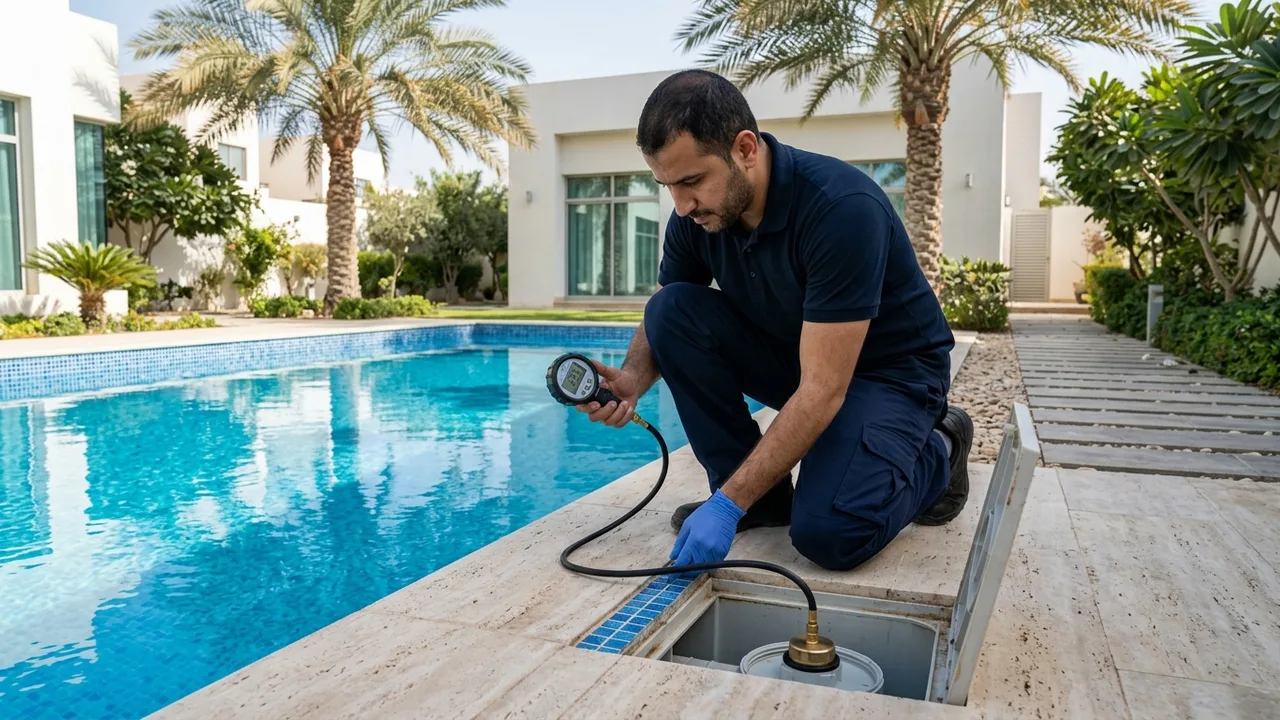
Why Swimming Pool Leak Detection Requires a Specialized Engineering Protocol
A swimming pool is far more complex than a static water tank: it combines a hydrostatically loaded concrete shell, multiple through-wall plastic and electrical penetrations (skimmers, underwater lights, return nozzles, vacuum ports, main drains), and a buried PVC circulation network connected to a pump and filter room.
The costliest mistake pool owners make is draining the pool and regrouting mosaic tiles while the actual leak lies in a cracked buried return pipe beneath the pool deck or inside an underwater light conduit—causing water loss to resume immediately upon refilling.
At Bashaer Al Khair, our diagnostic sequence strictly separates "Dynamic Plumbing Leaks" (which accelerate when the circulation pump runs) from "Static Structural/Penetration Leaks" (which continue when the pump is off).
Key Field Symptoms & Physical Indicators Requiring Inspection:
Pool water level dropping more than 1–1.5 cm per day requiring constant make-up water
Physical Mechanism: Water loss exceeding normal climatic evaporation due to a breach in circulation lines or shell penetrations.
Water level dropping and then stabilizing at a specific horizon (e.g., bottom of skimmer or lights)
Physical Mechanism: Direct physical proof that the leak sits at that exact elevation (skimmer throat, return fitting, or light niche).
Settling or hollow pavers along the pool deck perimeter or flooding inside the pump/filter room
Physical Mechanism: Pressurized water escaping from buried perimeter pipes washes out the sand bedding beneath deck stones.
Continuous air bubbles blowing from return jets or the circulation pump losing prime
Physical Mechanism: A breach on the suction side (skimmer or vacuum line) draws air in under pump vacuum and leaks water out when the pump stops.
The 5 Technical Causes of Swimming Pool Leaks & Our Verification Methods
Our pool inspection systematically tests five distinct subsystems:
1. Separation or Cracking at the Plastic-to-Concrete Skimmer Throat
Differential thermal expansion between the ABS plastic skimmer body and the concrete pool beam creates a gap along the skimmer throat.
2. Leaks in Buried Return, Skimmer, Vacuum, or Main Drain PVC Pipelines
Backfill settlement around the exterior pool wall places shear stress on rigid PVC elbows where pipes exit the concrete shell.
3. Seepage Through Underwater Light Niche Cord Seals & Conduits
Water passes behind the wet-niche light fixture and escapes through an unsealed cord grommet or cracked electrical conduit.
4. Balance Tank or Overflow Channel Seepage in Infinity/Overflow Pools
In overflow pools, the main pool basin may be intact while water escapes from the concealed concrete balance tank or perimeter gutter channel.
5. Deteriorated Mosaic Tile Grout or Structural Cracks in the Pool Shell
Imbalanced pool chemistry (low pH / chlorine) erodes cementitious mosaic grout, allowing water to reach structural concrete cracks.
When to Request Swimming Pool Leak Inspection & Pool Electrical Safety
When Should You Schedule Inspection Immediately?
- Whenever you have to open the pool make-up water valve daily or every other day.
- When the pump starts sucking air because water drops below the skimmer mouth.
- When dampness or standing water appears inside the underground filter room.
- When mosaic tiles begin detaching or perimeter deck pavers settle.
How We Isolate the Exact Leak Source in Jeddah During One Structured Visit
Manometer Line Isolation
Isolating and pressure-testing cold, hot, or pool circulation lines independently.
Drain & Joint Verification
Testing floor traps, P-traps, tile grout, and skimmers via dye & moisture probes.
Thermal & Moisture Mapping
Mapping subsurface moisture pockets and ΔT thermal anomalies across walls/slabs.
Acoustic Pinpointing & Report
Locking onto the exact fault coordinate acoustically and issuing the remediation plan.
Illustrative engineering diagram only — exact leak coordinates and remediation scope are confirmed following on-site instrument inspection.
How We Execute Swimming Pool Leak Detection in Jeddah Across 7 Structured Steps
Inquiry Intake & Initial Symptom Triage
We document the observed symptoms (bill spike, ceiling drip, peeling paint, or tank drop), property type in Jeddah or Makkah, and approximate plumbing age to prepare the right diagnostic kit.
Site Walkthrough & Safety Verification
The technician inspects visible dampness zones and checks that moisture has not compromised electrical panels, wall switches, or structural ceiling slab integrity.
Network Isolation, Meter & Pressure Testing
We isolate cold and hot supply branches and tank lines, monitoring pressure gauges and meter flow to determine whether the fault lies in a pressurized line or unpressurized drainage/grout.
Multi-Instrument Acoustic, Thermal & Moisture Mapping
We deploy the appropriate instruments (acoustic sensors for pressurized lines, thermal cameras for ΔT mapping, and dielectric moisture meters for saturation peaks) to narrow the fault to the smallest footprint.
Cross-Verification & Differential Diagnosis
We cross-check instrument readings to rule out non-pipe causes such as AC duct condensation, coastal capillary rising damp in Jeddah, or degraded shower tile grout.
Transparent On-Site Findings Briefing
We walk the client through the exact fault location, root cause, and whether remediation requires localized plumbing access (e.g., 1–2 tiles) or surface waterproofing treatment.
Actionable Remediation & Waterproofing Roadmap
We outline a prioritized remediation plan: stopping the active water source first, allowing substrate drying where required, and applying targeted waterproofing or plumbing repair.
Engineering Technologies Deployed for Swimming Pool Leak Detection in Jeddah
Our pool inspections combine mechanical expansion plugs and manometers to pressure-test every line from the filter room, acoustic ground sensors to locate pipe breaks beneath the pool deck, and static dye testing for skimmers and lights.
Hydrostatic & Pneumatic Line Pressure Testing
Scientific Principle: A specific supply branch (cold, hot, or pool circulation line) is isolated and capped, then pressurized with a calibrated manometer gauge; any pressure decay over the holding period confirms a breach in that exact circuit.
- • Definitively separating pressurized supply pipe failures from drainage or grout seepage in bathrooms and kitchens
- • Verifying the integrity of the main buried line between the water meter and underground tank
- • Independently testing swimming pool skimmer, return, and main drain lines apart from the concrete shell
- • Test pressure must never exceed safe operating limits for aging pipes to avoid stressing intact joints
- • Worn angle valves or mixer cartridges can cause false pressure drops unless outlets are properly plugged during the test
Acoustic Listening & Ground Microphones
Scientific Principle: Ground microphones and contact acoustic sensors amplify specific frequency vibrations generated when pressurized water escapes through a pipe crack or fitting joint, filtering ambient noise to locate the peak decibel point.
- • Pressurized water supply lines beneath ceramic and porcelain floor tiles
- • Buried external supply pipes under courtyard pavers and walkways
- • Pinpointing active leaks in pressurized PPR and metallic pipes inside walls
- • Requires sufficient internal line pressure to generate acoustic turbulence; it cannot detect unpressurized gravity drainage leaks on its own
- • Ambient noise from booster pumps, AC compressors, or street traffic must be isolated during measurement
- • Deep burial or thick insulation layers can attenuate acoustic signals, requiring correlation with pressure testing
Engineering Visual Inspection, Borescope & Flood Testing
Scientific Principle: Combines systematic inspection of grout joints, drain throats, tank necks, and plumbing shafts with flexible borescope cameras for concealed cavities and controlled flood/dye testing for unpressurized floor drains.
- • Inspecting above suspended gypsum ceilings and inside narrow pipe chases without demolition
- • Testing shower pan grout, floor drain seals, and toilet base connections
- • Examining concrete cracks, honeycombing, and neck joints inside water tanks and pools
- • Borescope cameras require an existing small aperture (e.g., spotlight cutout or access hatch) and cannot penetrate solid mortar
- • Controlled flood testing of wet-area floors requires sufficient observation time to confirm seepage migration
Dielectric & Pin Moisture Meters
Scientific Principle: Non-invasive dielectric meters measure changes in the electrical permittivity of building materials (concrete, plaster, gypsum, tile beds) up to 20–40 mm deep to quantify relative moisture saturation against dry baseline zones.
- • Locating the highest moisture concentration point along peeling lower walls and skirting boards
- • Distinguishing historic dried stains from active ongoing leaks in ceilings
- • Checking sub-tile saturation around shower drains, bathtubs, and bathroom thresholds
- • Dense steel rebar or shallow electrical conduits can influence capacitance readings, requiring dry-wall baseline calibration
- • Confirms moisture presence and gradient direction, but must be paired with line isolation to distinguish supply vs. drainage sources
Safe Tracer Gas Inspection for Deep Buried Lines
Scientific Principle: For deeply buried external pipelines or thick slabs where acoustic signals are muffled, the drained line is charged with a safe, non-toxic inert gas blend (95% nitrogen / 5% hydrogen); lightweight molecules escape the breach and rise to the surface detector.
- • Long exterior supply runs buried beneath thick courtyard concrete or paving
- • Deeply buried swimming pool manifolds where acoustic listening is inconclusive
- • Micro-leaks causing slow pressure decay without audible acoustic turbulence
- • Not required for routine indoor fixture leaks; reserved for complex buried lines that must first be drained of water
- • Subsurface vapor barriers can cause lateral gas migration toward the nearest tile joint, requiring experienced correlation with pipe routing
Service Scope: Pool Leak Detection vs. Line Repair vs. Pool Waterproofing
Pool Leak Detection: Verifying true leakage vs. evaporation, separating circulation plumbing leaks from shell/penetration leaks, and pinpointing the exact fault.
Pool Plumbing & Fitting Repair: Repairing the pinpointed buried PVC pipe elbow, replacing pump-room valves, or sealing the light conduit and skimmer throat.
Pool Waterproofing & Joint Remediation: When plumbing lines hold tight and seepage is through the concrete shell or mosaic joints, we provide chemical-resistant epoxy grouting and flexible pool waterproofing.
Remediation Pathways Following Swimming Pool Leak Detection
Finding 1: Leak at the skimmer throat joint or underwater light cord conduit
Zero tile removal required.Recommended Action: Lower water slightly below the fitting, clean and dry the joint, and seal with underwater-grade epoxy putty and elastomeric pool sealant.
Finding 2: Break in a return, vacuum, or skimmer PVC line beneath the perimeter pool deck
Localized opening in exterior deck paving over the break only.Recommended Action: Open only the acoustically marked deck paver, repair the PVC line with high-pressure fittings, and re-verify manometer pressure.
Finding 3: Structural cracks in the pool shell, degraded mosaic grout, or balance tank seepage
Non-destructive regrouting or targeted refurbishment depending on tile bond.Recommended Action: Drain the pool, treat cracks and joints with chlorine-resistant epoxy grout, or apply a complete flexible pool waterproofing system.
Separating Pool Evaporation, Plumbing Line Leaks, and Shell Seepage
Our pool engineering audit relies on three decisive diagnostic comparisons:
| Condition / Fault Type | Physical & Visual Signs | Instrument Reading Pattern | Correct Engineering Fix |
|---|---|---|---|
| Natural Climatic Evaporation Loss | Moderate drop (3–7 mm/day) that matches the water drop inside a reference bucket placed on the pool step. | Identical drop in Bucket Test + 100% stable pressure across all circulation lines. | No leak exists; use a pool cover to reduce evaporation—zero repair needed. |
| Circulation Plumbing Line Leak | Water loss accelerates when the filter pump runs (return line leak) or air enters the system with deck settlement. | Manometer pressure decay on the isolated pipe circuit + acoustic signal beneath the pool deck. | Localized repair of the buried pipe without touching internal pool mosaic tiles. |
| Pool Shell, Skimmer Throat, or Light Niche Leak | Water drops at the same rate whether the pump is on or off, often stopping at the skimmer or light level. | Plumbing lines hold pressure + dye test draws sharply into the skimmer joint, light conduit, or shell crack. | Seal the penetration fitting or waterproof the pool shell/joints. |
In Jeddah, private swimming pools across Obhur, North Jeddah villas, and compounds face sandy soil settlement around perimeter plumbing and high coastal water table pressures.
In villas across North/South Obhur, Al-Marjan, Al-Basateen, and Al-Shati, even minor seepage from a skimmer throat or return elbow washes out fine sand behind the pool wall, causing travertine/porcelain deck pavers to sink.
In high-water-table coastal zones of Jeddah, pools must never be drained blindly without accounting for external hydrostatic groundwater uplift.
Accelerated corrosion and seal wear inside humid subterranean filter vaults in Jeddah.
Coastal wind and solar heat in Jeddah cause 4–8 mm/day of natural evaporation, making calibrated bucket testing essential.
Common Property Scenarios We Inspect Across Jeddah:
- Private Villa Pools in Obhur, Al-Marjan, Al-Basateen & Al-Zahra: Daily pool water drop of 3–5 cm accompanied by settling deck tiles near the skimmer. — Pressure-testing return, skimmer, and vacuum lines from the filter vault while dye-testing the skimmer throat and light conduits.
- Overflow & Compound Pools in Al-Hamdaniyah & North Jeddah: Rapid depletion of the overflow balance tank causing circulation pumps to run dry. — Isolating the balance tank and perimeter gutter channel from the main basin to test each vessel independently.
Jeddah Field Scenario: 4 cm Daily Drop in a Villa Pool in Al-Basateen
A villa owner in Al-Basateen was losing 4 cm of pool water daily; a contractor proposed stripping all mosaic tiles and re-waterproofing the entire shell at high cost.
Our engineer plugged and pressure-tested all circulation lines—they held 100% tight. Calm-water dye testing around penetrations immediately showed dye drawing rapidly into the rear cord conduit of the center underwater light.
The light niche cord conduit was sealed with underwater epoxy putty and polyurethane sealant in one hour, stopping the leak completely with zero tile demolition.
District Clusters Served for Swimming Pool Leak Detection in Jeddah:
Swimming Pool Leak Inspection Cost Factors in Jeddah & Makkah
Pool leak detection pricing is based on the following technical parameters:
- Pool System Type: Standard Skimmer pool vs. Overflow/Infinity pool with perimeter gutters and a separate balance tank.
- Number of Plumbing Lines to Plug & Pressure-Test (skimmers, return loops, vacuum line, waterfalls, attached spa jets).
- Pool surface area, depth, and number of underwater light niches.
- Filter room configuration (subterranean vault vs. above-ground equipment pad).
How to Prepare Your Swimming Pool Before the Inspection Visit
Following these simple preparation steps helps our field engineer complete accurate readings faster:
- 1Do not drain the pool prior to inspection—clear water in the pool is required for dye testing skimmers, lights, and shell cracks.
- 2Shut off the automatic water fill valve 24 hours before the visit and note how many centimeters the water drops.
- 3Keep pool water as clear and filtered as possible so the main drain, light niches, and mosaic joints are clearly visible.
- 4Ensure unobstructed access to the pump and filter room.
What If Diagnostics Confirm Waterproofing Is Needed?
If pool diagnostics confirm your circulation pipes hold pressure and leakage stems from the concrete shell or eroded mosaic grout, we provide complete swimming pool waterproofing and epoxy joint remediation.
Related Leak Detection Services in Jeddah:
Common Questions About Swimming Pool Leak Detection in Jeddah
What is the normal daily evaporation rate for a swimming pool in Jeddah?
Normal evaporation in Jeddah typically ranges from 0.4 to 0.8 cm per day (roughly 3–5 cm per week) depending on sun exposure, wind, and humidity. Any loss exceeding 1–1.5 cm per day strongly indicates an active leak.
How can I perform a simple Bucket Test on my pool before booking an inspection?
Place a water-filled bucket on the top pool step (weighted down), mark the water level inside the bucket and the pool water level outside on the bucket wall, and turn off auto-fill for 24 hours. If the pool level drops more than the inside bucket mark, you have a confirmed leak.
Why does my pool in Jeddah lose water mainly when the filter pump is running?
When water loss accelerates during pump operation, the leak is almost always on the pressurized side—either a breach in the buried return line or a worn spider gasket in the sand filter’s multiport valve leaking continuously to waste.
Can you inspect a swimming pool leak in Jeddah while the pool is still full of water?
Yes—in fact, keeping the pool filled is essential so we can perform static dye testing around skimmers and underwater lights and monitor pressure/level behavior.
What is the most common leak point in residential villa pools in Jeddah?
The most frequent leak points are the plastic-to-concrete skimmer throat joint, the electrical conduit behind underwater light niches, buried PVC return elbows beneath the pool deck, and multiport backwash valves.
Do you inspect overflow/infinity pools and balance tanks in Jeddah?
Yes. We isolate the main pool basin, the perimeter overflow gutter channel, and the underground balance tank to pinpoint exactly which structure or pipe is leaking.
Diagnostic & Engineering Comparison Guides to Help You Decide
Swimming Pool Water Level Drop in Jeddah & Makkah: How to Scientifically Separate Evaporation from Plumbing & Shell Leaks
Every outdoor pool loses water to evaporation under the intense heat of Jeddah and Makkah—but when does daily water loss cross the engineering threshold into an active skimmer, light conduit, filtration pipe, or structural shell leak?
Lower Wall Dampness & Peeling Paint Causes: How to Distinguish Plumbing Leaks from Rising Damp
Paint blistering or white crystalline salt deposits 15 to 60 cm above floor skirting boards are never a cosmetic issue solved by repainting—they are physical indicators of active moisture migration that must be traced at the source.
Water Leaking from the Bathroom Ceiling: How to Pinpoint the Exact Source Upstairs Without Random Demolition
When yellow stains or active water drops appear on your bathroom ceiling or gypsum soffit, the source lies in the wet area directly above—but is the culprit a pressurized supply pipe, a drainage elbow, eroded tile grout, or a breached slab membrane?
Sudden High Water Bill Causes in Jeddah & Makkah: Step-by-Step Meter, Float Valve & Underground Tank Diagnostic Guide
When your monthly water bill doubles or triples with no change in household occupancy and zero visible dampness indoors, water is almost certainly escaping silently underground or directly into a drain line—here is how to isolate the culprit step by step.
Swimming Pool Leak Detection in Makkah
View our dedicated Swimming Pool Leak Detection guide tailored to Makkah properties.
View Makkah PageAll Leak Detection Services in Jeddah:
Submit Your Issue Details to Coordinate an Inspection or Quote
Complete the fields below accurately. Your submission is validated and assigned a unique reference ID, with a ready-to-share technical summary.