
Spray Polyurethane Foam Insulation in Makkah — Integrated Thermal & Moisture Roof Protection
Closed-cell spray polyurethane foam provides Makkah roofs with a monolithic blanket that encapsulates plinths and eliminates thermal bridges, executed strictly under professional PPE safety standards and verified topcoat protection.
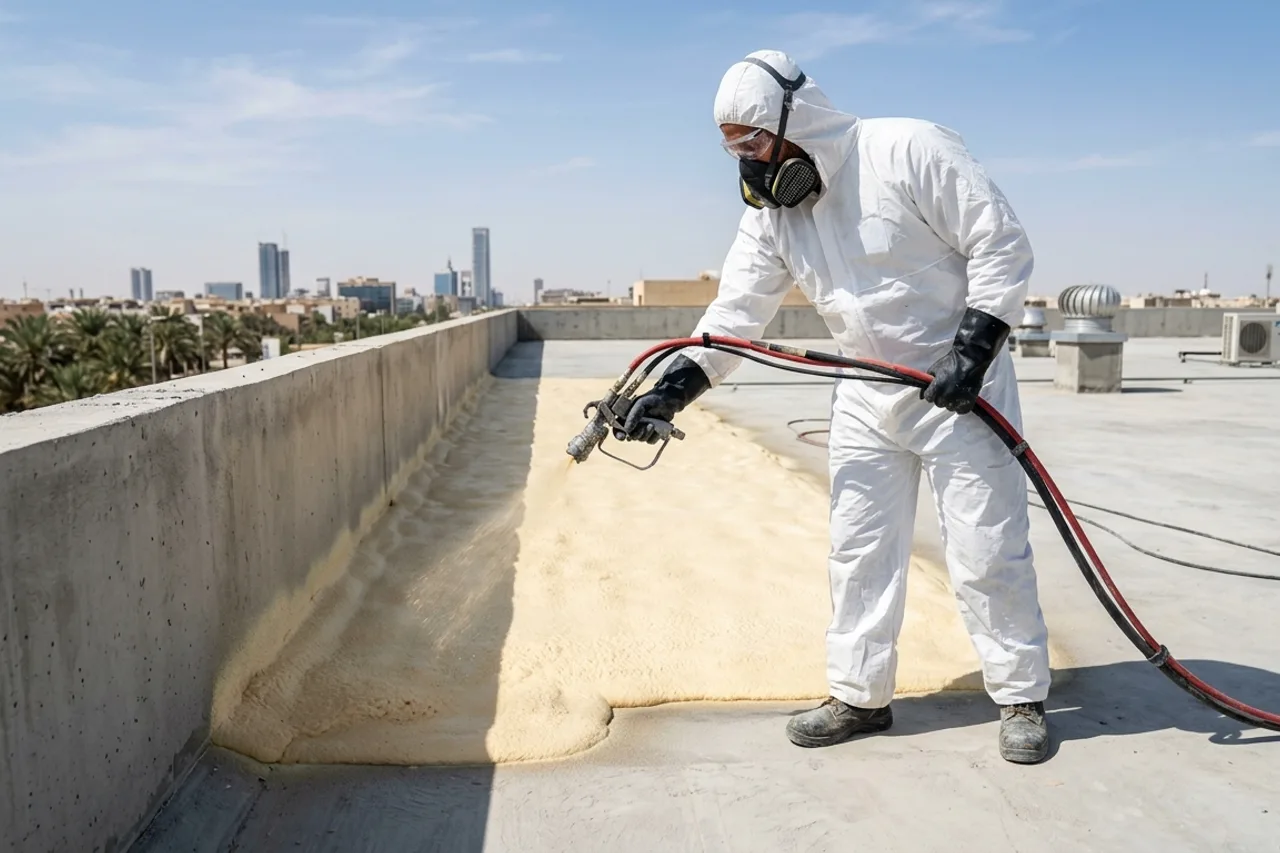
Why Property Owners Choose Spray Polyurethane Foam & What It Solves
Many villa, apartment, and warehouse roofs in Jeddah and Makkah face a dual challenge: intense solar heat transfer through concrete or metal decks, and rainwater seepage around joints, cracks, and pipe penetrations. On roofs crowded with HVAC units and piping, cutting rigid boards or welding sheet rolls around dozens of obstacles often leaves vulnerable seams and thermal gaps.
Closed-cell Spray Polyurethane Foam (SPF) solves this by expanding in situ into a monolithic, joint-free layer that adheres directly to the substrate, wraps seamlessly around upstands and plinths, and combines high thermal resistance with water impermeability once sealed with its UV protective topcoat.
Roofs with Dense Piping & HVAC Plinths Where Sheet Rolls Fail at Seams
Technical Mechanism: Frequent cutting and patching of sheet membranes around obstacles creates weak lap joints prone to water and heat leakage.
Corrugated Metal Roofs (Shinko) Suffering Extreme Heat & Fastener Leaks
Technical Mechanism: Sheet metal conducts solar heat instantaneously and expands rapidly, loosening fastener holes and sheet overlaps.
Chalking & Degradation of Previous Spray Foam Left Unprotected Under Sun
Technical Mechanism: Direct solar UV radiation oxidizes exposed polyurethane foam, turning the surface into a brittle, dusty layer that absorbs water.
Mandatory Engineering Details for Spray Foam & Bituminous Rolls in Makkah
Closed-Cell Foam + Mandatory UV Elastomeric Topcoat
- 1. Substrate Prep & Primer: Cleaning and drying concrete or metal decks and applying compatible primer.
- 2. Closed-Cell Polyurethane Core: Monolithic closed-cell spray application wrapping the deck, curbs, and upstands.
- 3. Mandatory UV Topcoat: Elastomeric acrylic or polyurethane UV topcoat shielding the foam from solar degradation.
Primer + Fused Overlaps + Cant Strip + Protection Layer
- 1. Bituminous Primer & 45° Cant Strip: Sealing concrete pores and forming 45° mortar coving so rolls never bend at sharp 90° angles.
- 2. Engineered Lap Seam Fusion: 10 cm side laps and 15 cm end laps, mechanically anchored at parapet tops with termination bars.
- 3. Separation & Protection Layer: Shielding membranes with non-woven geotextile felt under roof tiles or rigid boards before foundation backfilling.
Illustrative engineering diagram only — actual layer sequence and specification are determined following on-site substrate inspection per manufacturer TDS.
Technical Definition of Spray Polyurethane Foam (SPF) & System Requirements
No polyurethane foam should ever be marketed as automatically waterproof and maintenance-free on its own. A true exterior roof SPF system consists of two inseparable components: (1) Closed-Cell Spray Polyurethane Foam applied at an engineered density and thickness, and (2) a continuous UV-resistant elastomeric topcoat (acrylic or aliphatic polyurethane) that shields the foam from solar radiation and weathering.
Closed-cell SPF differs fundamentally from soft open-cell foam (used only for interior acoustics/cavities); open-cell foam absorbs water like a sponge and must never be used on exterior roofs.
What Is Included in Bashaer Al Khair’s Execution Scope:
- Inspecting and drying the substrate, plus masking adjacent AC units, solar panels, and parapet facades against overspray.
- Applying closed-cell polyurethane foam evenly across the deck, parapet coving, and equipment plinths.
- Applying the protective UV-stable elastomeric coating over the cured foam surface.
Engineering Scope Boundaries & Transparency
- Safety Compliance: We do not publish DIY chemical mixing instructions or high-pressure rig settings; two-component SPF application requires trained technicians wearing full respiratory and skin PPE in compliance with manufacturer SDS.
- Spray polyurethane foam is strictly an envelope/roof system and is never used inside potable water tanks or swimming pools.
Closed-Cell Spray Polyurethane Foam (SPF) + UV-Resistant Elastomeric Acrylic/Polyurethane Topcoat
Substrates & Roof Types Suited for Spray Foam Insulation
Closed-cell SPF delivers optimal thermal and moisture protection on the following roof structures:
Non-Tiled Concrete Roofs on Villas & Apartment Buildings
Substrate Type: Dry, sound reinforced concrete or sloped cementitious screed.
Corrugated Metal Roofs (Shinko), Warehouses & Annexes
Substrate Type: Galvanized or pre-painted profiled metal sheets after cleaning and rust priming.
Mechanical Roof Decks with Dense HVAC & Piping Networks
Substrate Type: Commercial or residential roofs with complex equipment footprints.
Pre-Spray Substrate & Environmental Assessment
Proper SPF adhesion and cellular stability depend critically on verifying three conditions prior to spraying:
1. Complete Substrate Dryness Verification
Polyurethane chemical reaction is moisture-sensitive during application; spraying onto a damp deck causes blowing/foaming anomalies and poor bond strength.
2. Removal of Dust, Oils & Loose Mortar
Spraying over dust layers or flaking paint prevents mechanical bonding, leading to wind-uplift delamination.
3. Wind Speed & Roof Drainage Slope Check
High winds cause overspray drift and uneven surface texture, while deep ponding depressions require slope correction.
SPF System Components & Protective Topcoat Options
A professional spray foam roof assembly integrates chemically compatible layers:
Roof-Grade Closed-Cell Spray Polyurethane Foam
Best Suited For: Providing bulk thermal resistance (R-value) and monolithic sealing over concrete or metal decks.
Elastomeric Acrylic UV-Protective Topcoat
Best Suited For: Well-sloped SPF roofs that shed rainwater efficiently and experience only periodic maintenance traffic.
High-Performance Aliphatic Polyurethane Topcoat
Best Suited For: Roofs requiring superior resistance to localized standing water and frequent HVAC maintenance foot traffic.
SPF Covered with Geotextile Felt & Protective Screed / Tiles
Best Suited For: Homeowners who want seamless SPF insulation beneath a tiled pedestrian roof deck.
Professional Application Workflow for Spray Foam Insulation
Phase 1: Substrate Cleaning, Drying & Overspray Masking
Removing dust/oil, verifying dryness, and masking AC condensers, heaters, doors, and parapet copings to prevent overspray.
Phase 2: Detailing Drains, Joints & Applying Substrate Primer
Protecting rainwater drain throats from foam blockage and applying substrate primer where required by manufacturer TDS.
Phase 3: Applying Closed-Cell Spray Polyurethane Foam Passes
Spraying uniform closed-cell foam passes across the slab, up parapet walls, and around equipment plinths to the target thickness.
Phase 4: Applying the UV-Resistant Elastomeric Protective Topcoat
Coating the entire cured SPF surface with elastomeric acrylic or aliphatic polyurethane to shield it from solar UV rays.
Critical Technical Details in Spray Foam Roof Installations
To ensure spray foam insulation performs without blistering or water trapping, our technicians enforce four critical details:
1. Preventing Drain Blockage or Raised Foam Dams Around Scuppers
Failure Risk:Allowing foam to expand high around a drain throat creates a raised dam that holds standing water on the roof.
2. Complete, Pinhole-Free UV Topcoat Coverage
Failure Risk:Applying a thin, diluted topcoat allows intense Saudi UV radiation to oxidize and degrade the underlying foam.
3. Encapsulating HVAC Plinths Without Blocking Service Access
Failure Risk:Spraying indiscriminately over isolation valves or service panels forces technicians to cut the foam later.
Limitations & Unsuitable Conditions for Spray Foam Insulation
While closed-cell SPF is highly effective in the right application, it has clear engineering boundaries:
Spray Foam Installation vs. Topcoat Restoration vs. Leak Detection
Before recommending a new spray foam installation, we evaluate what your roof actually needs:
Uninsulated concrete or metal roof suffering extreme heat and rainwater leaks
Correct Engineering Action: Clean and dry the deck, then install closed-cell SPF with a UV-resistant elastomeric topcoat.
Previously foam-insulated roof where the white topcoat has peeled, exposing yellow foam
Correct Engineering Action: Inspect foam core; if dry and sound, clean, patch localized damage, and reapply the elastomeric UV topcoat (Waterproofing Repair).
Water dripping through the ceiling directly beneath overhead tank pipes during dry weather
Correct Engineering Action: Perform Leak Detection and repair the pipe before encapsulating the roof with spray foam.
Why Spray Polyurethane Foam Makkah Requires Local Makkah Engineering Expertise
In Makkah, closed-cell spray polyurethane foam provides a practical solution for exposed, pipe-congested concrete roofs—eliminating thermal bridges under extreme summer heat and sealing against seasonal downpours.
Makkah experiences intense thermal radiation amplified by surrounding rocky mountain basins, combined with seasonal torrential downpours that rapidly load flat roofs and channel runoff along rock fissures toward foundations and underground cisterns. Furthermore, multi-story residential and hospitality buildings in Makkah feature dense rooftop mechanical installations creating critical penetration zones.
Key Building Envelope Challenges We Solve in Makkah:
- Intense solar UV in Makkah makes the protective elastomeric topcoat over SPF absolutely critical; unprotected foam degrades rapidly.
- Dense overhead tank piping on Makkah apartment roofs requires skilled spraying around plinths without obstructing drainage flow paths.
Common Local Application Scenarios in Makkah:
Installing seamless closed-cell SPF and elastomeric UV coating for combined thermal and rainwater protection.
Sealing complex AC plinths, tank bases, and parapet upstands on multi-story residential buildings.
Factors That Determine Spray Foam Insulation Cost per Square Meter
Spray foam pricing per square meter varies according to genuine technical specifications rather than generic ad rates:
1. Target Foam Thickness & Closed-Cell Density
Greater target thickness and higher closed-cell density consume proportionally more two-component raw material per square meter.
2. Type & Build-Up of the UV Protective Topcoat
Applying multi-coat high-solids elastomeric acrylic or aliphatic polyurethane costs more and lasts longer than a thin single wash.
3. Total Area & Substrate Profile (Flat Concrete vs. Corrugated Metal)
Corrugated metal profiles, tall parapet upstands, and multiple AC plinths have a larger actual surface area than flat plan dimensions.
4. Surface Preparation & Legacy Layer Removal
Pressure washing, stripping delaminated old coatings, and detailing drain sumps are scoped during site inspection.
Client Preparation Checklist Before Spray Foam Application
- Stop roof washing or any water discharge 24–48 hours prior to scheduled application so the deck is bone dry.
- Clear loose personal items from the roof and notify occupants so vehicles/items near the building perimeter are protected.
- Ensure no other trades (AC technicians or plumbers) are working on the roof deck during spraying and curing.
Post-Application Quality & Inspection Protocol
We verify completed SPF installations through systematic quality checks:
Performed immediately after foam curing and prior to topcoating to confirm uniform closed-cell rigidity and bond.
Inspecting 100% of horizontal and vertical surfaces to confirm zero exposed foam and unobstructed flow into drains.
Saudi Building Code — Energy Conservation for Low-Rise Residential Buildings (SBC 602)
Defines maximum allowable thermal transmittance (U-value) for roofs and exterior walls in low-rise residential villas based on climatic zone (Jeddah and Makkah fall within hot climate zones requiring robust roof thermal resistance).
Saudi Building Code — Energy Conservation for Non-Residential Buildings (SBC 601)
Governs building envelope thermal performance for commercial, administrative, hospitality, and multi-story buildings, emphasizing continuous insulation and thermal bridge mitigation.
Saudi Building Code — Soils and Foundations: Damp-Proofing & Waterproofing (SBC 303)
Distinguishes between subsurface Damp-Proofing (where no hydrostatic head exists) and full Waterproofing (required where groundwater tables, hydrostatic pressure, or aggressive sulfate/chloride soils are present, such as coastal Jeddah).
Manufacturer Technical Data Sheets (TDS), Safety Data Sheets (SDS) & Potable Contact Certifications
Manufacturer TDS documents govern maximum allowable substrate moisture, primer pairing, consumption rate per m², recoat intervals, and full curing times prior to water immersion.
Before proposing waterproofing on roofs, bathrooms, tanks, or pools, we verify whether moisture stems from pressurized pipes, drains, or float valves (routing to leak detection first if needed).
We evaluate substrate type (concrete, tile, metal), screed soundness, cracks, honeycombing, hollow tiles, and whether existing insulation can be restored or requires removal.
We map ponding zones, slope gradients toward rainwater scuppers/drains, and subsurface moisture levels beneath tiles or within concrete to prevent post-application blistering.
We determine whether the asset requires waterproofing, thermal insulation, or a combined system, selecting materials matched to foot traffic, UV exposure, or continuous water immersion.
We specify detailing protocols for parapet wall coving/upstands, structural expansion joints, HVAC/tank plinths, floor drains, and pipe sleeves.
We provide a clear scope covering surface preparation, proposed system layers, and topcoat/protection requirements so the client understands the exact quotation basis.
Build Your Project Scope & Request an Itemized Quote in Makkah
We never quote misleading flat rates without evaluating your substrate. Select your project parameters below to generate your technical scope summary and schedule an engineer visit.
Select Your Property Parameters for an Instant Engineering Recommendation
Complete Roof Waterproofing (Concrete & Tiled Roofs)
Proposed Engineering Assembly: Reinforced Liquid Polyurethane Membranes or Bituminous Assemblies Matched to Deck State
Delivers complete roof rainwater protection with full slope, parapet coving, and drain collar detailing.
Material & System Comparison: Where Each System Excels & Its Technical Limits
Filter by building zone to compare each system across water exposure, solar UV resistance, foot traffic, protective layers, and substrate constraints:
Modified Bituminous Membranes (APP / SBS Rolls)
Concrete roofs prior to tiling, buried foundations, retaining walls, and exposed non-traffic roofs (when using mineral slate-surfaced APP rolls).
Substrates: Smooth reinforced concrete slabs and cured slope-screed beds primed with compatible bituminous primer.
High resistance to rainwater ponding and subsurface dampness when side (10 cm) and end (15 cm) lap seams are fully fused.
Smooth rolls require UV cover; mineral-slate-surfaced APP membranes resist direct solar radiation on non-trafficked roofs.
Low when exposed — requires geotextile separation felt and protective screed/tiling for regular foot traffic.
Yes on trafficked roofs and buried foundations (protection boards or non-woven geotextile felt beneath screed/backfill).
Not suitable for internal potable water tanks or swimming pools; seam integrity depends heavily on skilled lap detailing.
Polymer-Modified Flexible Cementitious Waterproofing
Bathrooms and wet zones prior to tiling, concrete water tanks, swimming pool shells under mosaic tiles, and foundations.
Substrates: Sound reinforced concrete, cementitious renders, and plastered masonry brought to a saturated-surface-dry (SSD) state.
Engineered for continuous water immersion (tanks and pools) and both positive and selected negative hydrostatic pressure.
Moderate to low under prolonged direct desert sun — designed to be covered by ceramic/mosaic tiles or protective coatings.
Tolerates light installation traffic once cured, but requires protective tiling or screed for permanent foot traffic.
Yes on floors and decks (ceramic/porcelain tiling with compatible C2TE/S1 flexible adhesive or protective screed).
Lower crack-bridging elongation than pure polyurethane membranes; not intended as an exposed roof coating over wide thermal joints.
Liquid-Applied Acrylic & Hybrid Elastomeric Membranes
Sloped exposed roofs without heavy ponding, UV-protective topcoat over spray polyurethane foam, and parapet/roof restoration.
Substrates: Concrete, cementitious screed, closed-cell spray polyurethane foam (SPF), and properly abraded/primed tiled surfaces.
Effective against shedding rainwater; pure acrylics are not recommended for permanent ponding water unless PU-hybridized.
Excellent — highly resistant to UV degradation and maintains elasticity and solar-reflective white/light finish.
Suitable for light maintenance foot traffic; requires full fleece reinforcement or pedestrian-grade PU topcoat for regular traffic.
No UV cover required as the membrane itself is formulated for direct solar exposure.
Unsuitable for submerged tanks or pools, and cannot compensate for severe negative roof slopes causing deep standing water.
High-Elastomeric Liquid Polyurethane Waterproofing Systems
Concrete and tiled roofs subject to ponding water, balconies, terraces, and complex rooftop mechanical zones.
Substrates: Dry concrete (<4–5% moisture content), and existing ceramic/porcelain tiles after mechanical grinding and specialized epoxy/PU primer.
Superior resistance to standing/ponding rainwater with high crack-bridging elongation across thermal cycles.
Aromatic base coats require an Aliphatic polyurethane UV-stable topcoat when left exposed to direct sunlight.
Good to high durability when finished with a pedestrian-grade aliphatic polyurethane wear coat.
Requires an aliphatic UV topcoat if exposed, or silica-sand broadcast / geotextile layer if tiled over.
Will delaminate or blister if applied over existing tiles whose underlying sand bed is saturated with trapped water.
Rigid Thermal Insulation Boards (XPS / EPS / PIR)
Villa, residential, and commercial flat roofs (in inverted or conventional roof assemblies) to reduce conductive heat transfer.
Substrates: Installed over tested waterproofing membranes (in inverted roof systems with geotextile filter fabric) beneath ballast or tiles.
Extruded polystyrene (XPS) boards have low water absorption, but board joints are NOT waterproof—a separate waterproofing membrane is mandatory.
Degrades under direct UV and wind uplift — must always be covered by geotextile fabric and gravel ballast, tiles, or screed.
Supports foot traffic once covered by load-distributing screed or paving slabs matched to the board compressive strength.
Mandatory (non-woven geotextile filter layer + heavy ballast, paving tiles, or screed to prevent UV degradation and wind uplift).
Never stops water leaks on its own; strictly serves as the thermal resistance component of a multi-layer roof system.
Closed-Cell Spray Polyurethane Foam (SPF System)
Exposed concrete roofs, corrugated metal/warehouse roofs, and roofs with dense HVAC/piping penetrations requiring seamless encapsulation.
Substrates: Dry, clean concrete decks, primed/rust-free metal decks, and solid substrates free of moisture, oil, and loose dust.
Closed-cell SPF finished with a continuous elastomeric/acrylic topcoat provides reliable rainwater resistance when proper drainage slopes exist.
Raw polyurethane foam oxidizes and chalks rapidly under UV rays — a UV-resistant elastomeric topcoat is mandatory.
Moderate (handles careful maintenance traffic); sharp tools or dragging heavy mechanical equipment can puncture the topcoat.
Mandatory: UV-protective elastomeric acrylic/polyurethane coating, or geotextile separation felt beneath screed/tiles.
Open-cell foam is unsuitable for exterior roofs, and any neglected breach in the UV topcoat exposes the foam to solar degradation.
Specialized Water Tank & Pool Coatings (Epoxy & Hydraulic Mortars)
Internal lining of reinforced concrete water tanks (using certified potable-water systems) and swimming pool structural shells.
Substrates: Mechanically profiled reinforced concrete with all honeycombing, tie-rod holes, and active negative leaks sealed first.
Specifically engineered for 24/7 continuous water immersion and resistance to chlorides and treatment chemicals.
Internal tank epoxies are designed for enclosed tanks (low UV stability); outdoor pools use flexible cementitious membranes under tiles.
High abrasion resistance during periodic tank cleaning once the full manufacturer curing schedule is completed.
Potable tank epoxy serves as the final smooth lining; pool cementitious waterproofing is covered by mosaic tiles and chemical-resistant grout.
Never assume generic industrial epoxy is potable-water safe — requires verified potable-water compliance documentation and full cure time.
Important Engineering Note: This guide provides an engineering comparison of material families; final system specification, primer pairing, and layer build-up are determined after an on-site substrate and moisture assessment per manufacturer TDS.
Technical Answers on Spray Polyurethane Foam Makkah
Is spray polyurethane foam sufficient on its own without a protective coating on top?
No. While closed-cell SPF provides thermal and moisture resistance initially, raw polyurethane foam degrades rapidly under solar UV radiation—chalking, eroding, and eventually absorbing water. A UV-resistant elastomeric topcoat is an obligatory part of the system.
What is the difference between closed-cell and open-cell spray foam?
Closed-cell SPF is rigid and dense with sealed cells that resist water penetration and deliver high R-value per centimeter—making it the only type suitable for exterior roofs. Open-cell foam is soft and permeable, used strictly for interior acoustics.
Can you walk on a roof insulated with spray polyurethane foam?
Closed-cell SPF with an elastomeric topcoat supports careful maintenance foot traffic (such as servicing AC units in soft-soled shoes), but sharp metal furniture or dragging heavy tools can puncture the coating unless the system is topped with geotextile felt and screed/tiles.
Does spray foam insulation guarantee a 50% reduction in electricity bills?
A flat "50% savings guarantee" is a marketing cliché rather than an engineering fact. While closed-cell SPF substantially cuts heat gain through the roof slab, total electricity reduction depends on the entire building—including wall insulation, window glazing, HVAC efficiency, and occupancy habits.
How long does it take to apply spray foam and the protective topcoat on a villa roof?
Duration depends on roof area, preparation needs, and wind conditions; for most standard villa roofs, substrate preparation, foam spraying, and UV topcoat application are completed within 1 to 2 working days once the deck is dry.
Related Waterproofing & Insulation Services in Makkah
View All Makkah Waterproofing ServicesRoof Waterproofing in Makkah — Securing Villa & Building Roofs Against Rainwater & Thermal Stress
Thermal Roof Insulation in Makkah — High-Resistance Envelope Protection Against Extreme Heat
Waterproofing Repair & Restoration in Makkah — Maintaining & Renewing Existing Insulation Systems
Bituminous Membrane Waterproofing in Makkah — Heavy-Duty Sheet Membranes for Roofs & Substructures
Diagnostic & Engineering Comparison Guides to Help You Decide
Roof Rainwater Ponding & Top-Floor Ceiling Seepage: Why Rain Penetrates Flat Roofs & How to Engineer a Permanent Fix
Following heavy seasonal rainstorms in Jeddah or Makkah, damp stains and active leaks appear across top-floor ceilings and annexes—is the root failure poor screed slope, blocked roof drains, cracked parapet flashing, or a breached waterproofing membrane?
Engineering Guide to Tiled, Bare Concrete & Shinko Roof Waterproofing: Selecting the Right System Before and After Tiling
A durable waterproofing specification for a new bare-concrete roof slab differs fundamentally from rehabilitating an occupied villa’s existing tiled roof or insulating a corrugated galvanized steel (Shinko) annex.
Engineering Comparison: Polyurethane Spray Foam vs. Bituminous Membrane Rolls vs. Liquid Waterproofing in Jeddah & Makkah
When planning roof waterproofing in Jeddah or Makkah, contractors often push whichever single material they stock. This objective engineering breakdown compares all three primary systems so you can select the exact specification your roof requires.
Water Leak Detection vs. Plumbing Repair vs. Waterproofing vs. Thermal Insulation: Which Service Do You Need First?
Property owners frequently confuse applying waterproofing with fixing a leaking pipe. Coating over a burst pressurized pipe will never stop the leak, and fixing a pipe fitting without restoring a failed wet-area membrane won’t stop shower seepage.