
High Water Bill Investigation in Makkah — Complete Diagnostic Audit to Stop Silent Water Waste
Whether you own a private villa or a multi-unit apartment building on a shared meter in Makkah, a doubled or tripled water bill means silent leakage has pushed consumption into higher tariff tiers. We audit the meter, buried line, underground tank, floats, check valves, and toilets to pinpoint the exact leak.
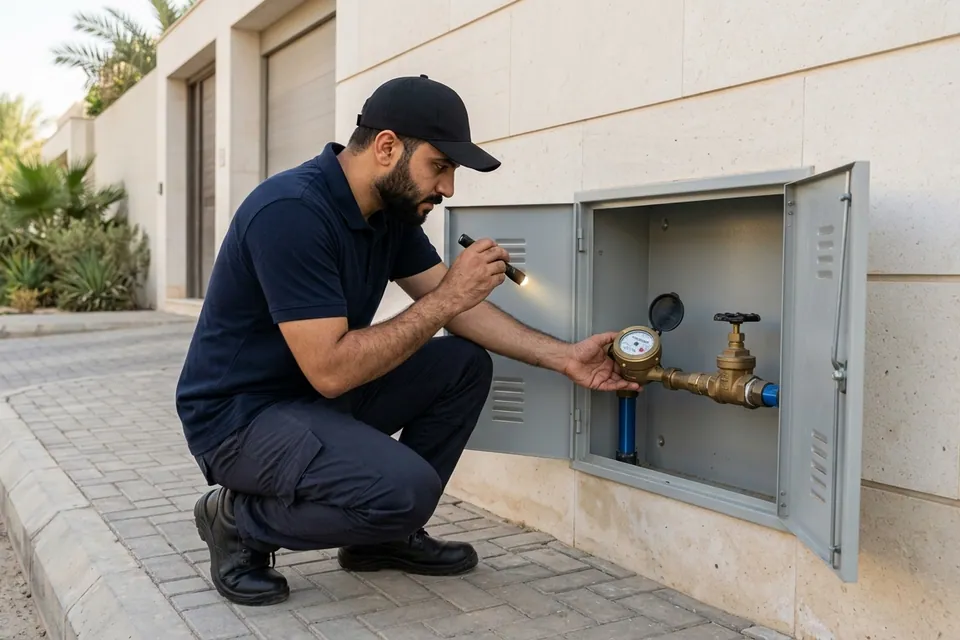
Why Water Bills Spike to 3x–5x Normal With Zero Visible Water on the Floor
Because residential water tariffs operate on progressive consumption tiers, a single "silent leak" losing just 2 to 3 cubic meters per day (equivalent to a pencil-thin stream underground or a faulty tank float) adds 60 to 90 m³ per month—pushing the account into top pricing brackets where the bill multiplies rapidly.
Homeowners rarely see this wasted water because over 80% of high-bill leaks in Jeddah and Makkah occur in two invisible zones: either below grade (the buried pipe between the street meter and ground tank, or cracks/neck overflow in the underground tank itself draining into soil) or directly into sanitary drains (such as silent 24/7 toilet cistern flapper leaks).
At Bashaer Al Khair, we never guess. We follow a strict "High-Bill Engineering Decision Tree" that isolates each hydraulic segment of your property from the street meter inward until every cubic meter of loss is accounted for.
Key Field Symptoms & Physical Indicators Requiring Inspection:
Monthly water bill doubling/tripling or receiving a high-consumption alert with no change in occupancy
Physical Mechanism: A 24/7 continuous leak in the service line, underground tank, or cisterns pushing monthly volume into higher tariff tiers.
Exterior water meter indicator continues spinning even when all indoor taps are shut off
Physical Mechanism: Continuous water flow passing through the meter into a ruptured buried pipe or overflowing ground tank.
Booster pump running for long periods or cycling every few minutes with no taps open
Physical Mechanism: Leak in the discharge risers, failed pump check valve (roof tank draining back to ground tank), or internal network leak.
Underground tank filled all the way into the manhole neck or constant hissing inside the tank
Physical Mechanism: Failed underground tank float valve allowing municipal water to pour nonstop and escape through the unsealed tank neck.
The 6 Most Common Causes of High Water Bills & How We Audit Them in Order
During our field audit, we test the following six points sequentially from the street boundary inward:
1. Failed Underground Tank Float Valve & Overflow Through the Tank Neck
When the mechanical float valve jams or its seat wears out, municipal water enters the full tank nonstop, rising into the masonry manhole collar and escaping silently beneath the courtyard tiles.
2. Rupture or Joint Leak in the Buried Pipe Between Water Meter and Ground Tank
The service pipe buried beneath the driveway or boundary wall can crack under soil settlement—spinning the meter rapidly while water drains into the ground before ever reaching the tank.
3. Structural Cracks or Failed Waterproofing in the Underground Concrete Tank
Water entering the tank escapes through cracks in the concrete walls or floor into surrounding soil/bedrock, causing the float valve to reopen continuously to replace lost volume.
4. Failed Pump Check Valve Causing Roof-to-Ground Tank Backflow Loops
The pump fills the rooftop tank, and as soon as it stops, water flows backward through a faulty check valve into the already-full ground tank—overflowing the neck in an endless loop.
5. Silent Internal Leaks in Toilet Cisterns (Concealed & Standard Tanks)
A worn flush valve seal lets a thin trickle of water flow down the toilet bowl 24/7; a single leaking cistern can waste 1 to 2 m³ every day almost silently.
6. Hidden Leaks in Under-Tile Supply Pipes, Courtyard Lines, or Rooftop Tank Floats
A hidden break in a ground-floor supply pipe or a failed rooftop tank float spilling water through an overflow pipe down a lightwell.
When to Request a High Water Bill Audit & How to Temporarily Curb Waste
When Should You Schedule Inspection Immediately?
- Immediately upon receiving a water bill 40% or higher than your historical monthly average.
- When you receive an automated high daily consumption alert from the water utility.
- When you notice the street water meter spinning late at night while everyone is asleep.
- When you suddenly need extra water tanker deliveries despite unchanged household occupancy.
Step-by-Step Decision Tree to Track Hidden Water Loss in Your Makkah Property
Close Ground Tank Inlet Valve & Watch Meter
If the meter keeps spinning → 100% confirmed leak in the buried meter-to-tank service line (pinpointed acoustically).
Inspect Water Horizon Inside Tank Manhole
If water reaches into the masonry neck collar without shutting off → silent sub-tile overflow from a faulty float or check valve.
Isolate Meter & Pump, Measure Static Level
If water level drops inside the isolated tank → structural seepage through concrete cracks requiring tank waterproofing.
Manometer Line Test & Toilet Dye Audit
Uncovers silent 24/7 toilet cistern flapper leaks, water heater relief valves, or under-tile supply pipe breaches.
Illustrative engineering diagram only — exact leak coordinates and remediation scope are confirmed following on-site instrument inspection.
How We Execute High Water Bill Investigation in Makkah Across 7 Structured Steps
Inquiry Intake & Initial Symptom Triage
We document the observed symptoms (bill spike, ceiling drip, peeling paint, or tank drop), property type in Jeddah or Makkah, and approximate plumbing age to prepare the right diagnostic kit.
Site Walkthrough & Safety Verification
The technician inspects visible dampness zones and checks that moisture has not compromised electrical panels, wall switches, or structural ceiling slab integrity.
Network Isolation, Meter & Pressure Testing
We isolate cold and hot supply branches and tank lines, monitoring pressure gauges and meter flow to determine whether the fault lies in a pressurized line or unpressurized drainage/grout.
Multi-Instrument Acoustic, Thermal & Moisture Mapping
We deploy the appropriate instruments (acoustic sensors for pressurized lines, thermal cameras for ΔT mapping, and dielectric moisture meters for saturation peaks) to narrow the fault to the smallest footprint.
Cross-Verification & Differential Diagnosis
We cross-check instrument readings to rule out non-pipe causes such as AC duct condensation, coastal capillary rising damp in Jeddah, or degraded shower tile grout.
Transparent On-Site Findings Briefing
We walk the client through the exact fault location, root cause, and whether remediation requires localized plumbing access (e.g., 1–2 tiles) or surface waterproofing treatment.
Actionable Remediation & Waterproofing Roadmap
We outline a prioritized remediation plan: stopping the active water source first, allowing substrate drying where required, and applying targeted waterproofing or plumbing repair.
Engineering Technologies Deployed for High Water Bill Investigation in Makkah
We begin with sequential hydraulic isolation from the street meter to the ground tank, followed by manometer pressure testing, acoustic ground listening, and moisture scanning across every subsystem.
Hydrostatic & Pneumatic Line Pressure Testing
Scientific Principle: A specific supply branch (cold, hot, or pool circulation line) is isolated and capped, then pressurized with a calibrated manometer gauge; any pressure decay over the holding period confirms a breach in that exact circuit.
- • Definitively separating pressurized supply pipe failures from drainage or grout seepage in bathrooms and kitchens
- • Verifying the integrity of the main buried line between the water meter and underground tank
- • Independently testing swimming pool skimmer, return, and main drain lines apart from the concrete shell
- • Test pressure must never exceed safe operating limits for aging pipes to avoid stressing intact joints
- • Worn angle valves or mixer cartridges can cause false pressure drops unless outlets are properly plugged during the test
Acoustic Listening & Ground Microphones
Scientific Principle: Ground microphones and contact acoustic sensors amplify specific frequency vibrations generated when pressurized water escapes through a pipe crack or fitting joint, filtering ambient noise to locate the peak decibel point.
- • Pressurized water supply lines beneath ceramic and porcelain floor tiles
- • Buried external supply pipes under courtyard pavers and walkways
- • Pinpointing active leaks in pressurized PPR and metallic pipes inside walls
- • Requires sufficient internal line pressure to generate acoustic turbulence; it cannot detect unpressurized gravity drainage leaks on its own
- • Ambient noise from booster pumps, AC compressors, or street traffic must be isolated during measurement
- • Deep burial or thick insulation layers can attenuate acoustic signals, requiring correlation with pressure testing
Dielectric & Pin Moisture Meters
Scientific Principle: Non-invasive dielectric meters measure changes in the electrical permittivity of building materials (concrete, plaster, gypsum, tile beds) up to 20–40 mm deep to quantify relative moisture saturation against dry baseline zones.
- • Locating the highest moisture concentration point along peeling lower walls and skirting boards
- • Distinguishing historic dried stains from active ongoing leaks in ceilings
- • Checking sub-tile saturation around shower drains, bathtubs, and bathroom thresholds
- • Dense steel rebar or shallow electrical conduits can influence capacitance readings, requiring dry-wall baseline calibration
- • Confirms moisture presence and gradient direction, but must be paired with line isolation to distinguish supply vs. drainage sources
Engineering Visual Inspection, Borescope & Flood Testing
Scientific Principle: Combines systematic inspection of grout joints, drain throats, tank necks, and plumbing shafts with flexible borescope cameras for concealed cavities and controlled flood/dye testing for unpressurized floor drains.
- • Inspecting above suspended gypsum ceilings and inside narrow pipe chases without demolition
- • Testing shower pan grout, floor drain seals, and toilet base connections
- • Examining concrete cracks, honeycombing, and neck joints inside water tanks and pools
- • Borescope cameras require an existing small aperture (e.g., spotlight cutout or access hatch) and cannot penetrate solid mortar
- • Controlled flood testing of wet-area floors requires sufficient observation time to confirm seepage migration
Service Scope: High-Bill Diagnostic Audit, Technical Reporting & Resolution
High-Bill Diagnostic Audit: Identifying the single or combined leaks causing water loss across the property, complete with a detailed technical report documenting meter, service line, tank, and internal plumbing status.
Mechanical & Plumbing Repair: Replacing failed float valves with heavy-duty brass/automatic assemblies, repairing meter lines or check valves, and fixing leaking cisterns or supply pipes.
Underground Tank Waterproofing: When diagnostics confirm the concrete ground tank or neck is leaking, Bashaer Al Khair executes complete crack injection/repair and internal tank waterproofing.
Resolution Pathways & Technical Documentation After a High-Bill Audit
Finding 1: Faulty underground/rooftop tank float valve, failed pump check valve, or leaking toilet cisterns
Zero tile removal required.Recommended Action: Replace defective float valves, check valves, or cistern seals, calibrate shut-off levels, and verify zero meter creep.
Finding 2: Break in the buried service line between the street water meter and underground tank
Localized single-point opening over the courtyard pipe break only.Recommended Action: Acoustically pinpoint the pipe break, perform a localized repair, and verify manometer pressure and meter standstill.
Finding 3: Cracks and waterproofing failure in the underground tank walls, floor, or neck
Performed inside the tank without breaking house flooring.Recommended Action: Drain the tank, repair structural cracks and the neck collar, apply approved internal tank waterproofing, and issue the technical inspection & repair report.
How Step-by-Step Hydraulic Isolation Pinpoints Where Your Water Is Going
The matrix below shows how each sequential isolation test reveals the exact leak zone:
| Condition / Fault Type | Physical & Visual Signs | Instrument Reading Pattern | Correct Engineering Fix |
|---|---|---|---|
| Tank Inlet Valve Closed — Meter Still Spinning | The street meter continues registering flow even though water is blocked from entering the tank. | Pressure decay on the meter-to-tank pipe + acoustic signal beneath the courtyard entry. | 100% confirmed leak in the buried meter-to-tank pipe (or a branch teed off before the tank). |
| Meter Stops When Tank Valve Closed, Spins Nonstop When Open (Tank Brim-Full) | Water inside the ground tank sits high inside the neck collar while the float valve keeps pouring. | Meter stops immediately when the float arm is lifted manually or isolated. | Confirmed float valve failure combined with leakage through the upper tank neck joints. |
| Meter Valve Closed & Pump Off — Ground Tank Level Still Drops | Measurable drop (in centimeters) inside the ground tank over a static hold window. | Failed static retention test + visual confirmation of cracks or coating failure inside the tank. | Confirmed structural leak in the underground tank shell requiring crack repair and internal waterproofing. |
Makkah High Water Bill Context: Multi-Unit Shared Meters, High Line Pressure & Rock-Cut Tanks
Makkah features a high concentration of multi-story residential and endowment buildings where 6 to 20 apartments share a single master water meter and a large underground concrete tank. In these properties, a faulty master tank float, cracked tank wall, or leaking cisterns in just two or three units pushes the entire building into top tariff brackets.
Across Makkah’s varied topography, nocturnal municipal line pressure spikes frequently force weak float valves open in underground tanks, while high static head from tall roof risers wears out booster pump check valves.
Common Property Scenarios We Inspect Across Makkah:
- Al-Shawqiyah, Batha Quraish, Al-Kakiyah & Al-Aziziyah apartment buildings: Master-meter audits across ground tanks, roof manifolds, and individual flats.
- Al-Awali, Al-Naseem, Al-Rawdah & Al-Rusaifah villas: Testing meter-to-tank pipes, ground tanks, check valves, and concealed cisterns.
- Al-Shara’i, Al-Zahir, Al-Nuzhah & Al-Umrah properties: Full high-bill root-cause diagnostics and written technical reports.
Makkah Field Scenario: Tripled Water Bill in a Residential Building in Batha Quraish
The owner of an 8-apartment building in Batha Quraish reported that the monthly water bill had more than tripled while the main booster pump ran almost continuously.
Our sequential audit revealed a failed check valve on the main riser pipe causing water from the rooftop tanks to drain backward into the full ground tank and overflow the neck, alongside a structural corner crack inside the ground tank.
A heavy-duty brass check valve was installed, the ground tank and neck were repaired and waterproofed, and a full technical report was issued—reducing monthly water consumption by 68%.
District Clusters Served for High Water Bill Investigation in Makkah:
Factors Determining High Water Bill Investigation Cost
Comprehensive audit pricing depends on:
- Property type (standalone villa, individual apartment, or multi-unit building on a shared meter).
- Number of underground tanks, rooftop tanks, and booster pumps connected to the meter.
- Number of internal wet rooms and units requiring inspection if exterior lines and tanks test tight.
- Requirement for a formal written technical inspection and repair report.
How to Prepare Before Your High Water Bill Investigation Visit
Following these simple preparation steps helps our field engineer complete accurate readings faster:
- 1Have your last 2–3 water bills (or consumption history screenshots) ready for baseline comparison.
- 2Clear access over the underground tank manhole cover, exterior water meter box, and roof door.
- 3Do not drain the underground tank before the visit (water is needed to test the float, neck, and drop rate).
- 4In multi-unit buildings: notify tenants of the inspection window so taps can be shut briefly during meter isolation.
What If Diagnostics Confirm Waterproofing Is Needed?
When our high-bill investigation proves that water loss stems from cracks in the underground concrete tank or its neck collar, Bashaer Al Khair executes complete internal tank crack repair and waterproofing.
Related Leak Detection Services in Makkah:
Common Questions About High Water Bill Investigation in Makkah
How do you investigate a high water bill in a Makkah apartment building where all flats share one meter?
We first audit the shared infrastructure (master meter line, main underground tank & float, booster pumps/check valves, and rooftop tanks)—which accounts for 75% of spikes—and then isolate individual apartment branches and cisterns.
How does a broken pump check valve cause a high water bill in Makkah?
When the check valve fails, water from the rooftop tank drains backward down the riser into an already-full ground tank whenever the pump stops—causing constant overflow out of the ground tank neck.
Does high municipal water pressure in certain Makkah districts damage float valves and raise bills?
Yes. High nighttime line pressure overpowers weak plastic float valves, preventing tight shut-off. We install heavy-duty brass or pilot-operated float valves calibrated well below the tank neck joint.
Do you provide a detailed technical report after completing a high-bill leak inspection in Makkah?
Yes, we issue a detailed written technical report documenting all field test results across the meter, tanks, and piping network along with the completed repairs.
Do you have to break the courtyard tiles just to inspect why the bill is high in Makkah?
Not at all. The diagnostic audit is 100% non-destructive, relying on valve isolation, pressure gauges, and acoustic sensors.
How can I request a high water bill investigation in Makkah?
Submit the quick inspection form on this page or contact us through our verified channels to schedule an audit in your Makkah neighborhood.
Diagnostic & Engineering Comparison Guides to Help You Decide
Sudden High Water Bill Causes in Jeddah & Makkah: Step-by-Step Meter, Float Valve & Underground Tank Diagnostic Guide
When your monthly water bill doubles or triples with no change in household occupancy and zero visible dampness indoors, water is almost certainly escaping silently underground or directly into a drain line—here is how to isolate the culprit step by step.
Underground Water Tank Level Drop & Salinity Intrusion in Jeddah & Makkah: Engineering Diagnosis & Permanent Remediation
Whether your underground tank empties rapidly forcing frequent water-tanker deliveries, or your household tap water in coastal Jeddah suddenly turns brackish and corrodes fixtures—the root cause lies in underground tank structural cracks and waterproofing failure.
Water Leak Detection & Waterproofing Cost Guide in Jeddah & Makkah: How Engineering Quotes Are Transparently Calculated
Why do blind over-the-phone flat prices almost always lead to poor workmanship or surprise add-ons? This guide explains the 8 concrete engineering variables that determine accurate leak detection and waterproofing costs in Jeddah and Makkah.
High Water Bill Investigation in Jeddah
View our dedicated High Water Bill Investigation guide tailored to Jeddah properties.
View Jeddah PageAll Leak Detection Services in Makkah:
Submit Your Issue Details to Coordinate an Inspection or Quote
Complete the fields below accurately. Your submission is validated and assigned a unique reference ID, with a ready-to-share technical summary.