
Waterproofing Repair & Restoration in Makkah — Maintaining & Renewing Existing Insulation Systems
Across Makkah, we resolve peeled bituminous parapet upstands, weathered spray-foam UV topcoats, degraded expansion joint sealants, and cracked flashing around roof drains and HVAC curbs.
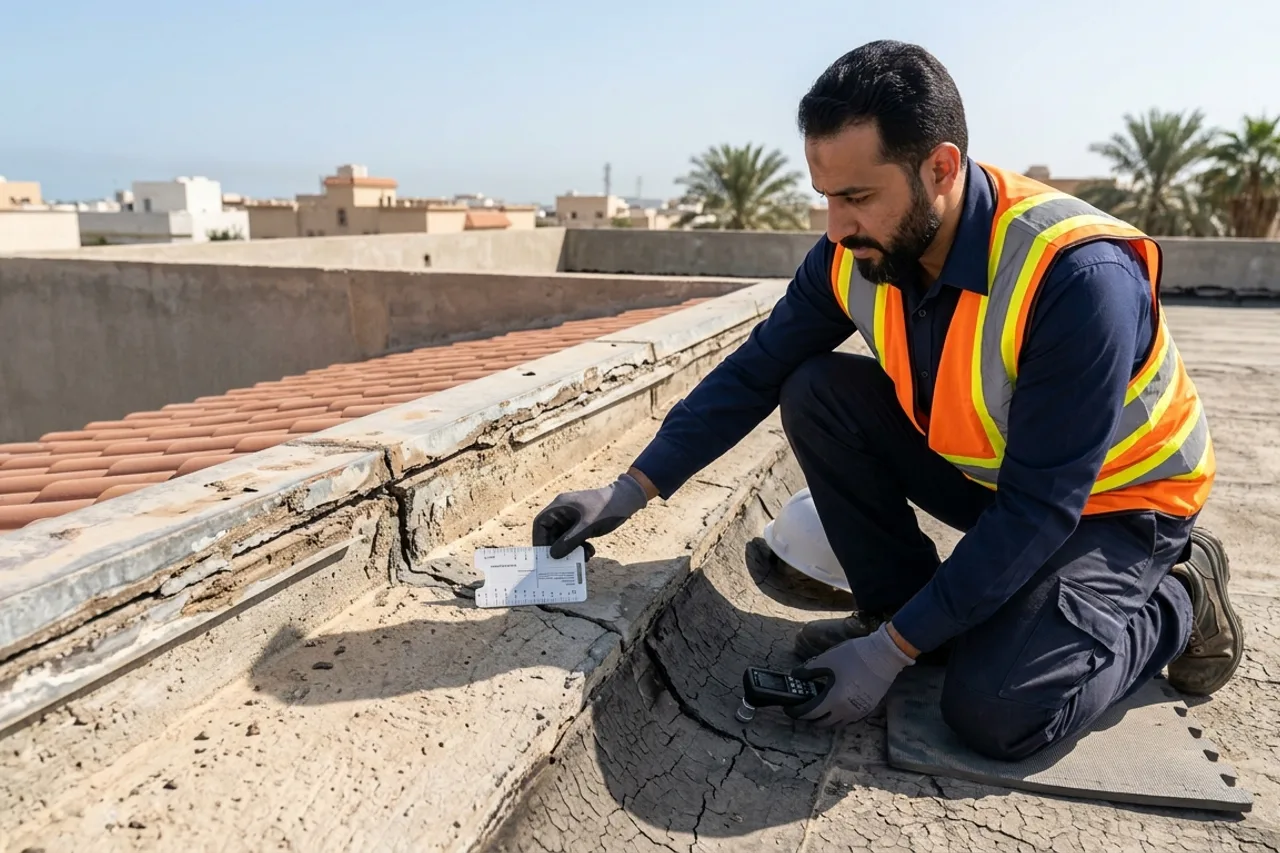
Why Existing Waterproofing Systems Deteriorate in Jeddah & Makkah
Many property owners in Jeddah and Makkah are surprised when ceiling dampness or rainwater leaks appear despite the roof or tank having been "waterproofed a few years ago." Existing waterproofing failures typically stem from either original installation shortcuts (unterminated parapet upstands, omitted primer, unreinforced corners) or UV/thermal aging of exposed topcoats without periodic maintenance.
The costliest mistake when an older membrane leaks is applying a random coat of cheap paint directly over cracked, dusty, or blistered existing waterproofing without checking substrate moisture or chemical compatibility—resulting in immediate peeling within weeks.
Peeling & Sagging of Bituminous Roll Upstands Along Parapet Walls
Technical Mechanism: Omission of a mechanical termination bar or wall chase during original installation, allowing solar heat to soften and peel the upper edge so rainwater runs behind the entire membrane.
Blisters & Bubbles Forming Beneath Liquid Membranes or Bituminous Rolls
Technical Mechanism: Vapor pressure from moisture trapped inside the concrete slab during original installation expanding under summer sun and lifting the membrane into hollow blisters.
Erosion of UV Topcoat Over Spray Foam Exposing Yellow Powdery Foam
Technical Mechanism: Weathering of an underspecified UV topcoat or mechanical punctures from bird pecking and HVAC maintenance.
Functional Comparison: Waterproofing vs. Thermal Insulation vs. Membrane Repair
Blocks Rain, Tank Water & Groundwater
Impervious membranes (bitumen, PU, flexible cementitious, epoxy) that stop liquid water migration, but do not provide thermal R-value alone.
Reduces Conductive Solar Heat Gain
Cellular materials (XPS/PIR boards or closed-cell SPF) that lower U-value, paired with a waterproofing membrane or UV topcoat.
Localized Detail Repair & Topcoat Renewal
Restoring detached parapet flashings, expansion joints, or weathered UV topcoats when the host membrane remains dry and bonded.
Illustrative engineering diagram only — actual layer sequence and specification are determined following on-site substrate inspection per manufacturer TDS.
Technical Definition: When to Repair Locally vs. When to Replace
Waterproofing repair and restoration at Bashaer Al Khair is a diagnostic and remedial engineering service for properties with existing waterproofing suffering localized defects or surface aging. Our primary mandate is honest technical triage: if 85%–90% of the existing assembly is well-bonded and dry—with defects confined to parapet upstands, drain flashings, expansion joints, or UV topcoats—we execute a targeted restoration protocol that saves the owner the cost of full demolition.
Conversely, if field moisture testing reveals water trapped beneath the entire membrane area or widespread cohesive breakdown of the old coating, we transparently advise the client that superficial patching will fail and recommend full removal and replacement.
What Is Included in Bashaer Al Khair’s Execution Scope:
- Inspecting the existing system (bituminous rolls, spray foam, liquid polyurethane/acrylic, or tank lining) and mapping delamination and trapped moisture.
- Cutting open and drying localized blisters, patching bituminous membranes with compatible torch/cold strips, and mechanically securing upstands with aluminum termination bars and PU sealant.
- Renewing UV-protective elastomeric topcoats over weathered spray foam or liquid membranes, and rebuilding expansion joint and roof drain seals.
Engineering Scope Boundaries & Transparency
- We never apply a new coating directly over peeling, flaking, or water-saturated existing membranes without removing failed sections and drying the substrate.
- Repair materials are strictly selected for chemical compatibility with the host membrane (e.g., never applying rigid cementitious slurry over an elastomeric membrane).
Compatible Membrane Restoration Systems (Polyurethane, Acrylic, Modified Bitumen Patches, Elastomeric Joint Sealants & Structural Repair Mortars)
Existing Waterproofing Systems We Repair & Restore
We restore four primary categories of aging or locally damaged waterproofing assemblies:
1. Bituminous Roll Membrane Repair (Upstands, Seams & Blisters)
Substrate Type: Bituminous roofs with detached parapet flashings, open lap seams, or mechanical punctures from satellite/HVAC installations.
2. Spray Foam Insulation Repair & UV Topcoat Renewal
Substrate Type: Spray-foamed roofs where the protective acrylic/PU topcoat has weathered thin or suffered mechanical damage.
3. Structural Expansion Joint & Roof Drain Flashing Restoration
Substrate Type: Building expansion joints with dried/split sealant and leaking roof scupper/drain perimeters.
Engineering Triage: How We Decide Between Repair vs. Replacement
Our field engineers rely on three diagnostic checks to evaluate your existing waterproofing:
1. Non-Destructive Sub-Membrane Moisture Scanning
If the concrete screed or thermal insulation beneath the membrane is waterlogged across the roof, surface patching merely traps water inside.
2. Testing Existing Membrane Adhesion & Flexibility
If the existing coating peels off easily by hand or has become brittle and chalky, any new layer applied over it will delaminate.
3. Identifying the Existing Material for Chemical Compatibility
Applying incompatible chemistries over one another causes plasticizer migration, blistering, or bond failure.
Restoration Materials Matched to Existing Waterproofing Types
We match restoration systems directly to the chemistry and condition of your existing waterproofing:
Modified Bitumen Patching, Liquid Bitumen-PU Mastic & Termination Bars
Best Suited For: Repairing localized roll punctures/blisters, re-fusing open seams, and mechanically anchoring peeled parapet upstands.
Mesh-Reinforced Liquid Polyurethane / Elastomeric Acrylic Overlay
Best Suited For: Renewing weathered UV topcoats on spray-foam roofs or reinforcing aged liquid membranes after crack-bridging tape preparation.
Elastomeric Expansion Joint Sealant & Hypalon/TPE Bandage System
Best Suited For: Stopping persistent leaks along structural expansion joints where rigid mortar or cheap silicone has cracked.
Step-by-Step Waterproofing Restoration Workflow
1. Isolating Failure Zones & Excising Delaminated Material
Cutting back blisters, peeled edges, and degraded sealant back to sound, tightly bonded host material and dry concrete.
2. Surface Grinding, Cleaning & Compatible Primer Application
Removing surface oxidation and dust from the overlap zone and applying an adhesion-promoting primer.
3. Applying Reinforced Restoration Patches & Securing Upstands
Installing mesh-reinforced liquid membrane or modified bitumen patches with generous overlap onto sound material, plus mechanical parapet termination bars.
4. Applying UV Protection Topcoat & Post-Repair Verification
Applying the UV-stable protective topcoat and verifying watertightness across the restored detail.
3 Most Common Details Requiring Waterproofing Restoration
In most waterproofing maintenance calls across Jeddah and Makkah, leaks originate at one of these three details:
1. Unsecured Parapet Wall Upstand Edges
Failure Risk:Relying solely on adhesive bond at the top of a vertical parapet allows solar heat to peel the membrane edge away from the wall.
2. Post-Waterproofing Roof Penetrations (HVAC Stands, Satellite Dishes, Pipes)
Failure Risk:HVAC or satellite installers drilling anchor bolts directly through the roof membrane without sealing the penetrations.
3. Cracked & Dried Structural Expansion Joints
Failure Risk:Hardened, split joint sealant lets rainwater pour directly into the structural gap between building sections.
When Localized Repair Is Technically Unviable (Requiring Full Replacement)
In the interest of engineering honesty, we advise against localized patching when:
Leak Detection vs. Localized Membrane Repair vs. Full Re-Waterproofing
A decision matrix to help you choose the most cost-effective and durable solution:
Detached parapet upstand or localized puncture around an AC stand while 90% of the roof membrane is dry and intact
Correct Engineering Action: Execute targeted Waterproofing Repair: re-bond upstand, install termination bar, and reinforce penetration flashing.
Weathered UV topcoat over an otherwise firm, dry polyurethane spray-foam roof
Correct Engineering Action: Clean the foam surface, repair minor gouges, and apply two new coats of UV-protective elastomeric topcoat.
Completely cracked, brittle old membrane with waterlogged underlying screed and widespread ceiling dampness
Correct Engineering Action: Strip failed layers, dry the deck, and install a new full Roof Waterproofing system.
Why Waterproofing Repair Makkah Requires Local Makkah Engineering Expertise
In Makkah, extreme summer heat dries and cracks conventional joint sealants and accelerates UV topcoat chalking on exposed roofs if not periodically maintained.
Makkah experiences intense thermal radiation amplified by surrounding rocky mountain basins, combined with seasonal torrential downpours that rapidly load flat roofs and channel runoff along rock fissures toward foundations and underground cisterns. Furthermore, multi-story residential and hospitality buildings in Makkah feature dense rooftop mechanical installations creating critical penetration zones.
Key Building Envelope Challenges We Solve in Makkah:
- Significant thermal movement across expansion joints in Makkah multi-story residential and hospitality buildings.
- Debris accumulation and localized flashing breakdown around roof rainwater scuppers.
Common Local Application Scenarios in Makkah:
Evaluating existing roof insulation and executing localized flashing repairs and reflective topcoat recoating.
Factors Determining Waterproofing Repair & Restoration Cost
Restoration and maintenance costs are determined following on-site inspection based on:
1. Scope: Localized Detail Repair (Linear Meter / Spot) vs. Full Topcoat Renewal
Repairing linear meters of parapet flashing or an expansion joint differs from recoating an entire roof’s UV topcoat.
2. Existing Membrane Chemistry & Required Compatible Repair Materials
Structural expansion joint bandages and polyurethane mastics carry different material costs than bituminous patches or acrylic recoats.
3. Extent of Stripping, Drying & Surface Preparation Required
Includes mechanical scraping of loose coatings, opening/drying wet pockets, or localized tile removal around a drain.
Preparation Checklist Before a Waterproofing Repair Visit
- Note the exact locations of interior ceiling stains or drips so our engineer can correlate them with roof surface details above.
- Share the approximate age/type of the existing waterproofing (if known) and any recent roof work such as new AC units or heaters.
- Provide clear access to the roof or tank and move stored items away from the suspected defect zone.
Quality Verification Following Waterproofing Restoration
Upon completing localized restoration or topcoat renewal, we verify repair integrity through:
Confirming monolithic bonding across the overlap zone and tight mechanical anchoring of termination bars.
Performed after full cure on repaired roof drains or expansion joints to verify watertight flow.
Saudi Building Code — Energy Conservation for Low-Rise Residential Buildings (SBC 602)
Defines maximum allowable thermal transmittance (U-value) for roofs and exterior walls in low-rise residential villas based on climatic zone (Jeddah and Makkah fall within hot climate zones requiring robust roof thermal resistance).
Saudi Building Code — Energy Conservation for Non-Residential Buildings (SBC 601)
Governs building envelope thermal performance for commercial, administrative, hospitality, and multi-story buildings, emphasizing continuous insulation and thermal bridge mitigation.
Saudi Building Code — Soils and Foundations: Damp-Proofing & Waterproofing (SBC 303)
Distinguishes between subsurface Damp-Proofing (where no hydrostatic head exists) and full Waterproofing (required where groundwater tables, hydrostatic pressure, or aggressive sulfate/chloride soils are present, such as coastal Jeddah).
Manufacturer Technical Data Sheets (TDS), Safety Data Sheets (SDS) & Potable Contact Certifications
Manufacturer TDS documents govern maximum allowable substrate moisture, primer pairing, consumption rate per m², recoat intervals, and full curing times prior to water immersion.
Before proposing waterproofing on roofs, bathrooms, tanks, or pools, we verify whether moisture stems from pressurized pipes, drains, or float valves (routing to leak detection first if needed).
We evaluate substrate type (concrete, tile, metal), screed soundness, cracks, honeycombing, hollow tiles, and whether existing insulation can be restored or requires removal.
We map ponding zones, slope gradients toward rainwater scuppers/drains, and subsurface moisture levels beneath tiles or within concrete to prevent post-application blistering.
We determine whether the asset requires waterproofing, thermal insulation, or a combined system, selecting materials matched to foot traffic, UV exposure, or continuous water immersion.
We specify detailing protocols for parapet wall coving/upstands, structural expansion joints, HVAC/tank plinths, floor drains, and pipe sleeves.
We provide a clear scope covering surface preparation, proposed system layers, and topcoat/protection requirements so the client understands the exact quotation basis.
Build Your Project Scope & Request an Itemized Quote in Makkah
We never quote misleading flat rates without evaluating your substrate. Select your project parameters below to generate your technical scope summary and schedule an engineer visit.
Select Your Property Parameters for an Instant Engineering Recommendation
Complete Roof Waterproofing (Concrete & Tiled Roofs)
Proposed Engineering Assembly: Reinforced Liquid Polyurethane Membranes or Bituminous Assemblies Matched to Deck State
Delivers complete roof rainwater protection with full slope, parapet coving, and drain collar detailing.
Material & System Comparison: Where Each System Excels & Its Technical Limits
Filter by building zone to compare each system across water exposure, solar UV resistance, foot traffic, protective layers, and substrate constraints:
Modified Bituminous Membranes (APP / SBS Rolls)
Concrete roofs prior to tiling, buried foundations, retaining walls, and exposed non-traffic roofs (when using mineral slate-surfaced APP rolls).
Substrates: Smooth reinforced concrete slabs and cured slope-screed beds primed with compatible bituminous primer.
High resistance to rainwater ponding and subsurface dampness when side (10 cm) and end (15 cm) lap seams are fully fused.
Smooth rolls require UV cover; mineral-slate-surfaced APP membranes resist direct solar radiation on non-trafficked roofs.
Low when exposed — requires geotextile separation felt and protective screed/tiling for regular foot traffic.
Yes on trafficked roofs and buried foundations (protection boards or non-woven geotextile felt beneath screed/backfill).
Not suitable for internal potable water tanks or swimming pools; seam integrity depends heavily on skilled lap detailing.
Polymer-Modified Flexible Cementitious Waterproofing
Bathrooms and wet zones prior to tiling, concrete water tanks, swimming pool shells under mosaic tiles, and foundations.
Substrates: Sound reinforced concrete, cementitious renders, and plastered masonry brought to a saturated-surface-dry (SSD) state.
Engineered for continuous water immersion (tanks and pools) and both positive and selected negative hydrostatic pressure.
Moderate to low under prolonged direct desert sun — designed to be covered by ceramic/mosaic tiles or protective coatings.
Tolerates light installation traffic once cured, but requires protective tiling or screed for permanent foot traffic.
Yes on floors and decks (ceramic/porcelain tiling with compatible C2TE/S1 flexible adhesive or protective screed).
Lower crack-bridging elongation than pure polyurethane membranes; not intended as an exposed roof coating over wide thermal joints.
Liquid-Applied Acrylic & Hybrid Elastomeric Membranes
Sloped exposed roofs without heavy ponding, UV-protective topcoat over spray polyurethane foam, and parapet/roof restoration.
Substrates: Concrete, cementitious screed, closed-cell spray polyurethane foam (SPF), and properly abraded/primed tiled surfaces.
Effective against shedding rainwater; pure acrylics are not recommended for permanent ponding water unless PU-hybridized.
Excellent — highly resistant to UV degradation and maintains elasticity and solar-reflective white/light finish.
Suitable for light maintenance foot traffic; requires full fleece reinforcement or pedestrian-grade PU topcoat for regular traffic.
No UV cover required as the membrane itself is formulated for direct solar exposure.
Unsuitable for submerged tanks or pools, and cannot compensate for severe negative roof slopes causing deep standing water.
High-Elastomeric Liquid Polyurethane Waterproofing Systems
Concrete and tiled roofs subject to ponding water, balconies, terraces, and complex rooftop mechanical zones.
Substrates: Dry concrete (<4–5% moisture content), and existing ceramic/porcelain tiles after mechanical grinding and specialized epoxy/PU primer.
Superior resistance to standing/ponding rainwater with high crack-bridging elongation across thermal cycles.
Aromatic base coats require an Aliphatic polyurethane UV-stable topcoat when left exposed to direct sunlight.
Good to high durability when finished with a pedestrian-grade aliphatic polyurethane wear coat.
Requires an aliphatic UV topcoat if exposed, or silica-sand broadcast / geotextile layer if tiled over.
Will delaminate or blister if applied over existing tiles whose underlying sand bed is saturated with trapped water.
Rigid Thermal Insulation Boards (XPS / EPS / PIR)
Villa, residential, and commercial flat roofs (in inverted or conventional roof assemblies) to reduce conductive heat transfer.
Substrates: Installed over tested waterproofing membranes (in inverted roof systems with geotextile filter fabric) beneath ballast or tiles.
Extruded polystyrene (XPS) boards have low water absorption, but board joints are NOT waterproof—a separate waterproofing membrane is mandatory.
Degrades under direct UV and wind uplift — must always be covered by geotextile fabric and gravel ballast, tiles, or screed.
Supports foot traffic once covered by load-distributing screed or paving slabs matched to the board compressive strength.
Mandatory (non-woven geotextile filter layer + heavy ballast, paving tiles, or screed to prevent UV degradation and wind uplift).
Never stops water leaks on its own; strictly serves as the thermal resistance component of a multi-layer roof system.
Closed-Cell Spray Polyurethane Foam (SPF System)
Exposed concrete roofs, corrugated metal/warehouse roofs, and roofs with dense HVAC/piping penetrations requiring seamless encapsulation.
Substrates: Dry, clean concrete decks, primed/rust-free metal decks, and solid substrates free of moisture, oil, and loose dust.
Closed-cell SPF finished with a continuous elastomeric/acrylic topcoat provides reliable rainwater resistance when proper drainage slopes exist.
Raw polyurethane foam oxidizes and chalks rapidly under UV rays — a UV-resistant elastomeric topcoat is mandatory.
Moderate (handles careful maintenance traffic); sharp tools or dragging heavy mechanical equipment can puncture the topcoat.
Mandatory: UV-protective elastomeric acrylic/polyurethane coating, or geotextile separation felt beneath screed/tiles.
Open-cell foam is unsuitable for exterior roofs, and any neglected breach in the UV topcoat exposes the foam to solar degradation.
Specialized Water Tank & Pool Coatings (Epoxy & Hydraulic Mortars)
Internal lining of reinforced concrete water tanks (using certified potable-water systems) and swimming pool structural shells.
Substrates: Mechanically profiled reinforced concrete with all honeycombing, tie-rod holes, and active negative leaks sealed first.
Specifically engineered for 24/7 continuous water immersion and resistance to chlorides and treatment chemicals.
Internal tank epoxies are designed for enclosed tanks (low UV stability); outdoor pools use flexible cementitious membranes under tiles.
High abrasion resistance during periodic tank cleaning once the full manufacturer curing schedule is completed.
Potable tank epoxy serves as the final smooth lining; pool cementitious waterproofing is covered by mosaic tiles and chemical-resistant grout.
Never assume generic industrial epoxy is potable-water safe — requires verified potable-water compliance documentation and full cure time.
Important Engineering Note: This guide provides an engineering comparison of material families; final system specification, primer pairing, and layer build-up are determined after an on-site substrate and moisture assessment per manufacturer TDS.
Technical Answers on Waterproofing Repair Makkah
Can I repair just the damaged section of my roof waterproofing, or must I redo the whole roof?
It depends on the condition of the host system: if the main roof membrane is dry and firmly bonded, with defects limited to a peeled parapet upstand, HVAC puncture, drain collar, or expansion joint, targeted engineering repair is highly effective. If water is trapped beneath the entire membrane or the material has perished throughout, full replacement is necessary.
My spray-foam roof topcoat is peeling and showing yellow foam—do I need new foam?
As long as the polyurethane foam core itself remains firm and dry, you do not need to strip the foam. The proper solution is pressure cleaning the surface, repairing any localized gouges, and applying two fresh coats of UV-resistant elastomeric topcoat.
Can a liquid waterproof membrane be applied over old bituminous rolls?
Yes, provided two strict engineering conditions are met: (1) any blisters or loose seams in the existing rolls are cut, dried, and re-bonded first, and (2) a chemically compatible primer and fleece-reinforced liquid polyurethane/bitumen-modified system specifically rated for bituminous substrates is used.
How can I tell if a leak is coming from an expansion joint rather than the main roof membrane?
Expansion joint leaks typically appear indoors as a linear moisture stain or peeling paint line following the exact structural joint path between building sections after rainfall. We treat this using backer rods, PU sealant, and elastomeric joint bandages.
Related Waterproofing & Insulation Services in Makkah
View All Makkah Waterproofing ServicesRoof Waterproofing in Makkah — Securing Villa & Building Roofs Against Rainwater & Thermal Stress
Spray Polyurethane Foam Insulation in Makkah — Integrated Thermal & Moisture Roof Protection
Bituminous Membrane Waterproofing in Makkah — Heavy-Duty Sheet Membranes for Roofs & Substructures
Water Tank Waterproofing in Makkah — Securing Underground & Overhead Concrete Water Tanks
Diagnostic & Engineering Comparison Guides to Help You Decide
Water Leaking from the Bathroom Ceiling: How to Pinpoint the Exact Source Upstairs Without Random Demolition
When yellow stains or active water drops appear on your bathroom ceiling or gypsum soffit, the source lies in the wet area directly above—but is the culprit a pressurized supply pipe, a drainage elbow, eroded tile grout, or a breached slab membrane?
Lower Wall Dampness & Peeling Paint Causes: How to Distinguish Plumbing Leaks from Rising Damp
Paint blistering or white crystalline salt deposits 15 to 60 cm above floor skirting boards are never a cosmetic issue solved by repainting—they are physical indicators of active moisture migration that must be traced at the source.
Sudden High Water Bill Causes in Jeddah & Makkah: Step-by-Step Meter, Float Valve & Underground Tank Diagnostic Guide
When your monthly water bill doubles or triples with no change in household occupancy and zero visible dampness indoors, water is almost certainly escaping silently underground or directly into a drain line—here is how to isolate the culprit step by step.
Swimming Pool Water Level Drop in Jeddah & Makkah: How to Scientifically Separate Evaporation from Plumbing & Shell Leaks
Every outdoor pool loses water to evaporation under the intense heat of Jeddah and Makkah—but when does daily water loss cross the engineering threshold into an active skimmer, light conduit, filtration pipe, or structural shell leak?