
Bituminous Membrane Waterproofing in Makkah: Heavy-Duty Sheet Membranes for Roofs and Substructures
Polyester-reinforced bitumen rolls give a dependable main waterproofing barrier for Makkah roofs and substructures. Apply them over a smooth slope screed and protect them with geotextile felt, thermal boards or tiling.
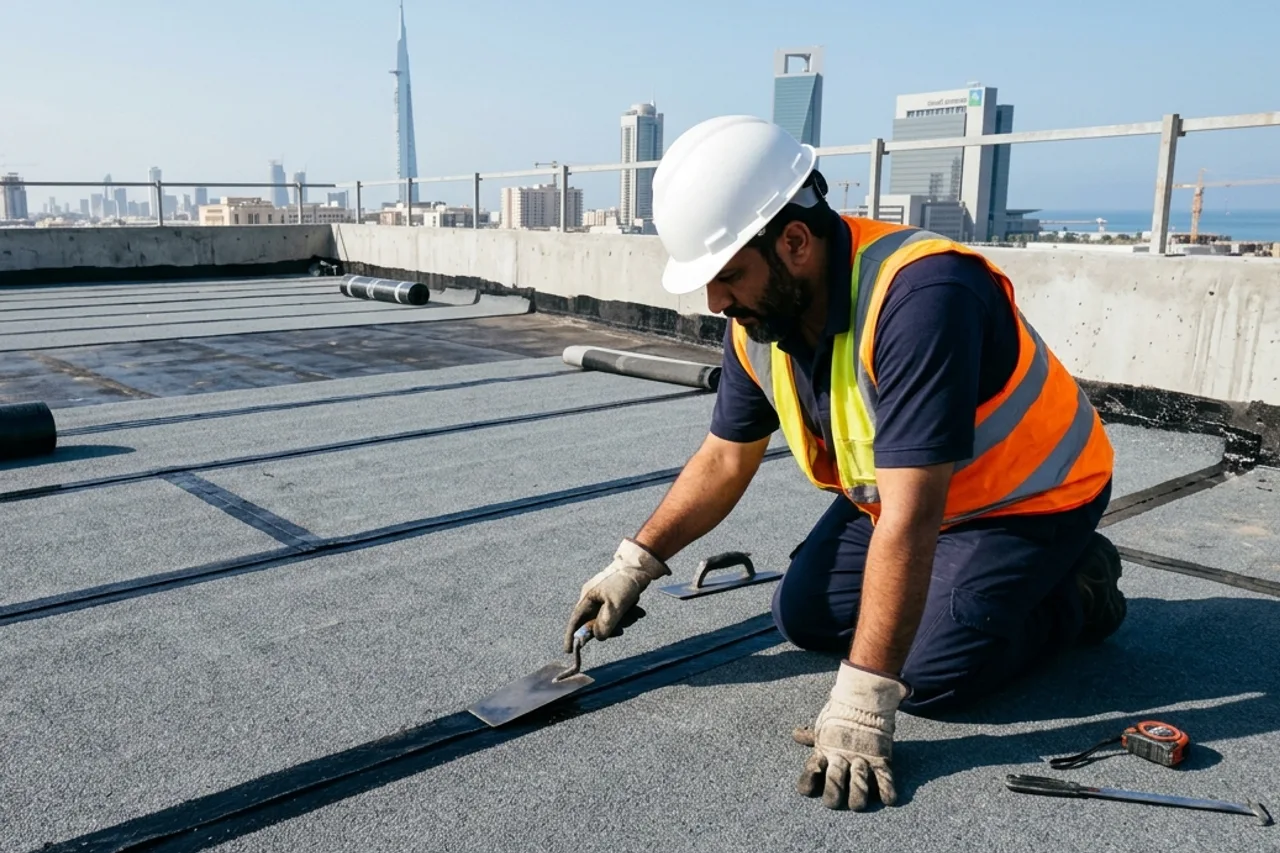
When We Choose Bituminous Sheet Membranes and What Failures They Prevent
In new villa and apartment builds, or full roof strip-and-relay projects before tiling, owners and supervising engineers need a base waterproofing layer. Its thickness should be factory-guaranteed, not hand-rolled. It must carry the thermal boards, screed and tiles above it.
Modified bitumen rolls give this strength and resist water pressure. This works only if the base is prepared well and the overlap seams are fused fully. One unsealed lap edge, or a missing 45° parapet cant strip, can let water creep under the membrane.
Seam Separation in Poorly Installed Old Bitumen Rolls
Technical Mechanism: Laying rolls over unprimed, dusty concrete, or skimping on the 10 cm side and 15 cm end overlaps, makes seams open under heat stress.
Membrane Puncturing at Sharp 90° Corners or Rough Concrete Projections
Technical Mechanism: Bending a bituminous sheet sharply at a 90° wall corner, with no 45° cementitious cant strip, stretches and splits the membrane.
Cracking and Alligatoring of Smooth Bitumen Rolls Left Exposed to Direct Sun
Technical Mechanism: Smooth-surfaced rolls are made for buried or covered systems. Leaving them in direct UV causes oxidation and cracking.
Mandatory Engineering Details for Spray Foam and Bituminous Rolls in Makkah
Closed-Cell Foam + Mandatory UV Elastomeric Topcoat
- 1. Substrate Prep & Primer: Cleaning and drying concrete or metal decks and applying a compatible primer.
- 2. Closed-Cell Polyurethane Core: One seamless closed-cell spray layer wraps the deck, curbs and upstands.
- 3. Mandatory UV Topcoat: Elastomeric acrylic or polyurethane UV topcoat that shields the foam from sun damage.
Primer + Fused Overlaps + Cant Strip + Protection Layer
- 1. Bituminous Primer & 45° Cant Strip: Sealing concrete pores and forming 45° mortar coving so rolls never bend at sharp 90° angles.
- 2. Engineered Lap Seam Fusion: Use 10 cm side laps and 15 cm end laps. Fix them with termination bars at the top of the parapet.
- 3. Separation & Protection Layer: Shielding membranes with non-woven geotextile felt under roof tiles or rigid boards before foundation backfilling.
Illustrative diagram only. The actual layer order and spec are set after an on-site surface inspection, per manufacturer TDS.
Technical Definition & Scope of Bituminous Membrane Waterproofing
Bituminous membrane waterproofing uses polymer-modified bitumen sheets. These include heat-resistant APP or flexible SBS membranes. They are reinforced with non-woven polyester fabric and laid over primed concrete.
Smooth-surfaced membranes are the base waterproofing layer under tiles, screed or XPS thermal boards (in inverted roofs) and on buried concrete foundations. Mineral-slate-surfaced APP membranes are used on exposed roof decks with no foot traffic.
What Bashaer Al Khair's Work Includes:
- Checking the concrete slab and slope screed for flatness, grinding sharp bumps, and cleaning off dust.
- We form 45° cement cant strips where the parapet meets the roof. Then we apply a penetrating bitumen primer.
- Laying modified bitumen rolls from the lowest drainage points up the slope. We fuse all lap seams and add mechanical protection.
Engineering Scope Boundaries & Transparency
- Never Used Inside Drinking Water Tanks or Pools: Bitumen membranes are not suitable for internal drinking water tanks or tiled swimming pool shells.
- Safety Compliance: We never publish DIY torch or open-flame steps for non-professionals. Only trained specialists do thermal bonding and seam sealing, under site fire-safety controls.
APP and SBS Polymer-Modified Bitumen Sheet Membranes with Non-Woven Polyester Reinforcement and Bitumen Primer
Suitable Substrates & Applications for Bituminous Membranes
Modified bitumen sheet membranes are made for these building envelope uses:
New Concrete Roof Slabs Before Thermal Boards and Tiling
Substrate Type: Reinforced concrete slab topped with smooth, cured slope screed.
Exposed Non-Trafficked Roofs (Mineral-Slate Surfaced Rolls)
Substrate Type: Concrete annex roofs or flat decks with few obstacles.
Buried Concrete Foundations, Footings & Retaining Walls
Substrate Type: Cured concrete basement walls, tie beams and foundation footings.
Concrete Substrate Assessment Prior to Membrane Installation
Pre-made sheet membranes need an even base. Our engineers check three things before installation:
1. Smoothness & Slope Accuracy of the Cementitious Screed
Sharp aggregate or trowel ridges in the screed can puncture the membrane under the weight above.
2. Concrete Cure & Moisture Evaporation Check
Sealing bituminous sheets over freshly poured, wet screed traps evaporating cure water and creates vapor blisters.
3. Assessing Pipe Congestion & Complex Geometry
On decks with tightly packed pipe clusters, cutting and welding stiff rolls around every pipe raises the risk of seam failure.
Types of Modified Bituminous Membranes & System Layers
We match the modified bitumen polymer type and protective layers to the exact building element:
APP-Modified Bituminous Membranes (Plastomeric — Polyester Reinforced)
Best Suited For: Flat roofs in hot climates like Jeddah and Makkah (fitted under thermal insulation and tiles).
SBS-Modified Bituminous Membranes (Elastomeric — High Flexibility)
Best Suited For: Foundations below ground, retaining walls, and details that face structural movement or vibration.
Dual-Layer Staggered Bituminous Membrane System
Best Suited For: Large commercial roofs, podium decks and foundations with high water exposure.
General Professional Workflow for Bituminous Membrane Installation
Phase 1: Substrate Preparation & 45° Cementitious Cant Strips
Creating a smooth, dust-free deck and forming 45° mortar fillets at all wall-to-slab corners so rolls turn smoothly.
Phase 2: Applying Penetrating Bituminous Primer
Sealing concrete pores and binding fine dust to make the membrane bond strongly to the deck.
Phase 3: Membrane Alignment, Installation & Lap-Seam Fusion
Installing rolls from the lowest drain level upward against the slope. We keep 10 cm side laps and 15 cm staggered end laps.
Phase 4: Parapet Upstand Flashing & Mechanical Protection
Flashing parapet upstands and finishing the top edges. Then laying geotextile felt or protection boards before the next trades.
Critical Detailing Zones in Bituminous Roll Waterproofing
Four details separate a long-lasting bitumen system from one that leaks in the first storm:
1. Side-Lap (10 cm) & Staggered End-Lap (15 cm) Seam Integrity
Failure Risk:Any unbonded gap along a lap seam lets standing rainwater creep under the sheet.
2. Double-Collar Detailing Around Rainwater Drains
Failure Risk:Cutting a roll roughly around a floor drain leaves an unsealed gap around the drain pipe.
3. Securing the Top Edge on Parapet Walls
Failure Risk:Leaving the top edge of an upstand sheet unsupported on a vertical wall makes it sag and peel in the sun's heat.
Where Bituminous Membranes Should NOT Be Used
We strictly avoid bituminous roll membranes where they are technically or hygienically unsuitable:
Bituminous Rolls vs. Liquid Membranes vs. Local Repair
A practical comparison to help you pick the right fix for your roof or foundation:
New villa or apartment concrete roof slab getting XPS thermal boards and tiles
Correct Engineering Action: Install polyester-reinforced modified bituminous rolls over primed slope screed, topped with geotextile felt.
Local peeling at a parapet upstand edge on an otherwise sound bituminous roof
Correct Engineering Action: Request Existing Waterproofing Repair to re-bond, patch and mechanically terminate the upstand.
Why Bituminous Waterproofing in Makkah Needs Local Expertise
In Makkah, polyester-reinforced bitumen rolls are the trusted choice for new multi-story building and villa roofs with inverted thermal systems and tiles. They are also used on retaining walls.
Makkah has intense heat radiation, made stronger by the rocky mountain basins around it. Seasonal torrential rain also loads flat roofs fast and sends runoff along rock fissures toward foundations and underground cisterns. Multi-story homes and hotels in Makkah also have dense rooftop equipment, which creates critical penetration zones.
Key Building Envelope Challenges We Solve in Makkah:
- Makkah’s intense summer heat means rolls must be stored in shade on site. It also calls for high-softening-point APP membrane specs.
- Expansion joints and roof drains on Makkah buildings need extra reinforcement strips for heavy seasonal rain.
Common Local Application Scenarios in Makkah:
Applying modified bitumen membranes with full upstand and scupper detailing. Geotextile felt and thermal boards go on top.
Factors Determining Bituminous Membrane Waterproofing Cost
Bituminous roll jobs are quoted based on these project details:
1. Membrane Thickness, Carrier Weight and Finish (Smooth or Mineral Slate)
Membrane cost varies with thickness, polyester gram-weight reinforcement, and mineral-slate vs. smooth finish.
2. Single-Ply vs. Double-Ply Assembly
Double-layer specs need twice the roll material and seam-fusion labor.
3. Substrate Preparation, Cant Strips & Protection Layers
Includes linear meters of 45° mortar coving and geotextile felt or protection boards on top.
Site Preparation Checklist Before Bituminous Roll Installation
- Finish and cure the sloped cementitious screed so it is dry and smooth before the membrane goes on.
- Install all floor drain bodies and pipe sleeves before waterproofing. This avoids core drilling through the membrane later.
- Clear the roof deck or foundation trench of timber, rebar scraps and construction debris.
Quality Verification Prior to Covering Bituminous Membranes
Before covering bituminous membranes with thermal boards, screed or backfill, we check:
Probing every side lap, end lap and upstand corner to confirm 100% continuous fusion.
Done on new concrete roof decks before laying thermal boards and tiles to confirm watertightness.
Saudi Building Code: Energy Conservation for Low-Rise Residential Buildings (SBC 602)
Sets the maximum heat transfer (U-value) for roofs and outer walls in low-rise villas, by climate zone. Jeddah and Makkah are hot zones that need strong roof heat resistance.
Saudi Building Code: Energy Conservation for Non-Residential Buildings (SBC 601)
Sets the thermal performance of building envelopes for commercial, office, hotel and multi-story buildings. It stresses continuous insulation and fewer thermal bridges.
Saudi Building Code: Soils and Foundations, Damp-Proofing and Waterproofing (SBC 303)
Separates damp-proofing (no water pressure) from full waterproofing. Full waterproofing is needed where groundwater, water pressure, or sulfate and chloride soils are present, as in coastal Jeddah.
Manufacturer Technical Data Sheets (TDS), Safety Data Sheets (SDS) and Potable Contact Certifications
Manufacturer TDS documents set the maximum base moisture, primer pairing, use rate per m², recoat intervals and full curing times before water immersion.
Before we propose waterproofing for roofs, bathrooms, tanks or pools, we check whether the moisture comes from pressurized pipes, drains or float valves. If it does, we start with leak detection.
We check the substrate type (concrete, tile, metal), screed condition, cracks, honeycombing and hollow tiles. We also check whether existing insulation can be restored or must be removed.
We map ponding zones, slope toward rainwater scuppers and drains, and moisture levels under tiles or inside the concrete. This prevents blistering after application.
We determine whether the asset requires waterproofing, thermal insulation, or a combined system, selecting materials matched to foot traffic, UV exposure, or continuous water immersion.
We specify details for parapet wall coving and upstands, structural expansion joints, HVAC and tank plinths, floor drains and pipe sleeves.
We give a clear scope covering surface preparation, the proposed system layers, and topcoat or protection needs. This way the client understands exactly what the quote covers.
Build Your Project Scope & Request an Itemized Quote in Makkah
We never quote vague flat rates without checking your surface. Choose your project details below to get a technical scope summary and book an engineer visit.
Choose Your Property Details for an Instant Expert Tip
Complete Roof Waterproofing (Concrete & Tiled Roofs)
Proposed Engineering Assembly: Reinforced Liquid Polyurethane Membranes or Bitumen Systems Matched to the Deck
Gives full roof rainwater protection. We detail the slope, parapet coving and drain collars.
Material and System Comparison: Where Each System Works Best and Its Limits
Filter by building zone to compare each system on water exposure, sun UV resistance, foot traffic, protective layers, and surface limits:
Modified Bituminous Membranes (APP / SBS Rolls)
Concrete roofs before tiling, buried foundations, retaining walls, and exposed roofs with no traffic (with mineral slate-surfaced APP rolls).
Substrates: Smooth reinforced concrete slabs and cured slope screed. Prime them with a matching bitumen primer.
Strong against rainwater ponding and damp in the ground. The side (10 cm) and end (15 cm) laps must be fully fused.
Smooth rolls need UV cover. Mineral-slate-surfaced APP membranes resist direct sun on roofs with no traffic.
Low when exposed. It needs a geotextile separation felt and a protective screed or tiling for regular foot traffic.
Yes, on roofs with traffic and buried foundations. Use protection boards or non-woven geotextile felt under the screed or backfill.
Not suitable for drinking water tanks inside buildings or swimming pools. Seam quality depends on skilled lap work.
Polymer-Modified Flexible Cementitious Waterproofing
Bathrooms and wet zones before tiling, concrete water tanks, swimming pool shells under mosaic tiles, and foundations.
Substrates: Sound reinforced concrete, cement renders, and plastered masonry. The surface must be saturated-surface-dry (SSD).
Made for constant water contact (tanks and pools). It handles positive and some negative water pressure.
Moderate to low under long direct desert sun. Cover it with ceramic or mosaic tiles or protective coatings.
Handles light foot traffic during work once cured. Permanent foot traffic needs protective tiling or screed.
Yes, on floors and decks. Use ceramic or porcelain tiles with a matching C2TE/S1 flexible adhesive, or a protective screed.
Bridges cracks less than pure polyurethane membranes. Not meant as an exposed roof coating over wide thermal joints.
Liquid-Applied Acrylic & Hybrid Elastomeric Membranes
Sloped exposed roofs without heavy ponding, UV topcoat over spray polyurethane foam, and parapet and roof repair.
Substrates: Concrete, cement screed, closed-cell spray polyurethane foam (SPF), and tiled surfaces that are properly abraded and primed.
Works well against running rainwater. Pure acrylics are not advised for permanent ponding unless they are PU-hybrid.
Excellent. It resists UV damage and keeps its stretch and its white or light, sun-reflecting finish.
Suits light maintenance foot traffic. Regular traffic needs full fleece reinforcement or a pedestrian-grade PU topcoat.
No UV cover needed. The membrane is made for direct sun.
Not suitable for tanks or pools full of water. It cannot fix severe negative roof slopes that hold deep water.
High-Elastomeric Liquid Polyurethane Waterproofing Systems
Concrete and tiled roofs with ponding water, balconies, terraces, and rooftop equipment areas.
Substrates: Dry concrete (<4–5% moisture content), and existing ceramic/porcelain tiles after mechanical grinding and specialized epoxy/PU primer.
Very good against standing and ponding rainwater. It bridges cracks well through heat cycles.
Aromatic base coats need an aliphatic polyurethane UV-stable topcoat when left in direct sun.
Good to high durability with a pedestrian-grade aliphatic polyurethane wear coat.
Needs an aliphatic UV topcoat if exposed. If tiled over, use silica sand or a geotextile layer.
It can peel or blister over old tiles whose sand bed is full of trapped water.
Rigid Thermal Insulation Boards (XPS / EPS / PIR)
Villa, home, and commercial flat roofs (inverted or standard roof builds) to cut heat transfer.
Substrates: Fitted over tested waterproofing membranes (in inverted roofs with geotextile filter fabric) under ballast or tiles.
Extruded polystyrene (XPS) boards absorb little water. But board joints are NOT waterproof, so a separate waterproofing membrane is a must.
It breaks down under direct UV and wind lift. Always cover it with geotextile fabric and gravel ballast, tiles, or screed.
Takes foot traffic once covered by a load-spreading screed or paving slabs matched to the board strength.
Required: a non-woven geotextile filter layer plus heavy ballast, paving tiles, or screed. This stops UV damage and wind lift.
It never stops water leaks by itself. It only adds heat resistance to a multi-layer roof system.
Closed-Cell Spray Polyurethane Foam (SPF System)
Exposed concrete roofs, corrugated metal and warehouse roofs, and roofs with many HVAC or pipe penetrations that need seamless cover.
Substrates: Dry, clean concrete decks, primed and rust-free metal decks, and solid surfaces free of moisture, oil, and loose dust.
Closed-cell SPF with a continuous elastomeric or acrylic topcoat resists rainwater well when the roof drains properly.
Raw polyurethane foam oxidizes and chalks fast under UV rays. A UV-resistant elastomeric topcoat is a must.
Moderate. It handles careful maintenance traffic. Sharp tools or dragged heavy equipment can puncture the topcoat.
Required: a UV-protective elastomeric acrylic or polyurethane coating, or geotextile separation felt under screed or tiles.
Open-cell foam is not suitable for outdoor roofs. Any gap in the UV topcoat exposes the foam to sun damage.
Special Water Tank and Pool Coatings (Epoxy and Hydraulic Mortars)
Inside lining of reinforced concrete water tanks (using certified drinking-water systems) and swimming pool shells.
Substrates: Reinforced concrete that is mechanically profiled. Seal all honeycombing, tie-rod holes, and active negative leaks first.
Made for 24/7 constant water contact. It resists chlorides and water treatment chemicals.
Tank epoxies suit enclosed tanks (low UV stability). Outdoor pools use flexible cement membranes under tiles.
High abrasion resistance during regular tank cleaning once the full curing time from the maker is done.
Drinking-water tank epoxy is the final smooth lining. Pool cement waterproofing is covered by mosaic tiles and chemical-resistant grout.
Never assume general industrial epoxy is safe for drinking water. Ask for proof of drinking-water compliance and allow full cure time.
Important Engineering Note: This guide compares material families. The final system, primer pairing, and layer build-up are set after an on-site surface and moisture check per the maker TDS.
Technical Answers on Bituminous Waterproofing Makkah
What is the difference between APP and SBS modified bituminous membranes?
APP membranes are plastic-modified. They resist high temperatures and UV well, so they suit roofs in Jeddah and Makkah. SBS membranes are rubber-modified and stretch a lot. They are often used in buried foundations and substructure walls.
Can standard smooth bituminous rolls be left in the sun with no tiles or cover?
No. Smooth black bitumen rolls must be protected from direct sun by thermal boards, gravel ballast or tiles. If a roof stays exposed with no foot traffic, use mineral-slate APP rolls or UV-stable liquid membranes.
Can bitumen membrane rolls be used to waterproof the inside of a drinking water tank?
No. Bitumen membranes are used only on the outside of underground structures during construction, before backfilling. Internal domestic water tanks need certified cement or drinking-water-grade epoxy linings.
Why is bituminous primer a must before installing membrane rolls?
Concrete and screed have tiny dust and pores. Hot bitumen cannot bond straight to them. Liquid bituminous primer sinks into the pores and makes a strong bonding layer.
Related Waterproofing & Insulation Services in Makkah
View All Makkah Waterproofing ServicesRoof Waterproofing in Makkah: Protecting Villa and Building Roofs from Rain and Heat Stress
Thermal Roof Insulation in Makkah: Strong Protection for Your Building Against Extreme Heat
Basement and Foundation Waterproofing in Makkah: Protecting Retaining Walls, Grade Beams and Basements
Waterproofing Repair and Restoration in Makkah: Maintaining and Renewing Existing Systems
Comparison Guides to Help You Decide
Guide to Tiled, Bare Concrete and Shinko Roof Waterproofing: Choosing the Right System Before and After Tiling
A new bare-concrete roof slab needs a different waterproofing plan from other roofs. An occupied villa’s tiled roof needs another, and so does a corrugated galvanized steel (Shinko) annex.
Polyurethane Spray Foam vs. Bitumen Membrane Rolls vs. Liquid Waterproofing in Jeddah and Makkah
When planning roof waterproofing in Jeddah or Makkah, contractors often push whichever single material they stock. This plain breakdown compares all three main systems. You can then choose the exact specification your roof needs.
Lower Wall Dampness and Peeling Paint Causes: How to Tell Plumbing Leaks from Rising Damp
Paint blisters or white salt crystals 15 to 60 cm above the skirting boards are never just a cosmetic issue to repaint. They show active moisture movement that must be traced to its source.
Water Leaking from the Bathroom Ceiling: How to Find the Exact Source Upstairs Without Random Demolition
Yellow stains or active drops may appear on your bathroom ceiling or gypsum soffit. The source is in the wet area directly above. But is it a pressurized supply pipe, a drainage elbow, worn tile grout or a breached slab membrane?