
Water Tank Leak Detection in Jeddah — Engineering Diagnostics for Underground & Overhead Tanks
Your underground concrete water tank in Jeddah is the primary reservoir for your property; any defect in its meter supply line, float valve, masonry neck, or concrete shell triggers severe bill spikes or coastal groundwater contamination. We audit all 4 zones methodically.
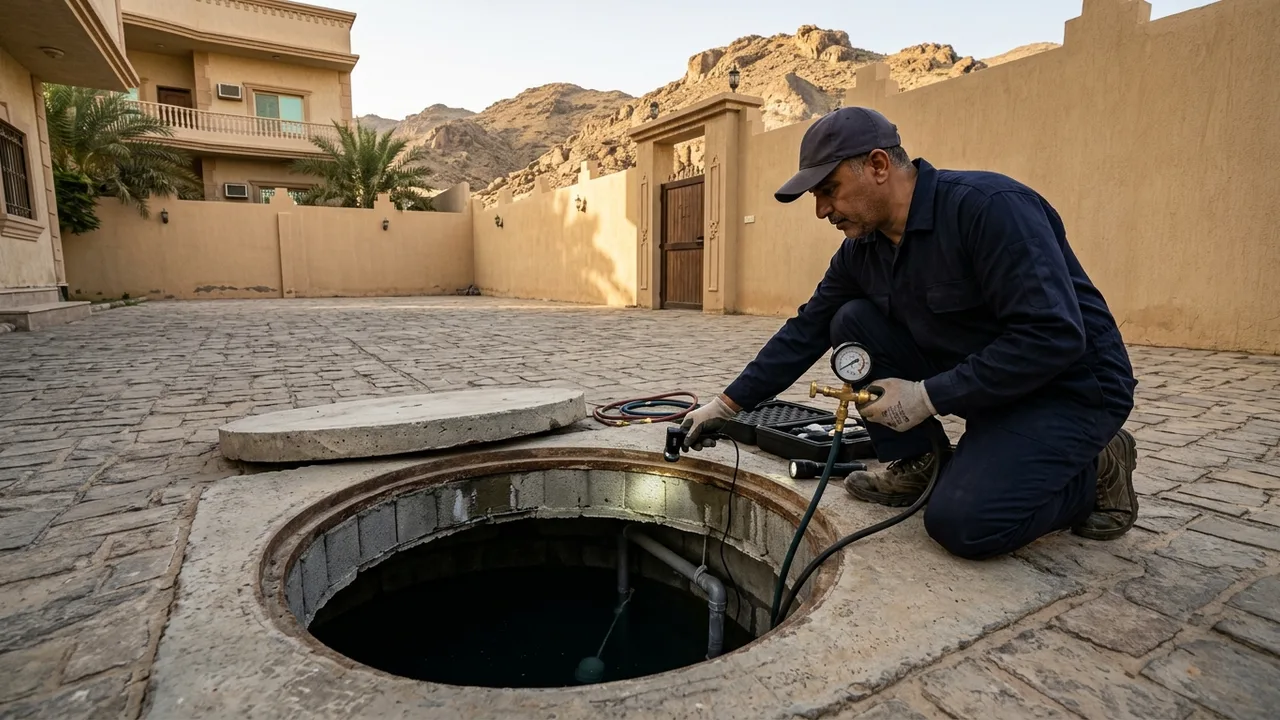
Why Underground Tank Leaks Are the #1 Cause of Massive Water Loss and Foundation Risk
Residential underground water tanks in Jeddah and Makkah typically hold 15 to 50 cubic meters (15,000–50,000 liters) of water. When a structural crack develops in the concrete wall, neck joint, or float valve, thousands of liters escape directly into the subsurface every day with zero visible indoor signs.
Beyond skyrocketing water bills and frequent tanker refills, continuous tank leakage erodes soil beneath courtyard paving and foundation grade beams, floods basements and elevator pits, and risks contaminating domestic water with saline groundwater.
At Bashaer Al Khair, we never recommend expensive full-tank recoating blindly. Our engineering diagnostic first verifies whether the water loss is actually caused by a simple float valve failure, an upper masonry neck gap, a suction foot-valve leak, or deep concrete wall cracking.
Key Field Symptoms & Physical Indicators Requiring Inspection:
Underground tank water level dropping rapidly despite normal household usage
Physical Mechanism: Direct outward water loss through cracks in the concrete walls/slab or a breach in the buried suction/distribution line.
Water overflowing around the tank manhole cover or continuous inflow sound when full
Physical Mechanism: A stuck mechanical float valve allows municipal water to keep flowing once the tank is full, escaping through the unsealed masonry neck into courtyard sand.
Salty taste, odor, or turbidity in tank water—or water level rising when shut off
Physical Mechanism: Inward seepage of saline subsurface groundwater through compromised exterior/interior tank waterproofing.
Sinking courtyard tiles around the tank hatch or persistent dampness near the cover
Physical Mechanism: Water escaping from the tank neck or roof slab joint washes away the surrounding sand bedding.
The 5 Engineering Causes of Underground & Overhead Tank Leaks
We inspect the tank as a complete hydraulic and structural system across five failure modes:
1. Cracking at the Underground Tank Masonry Neck & Roof Slab Joint
Tank access necks are often built with masonry blocks atop the concrete roof slab; thermal movement and courtyard traffic crack this cold joint, causing massive water loss whenever the tank fills near the top.
2. Faulty Float Valve Assembly or Leaking Meter-to-Tank Supply Pipe
Corroded float arms or worn valve seats fail to shut off incoming municipal flow, or the buried service pipe between the meter and tank is cracked.
3. Concrete Wall/Floor Cracks, Honeycombing, and Degraded Internal Lining
Concrete honeycombing, shrinkage cracks at wall-to-floor coving corners, or delaminated legacy epoxy/cementitious coatings allow hydrostatic water escape.
4. Leaking Booster Pump Suction Pipe or Faulty Foot Valve (Check Valve)
When the foot check valve at the bottom of the suction pipe fails, water from the overhead tank drains backward into the ground tank—causing it to overflow—or leaks through the buried suction pipe.
5. Overhead Rooftop Tank Cracks, Union Leaks, or Float Switch Failures
Rooftop fiberglass and polyethylene tanks suffer UV degradation at bulkhead fittings and float switches, spilling water onto the roof slab.
When to Request Water Tank Leak Inspection & Safety Rules
When Should You Schedule Inspection Immediately?
- Immediately upon receiving a high water bill or consumption spike alert.
- When you need to order water tanker refills more frequently than usual.
- If tap water develops a salty taste, odor, or discoloration.
- When dampness appears in the basement or courtyard tiles settle near the tank hatch.
Separating Meter-Line Breaks, Float/Neck Overflow, and Tank Shell Seepage in Jeddah
Float Valve, Tank Neck, or Check Valve
- • Tank is brim-full into the neck while meter spins.
- • Water escapes through unsealed masonry neck joints.
- Fix: Replace float/check valve & seal neck collar only.
Meter-to-Tank Pipe or Suction Line Leak
- • Meter spins even with tank inlet valve closed.
- • Tank water level itself holds steady when isolated.
- Fix: Acoustically pinpoint & repair the buried pipe break.
Concrete Wall/Floor Cracks or Groundwater Ingress
- • Tank water level drops with meter & pump shut off.
- • Or rising TDS salinity inside tank in coastal Jeddah.
- Fix: Drain tank, repair cracks & apply full internal waterproofing.
Illustrative engineering diagram only — exact leak coordinates and remediation scope are confirmed following on-site instrument inspection.
How We Execute Water Tank Leak Detection in Jeddah Across 7 Structured Steps
Inquiry Intake & Initial Symptom Triage
We document the observed symptoms (bill spike, ceiling drip, peeling paint, or tank drop), property type in Jeddah or Makkah, and approximate plumbing age to prepare the right diagnostic kit.
Site Walkthrough & Safety Verification
The technician inspects visible dampness zones and checks that moisture has not compromised electrical panels, wall switches, or structural ceiling slab integrity.
Network Isolation, Meter & Pressure Testing
We isolate cold and hot supply branches and tank lines, monitoring pressure gauges and meter flow to determine whether the fault lies in a pressurized line or unpressurized drainage/grout.
Multi-Instrument Acoustic, Thermal & Moisture Mapping
We deploy the appropriate instruments (acoustic sensors for pressurized lines, thermal cameras for ΔT mapping, and dielectric moisture meters for saturation peaks) to narrow the fault to the smallest footprint.
Cross-Verification & Differential Diagnosis
We cross-check instrument readings to rule out non-pipe causes such as AC duct condensation, coastal capillary rising damp in Jeddah, or degraded shower tile grout.
Transparent On-Site Findings Briefing
We walk the client through the exact fault location, root cause, and whether remediation requires localized plumbing access (e.g., 1–2 tiles) or surface waterproofing treatment.
Actionable Remediation & Waterproofing Roadmap
We outline a prioritized remediation plan: stopping the active water source first, allowing substrate drying where required, and applying targeted waterproofing or plumbing repair.
Engineering Technologies Deployed for Water Tank Leak Detection in Jeddah
Tank diagnostics combine mechanical isolation testing (shutting off meter inflow and pump suction to measure static water level retention) with internal structural inspection of the neck, walls, and floor.
Water Meter Flow & Staged Valve Isolation Audit
Scientific Principle: Monitors the low-flow indicator on the water meter while sequentially closing isolation valves (main tank inlet, float valve, booster pump, floor manifolds) to isolate silent consumption to a specific building zone.
- • Investigating sudden high water bill spikes where no indoor dampness is visible
- • Detecting underground leaks in the service pipe between the external meter and ground tank
- • Identifying silent continuous overflow from tank float valves and toilet cisterns
- • Requires temporary cessation of household water use during the isolation window
- • Leaks occurring through the concrete walls of the ground tank after the float valve require static water-level drop measurement inside the tank itself
Hydrostatic & Pneumatic Line Pressure Testing
Scientific Principle: A specific supply branch (cold, hot, or pool circulation line) is isolated and capped, then pressurized with a calibrated manometer gauge; any pressure decay over the holding period confirms a breach in that exact circuit.
- • Definitively separating pressurized supply pipe failures from drainage or grout seepage in bathrooms and kitchens
- • Verifying the integrity of the main buried line between the water meter and underground tank
- • Independently testing swimming pool skimmer, return, and main drain lines apart from the concrete shell
- • Test pressure must never exceed safe operating limits for aging pipes to avoid stressing intact joints
- • Worn angle valves or mixer cartridges can cause false pressure drops unless outlets are properly plugged during the test
Engineering Visual Inspection, Borescope & Flood Testing
Scientific Principle: Combines systematic inspection of grout joints, drain throats, tank necks, and plumbing shafts with flexible borescope cameras for concealed cavities and controlled flood/dye testing for unpressurized floor drains.
- • Inspecting above suspended gypsum ceilings and inside narrow pipe chases without demolition
- • Testing shower pan grout, floor drain seals, and toilet base connections
- • Examining concrete cracks, honeycombing, and neck joints inside water tanks and pools
- • Borescope cameras require an existing small aperture (e.g., spotlight cutout or access hatch) and cannot penetrate solid mortar
- • Controlled flood testing of wet-area floors requires sufficient observation time to confirm seepage migration
Dielectric & Pin Moisture Meters
Scientific Principle: Non-invasive dielectric meters measure changes in the electrical permittivity of building materials (concrete, plaster, gypsum, tile beds) up to 20–40 mm deep to quantify relative moisture saturation against dry baseline zones.
- • Locating the highest moisture concentration point along peeling lower walls and skirting boards
- • Distinguishing historic dried stains from active ongoing leaks in ceilings
- • Checking sub-tile saturation around shower drains, bathtubs, and bathroom thresholds
- • Dense steel rebar or shallow electrical conduits can influence capacitance readings, requiring dry-wall baseline calibration
- • Confirms moisture presence and gradient direction, but must be paired with line isolation to distinguish supply vs. drainage sources
Acoustic Listening & Ground Microphones
Scientific Principle: Ground microphones and contact acoustic sensors amplify specific frequency vibrations generated when pressurized water escapes through a pipe crack or fitting joint, filtering ambient noise to locate the peak decibel point.
- • Pressurized water supply lines beneath ceramic and porcelain floor tiles
- • Buried external supply pipes under courtyard pavers and walkways
- • Pinpointing active leaks in pressurized PPR and metallic pipes inside walls
- • Requires sufficient internal line pressure to generate acoustic turbulence; it cannot detect unpressurized gravity drainage leaks on its own
- • Ambient noise from booster pumps, AC compressors, or street traffic must be isolated during measurement
- • Deep burial or thick insulation layers can attenuate acoustic signals, requiring correlation with pressure testing
Service Scope: Tank Leak Detection vs. Valve/Pipe Repair vs. Tank Waterproofing
Tank Leak Detection: Determining whether water loss occurs upstream (meter line), at the top (float valve/neck), downstream (pump suction line), or through the concrete tank shell.
Mechanical & Plumbing Repair: Replacing the float valve, fixing the pump foot check valve, or repairing the external supply/suction pipe.
Tank Crack Repair & Waterproofing: When structural cracks, honeycombing, or failed internal linings are confirmed, the tank is drained, repaired with hydraulic mortars, and coated with epoxy or flexible cementitious waterproofing.
Resolution Options After Water Tank Leak Detection
Finding 1: Leaking float valve or backflowing pump check valve while concrete shell is sound
Zero breaking or excavation required.Recommended Action: Install a heavy-duty float valve adjusted below the neck joint or replace the foot check valve, then verify meter stability.
Finding 2: Leak restricted to the upper tank neck and neck-to-roof joint
Internal neck work without breaking courtyard tiles.Recommended Action: Partially lower water level, strip loose render inside the neck collar, and seal with non-shrink hydraulic mortar and waterproofing.
Finding 3: Structural cracks/honeycombing in tank walls/floor or inward groundwater seepage
Performed entirely inside the tank through the manhole hatch.Recommended Action: Pump out, clean, and dry the tank, rout and seal structural cracks, and apply multi-coat internal waterproofing.
Separating Outward Tank Leaks, Inward Groundwater Seepage, and Pipe Failures
The diagnostic table below explains how our engineers isolate the exact tank mechanism:
| Condition / Fault Type | Physical & Visual Signs | Instrument Reading Pattern | Correct Engineering Fix |
|---|---|---|---|
| Outward Leak Through Concrete Tank Walls/Floor | Water level inside the tank drops steadily even when the booster pump and meter inlet are shut off. | Static level test records measurable drop (cm/hr) + internal inspection reveals cracks or coating failure. | Drain tank, repair cracks, and apply internal waterproofing. |
| Tank Neck Leak or Float Valve Overflow Only | Water drops rapidly when filled to the top, then stabilizes once the level falls below the neck joint. | Water level holds steady below roof slab line + visible gaps in neck masonry and faulty float shut-off. | Replace float valve and waterproof the tank neck collar. |
| Inward Saline Groundwater Seepage (Coastal Jeddah) | Brackish water taste, white salt weeping lines on internal walls, and level rising when tank is low. | Elevated TDS/salinity reading inside the tank compared to incoming municipal meter water. | Stop active weeping with hydraulic plug mortar and apply negative/positive-pressure waterproofing. |
In Jeddah, underground tanks face a dual challenge: outward loss of treated municipal water driving up bills, and inward infiltration of brackish coastal groundwater (Sabkha) contaminating the tank.
In Obhur, Al-Shati, Al-Hamra, Al-Marjan, Al-Basateen, and Al-Salamah, shallow saline groundwater surrounds underground tank walls externally—corroding roof/neck rebar and seeping inward whenever tank water levels drop.
Most Jeddah villas locate the underground tank beneath the courtyard car parking bay, subjecting the tank neck and roof slab to daily vehicle wheel loads.
Fluctuating municipal supply pressures in Jeddah test ground-tank float valves; if a float fails to seat, water overflows silently through the neck into courtyard sand.
High humidity and salinity inside Jeddah tank headspaces rapidly corrode metallic float arms and bolts.
Common Property Scenarios We Inspect Across Jeddah:
- Coastal & North Jeddah Villas: Sudden salty taste in household tap water or high water bills without visible leaks. — Comparing TDS salinity between the street meter and tank interior while inspecting the float valve, neck joint, and walls.
- Apartment Buildings in Central, East & South Jeddah: Rapid ground-tank depletion accompanied by sinking entrance tiles around the manhole. — Pressure-testing meter and pump lines, measuring static level drop, and inspecting the internal concrete shell.
Jeddah Field Scenario: High Bill & Tile Settlement Around a Villa Tank in Al-Marjan
A villa owner in Al-Marjan saw his water bill double alongside slight tile settlement in the carport next to the tank cover.
Our inspection proved the lower concrete tank walls and floor were 100% water-tight, but a bent float valve arm allowed water to rise into the unsealed masonry neck collar and escape into the carport sand bed.
Replacing the float valve and waterproofing only the upper neck collar stopped the water loss completely without needing full tank recoating.
District Clusters Served for Water Tank Leak Detection in Jeddah:
Water Tank Leak Inspection Cost Factors in Jeddah & Makkah
Tank inspection pricing depends on the following factors:
- Type and number of tanks (single underground villa tank vs. ground tank + multiple rooftop tanks).
- Whether the audit is performed filled (meter, float, neck, suction line, and static drop test) or includes dewatering for internal concrete entry.
- Tank capacity and compartment count (standard residential vs. multi-chamber commercial/apartment reservoir).
- Length of the buried meter-to-tank service line requiring pressure testing.
Preparing Your Water Tank Before the Technician Arrives
Following these simple preparation steps helps our field engineer complete accurate readings faster:
- 1Clear the area over the underground tank manhole cover (move parked cars or planters off the hatch).
- 2Do not drain the tank before the initial diagnostic visit—having water in the tank is essential to test the float valve, neck joint, and static drop rate.
- 3Ensure access to the street water meter box and the booster pump power switch.
- 4Have recent water bill history or tanker refill intervals ready for reference.
What If Diagnostics Confirm Waterproofing Is Needed?
When tank diagnostics confirm concrete cracks, failed linings, or groundwater seepage, Bashaer Al Khair executes complete internal tank crack remediation and waterproofing.
Related Leak Detection Services in Jeddah:
Common Questions About Water Tank Leak Detection in Jeddah
How do I know if my underground tank in Jeddah is leaking from the float valve or a concrete crack?
If the street water meter keeps spinning while the tank is brim-full or overflowing, the float valve or neck is at fault. If you shut off the meter inlet and booster pump and the water level inside the tank still drops, the concrete shell or suction line is leaking.
Our tap water in Jeddah suddenly turned salty—is that caused by an underground tank leak?
Yes. In coastal Jeddah districts, sudden brackish tap water almost always indicates that saline groundwater is seeping inward through cracks in the underground tank wall or neck—which we verify by comparing TDS readings at the meter vs. inside the tank.
Does the underground tank need to be completely drained before the first inspection visit in Jeddah?
No. For the initial diagnostic visit, having water inside the tank helps us test the float valve, meter line, pump suction, neck joint, and drop rate. Draining is only scheduled when internal entry or waterproofing execution is required.
What is the "tank neck" and why does it leak so often in Jeddah?
The tank neck is the upper collar between the concrete tank roof slab and the courtyard manhole frame, usually built of masonry block. Whenever water rises into an unsealed neck (due to high fill level or a faulty float), it pours directly into the surrounding sand bed.
Does water draining back from the roof tank into the ground tank cause overflow and high bills?
Yes. If the pump check valve/foot valve fails, water from the rooftop tank drains backward by gravity into an already full ground tank—causing continuous neck overflow and endless pump cycling.
Do you also inspect rooftop fiberglass and polyethylene water tanks in Jeddah?
Yes, we inspect rooftop storage tanks, bulkhead unions, manifold valves, and electric/mechanical float switches that can leak onto roof slabs.
Diagnostic & Engineering Comparison Guides to Help You Decide
Sudden High Water Bill Causes in Jeddah & Makkah: Step-by-Step Meter, Float Valve & Underground Tank Diagnostic Guide
When your monthly water bill doubles or triples with no change in household occupancy and zero visible dampness indoors, water is almost certainly escaping silently underground or directly into a drain line—here is how to isolate the culprit step by step.
Underground Water Tank Level Drop & Salinity Intrusion in Jeddah & Makkah: Engineering Diagnosis & Permanent Remediation
Whether your underground tank empties rapidly forcing frequent water-tanker deliveries, or your household tap water in coastal Jeddah suddenly turns brackish and corrodes fixtures—the root cause lies in underground tank structural cracks and waterproofing failure.
Lower Wall Dampness & Peeling Paint Causes: How to Distinguish Plumbing Leaks from Rising Damp
Paint blistering or white crystalline salt deposits 15 to 60 cm above floor skirting boards are never a cosmetic issue solved by repainting—they are physical indicators of active moisture migration that must be traced at the source.
Water Leaking from the Bathroom Ceiling: How to Pinpoint the Exact Source Upstairs Without Random Demolition
When yellow stains or active water drops appear on your bathroom ceiling or gypsum soffit, the source lies in the wet area directly above—but is the culprit a pressurized supply pipe, a drainage elbow, eroded tile grout, or a breached slab membrane?
Water Tank Leak Detection in Makkah
View our dedicated Water Tank Leak Detection guide tailored to Makkah properties.
View Makkah PageAll Leak Detection Services in Jeddah:
Submit Your Issue Details to Coordinate an Inspection or Quote
Complete the fields below accurately. Your submission is validated and assigned a unique reference ID, with a ready-to-share technical summary.