
Underground & External Pipe Leak Detection in Makkah — Engineering Diagnostics for Buried Pipelines
We locate leaks in buried exterior supply lines beneath tiled courtyards and perimeter walkways in Makkah using hydrostatic isolation, acoustic ground microphones, and safe tracer gas—accounting for rocky backfill stress and grade slopes.
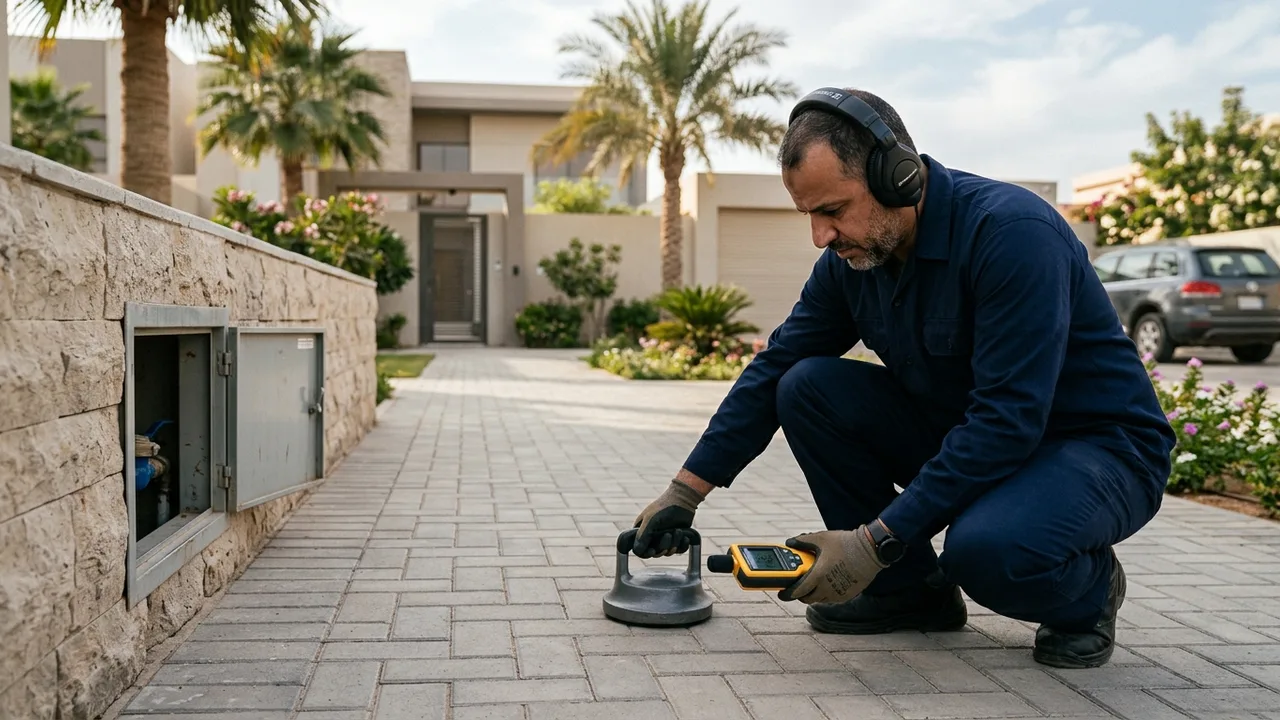
Why Buried Exterior Pipeline Leaks Are Invisible Until Major Damage Occurs
Beneath the courtyard pavers and side walkways of every villa or building lies a critical network of pipes buried 30 to 80 cm deep: running from the boundary-wall water meter to the underground tank, from the tank to the booster pump, into the building manifold, and out to garden irrigation and wash taps.
When a buried yard pipe fractures, escaping water often percolates straight down into the soil without ever ponding on the surface. The leak can run silently for months until triggered by a massive water bill spike, sudden settlement of carport pavers, or dampness along the boundary wall.
Trenching blindly along the entire pipeline path destroys courtyard landscaping and paving. Bashaer Al Khair uses calibrated pressure gauges, ground microphones, and safe tracer gas to pinpoint the exact square foot of the break before a single paver is lifted.
Key Field Symptoms & Physical Indicators Requiring Inspection:
Street water meter spinning continuously even when the underground tank float valve is closed
Physical Mechanism: A rupture or uncoupled joint in the buried service line between the street meter box and the underground tank inlet.
Sinking, dipping, or undulating interlock pavers or ceramic tiles in the courtyard or carport
Physical Mechanism: Water escaping from a buried supply pipe washes away the sub-base sand bedding, creating a subterranean void beneath the paving.
A specific patch of courtyard grout or garden soil remaining perpetually wet or mossy in dry weather
Physical Mechanism: Upward capillary migration of water escaping from a pressurized buried branch or irrigation valve.
Booster pump running continuously while indoor water pressure drops noticeably
Physical Mechanism: A significant portion of the booster pump’s discharge is escaping through a cracked buried yard pipe before reaching indoor risers.
Engineering Causes of Buried Exterior Pipeline Failures
Buried exterior pipelines endure severe mechanical and environmental stresses that we evaluate on site:
1. Shear Stress Where Pipes Penetrate Concrete Grade Beams and Boundary Walls
When a pipe passes rigidly through a concrete grade beam while the surrounding courtyard backfill settles even 1–2 cm, shear force snaps the pipe right at the beam face.
2. Vehicle Wheel Loads & Sharp Backfill Stones Over Unsleeved Pipes
Laying pipes at shallow depth beneath carports or backfilling with sharp stones without protective sleeves causes point-load fractures under vehicle traffic.
3. Corrosion of Legacy Galvanized Fittings or Failed PVC Solvent Joints
Transition unions between galvanized iron and plastic corrode in saline soil, while solvent-welded PVC couplings can slip under pump pressure spikes.
4. Leaking Landscape Irrigation Solenoid Valves and Planter Bed Lines
Automated garden irrigation lines tied into the main booster line frequently crack from tree root intrusion or faulty solenoid valves.
When to Request Underground Pipe Leak Inspection & Safety Alerts
When Should You Schedule Inspection Immediately?
- When the external water meter spins even after shutting off the main building valve and tank float.
- When courtyard tiles or interlock pavers begin sinking or water pools along the boundary wall.
- When indoor water pressure drops despite the booster pump running normally.
- Prior to repaving a courtyard or installing new interlock so buried lines are verified first.
Comparison of Leak Detection Instruments & Why We Combine Them in Makkah
| Diagnostic Instrument | Primary Target | Effective Depth / Scope | Why We Pair It With Other Tools |
|---|---|---|---|
| Digital Acoustic Ground Sensor | Pressurized supply pipes beneath tiles & courtyards | Up to 1.5–2.0 m through screed & soil | Cannot hear non-pressurized gravity drains; paired with pressure & borescope. |
| Thermal Imaging Camera (ΔT) | Hot-water PPR lines, ceiling ingress & sub-tile dampness | Surface thermal profile & immediate sub-tile zone | Reads surface ΔT rather than deep buried water; verified with moisture & pressure gauges. |
| Dielectric Moisture Meter | Locating peak moisture saturation behind tiles & paint | Up to 40–50 mm into plaster, screed & concrete | Quantifies dampness but not which pipe is leaking; combined with line isolation. |
| Hydrostatic Pressure Manometer | Proving tightness of cold, hot & pool pipe circuits | Tests the entire isolated pipe run regardless of depth | Proves a line is leaking; acoustic & thermal tools then pinpoint the exact coordinate. |
Illustrative engineering diagram only — exact leak coordinates and remediation scope are confirmed following on-site instrument inspection.
How We Execute Underground & External Pipe Leak Detection in Makkah Across 7 Structured Steps
Inquiry Intake & Initial Symptom Triage
We document the observed symptoms (bill spike, ceiling drip, peeling paint, or tank drop), property type in Jeddah or Makkah, and approximate plumbing age to prepare the right diagnostic kit.
Site Walkthrough & Safety Verification
The technician inspects visible dampness zones and checks that moisture has not compromised electrical panels, wall switches, or structural ceiling slab integrity.
Network Isolation, Meter & Pressure Testing
We isolate cold and hot supply branches and tank lines, monitoring pressure gauges and meter flow to determine whether the fault lies in a pressurized line or unpressurized drainage/grout.
Multi-Instrument Acoustic, Thermal & Moisture Mapping
We deploy the appropriate instruments (acoustic sensors for pressurized lines, thermal cameras for ΔT mapping, and dielectric moisture meters for saturation peaks) to narrow the fault to the smallest footprint.
Cross-Verification & Differential Diagnosis
We cross-check instrument readings to rule out non-pipe causes such as AC duct condensation, coastal capillary rising damp in Jeddah, or degraded shower tile grout.
Transparent On-Site Findings Briefing
We walk the client through the exact fault location, root cause, and whether remediation requires localized plumbing access (e.g., 1–2 tiles) or surface waterproofing treatment.
Actionable Remediation & Waterproofing Roadmap
We outline a prioritized remediation plan: stopping the active water source first, allowing substrate drying where required, and applying targeted waterproofing or plumbing repair.
Engineering Technologies Deployed for Underground & External Pipe Leak Detection in Makkah
For exterior pipelines buried beneath concrete slabs or interlock pavers, we pair hydrostatic testing with heavy-duty wind-shielded ground bells that block street noise, supplemented by safe tracer gas on deep runs.
Water Meter Flow & Staged Valve Isolation Audit
Scientific Principle: Monitors the low-flow indicator on the water meter while sequentially closing isolation valves (main tank inlet, float valve, booster pump, floor manifolds) to isolate silent consumption to a specific building zone.
- • Investigating sudden high water bill spikes where no indoor dampness is visible
- • Detecting underground leaks in the service pipe between the external meter and ground tank
- • Identifying silent continuous overflow from tank float valves and toilet cisterns
- • Requires temporary cessation of household water use during the isolation window
- • Leaks occurring through the concrete walls of the ground tank after the float valve require static water-level drop measurement inside the tank itself
Hydrostatic & Pneumatic Line Pressure Testing
Scientific Principle: A specific supply branch (cold, hot, or pool circulation line) is isolated and capped, then pressurized with a calibrated manometer gauge; any pressure decay over the holding period confirms a breach in that exact circuit.
- • Definitively separating pressurized supply pipe failures from drainage or grout seepage in bathrooms and kitchens
- • Verifying the integrity of the main buried line between the water meter and underground tank
- • Independently testing swimming pool skimmer, return, and main drain lines apart from the concrete shell
- • Test pressure must never exceed safe operating limits for aging pipes to avoid stressing intact joints
- • Worn angle valves or mixer cartridges can cause false pressure drops unless outlets are properly plugged during the test
Acoustic Listening & Ground Microphones
Scientific Principle: Ground microphones and contact acoustic sensors amplify specific frequency vibrations generated when pressurized water escapes through a pipe crack or fitting joint, filtering ambient noise to locate the peak decibel point.
- • Pressurized water supply lines beneath ceramic and porcelain floor tiles
- • Buried external supply pipes under courtyard pavers and walkways
- • Pinpointing active leaks in pressurized PPR and metallic pipes inside walls
- • Requires sufficient internal line pressure to generate acoustic turbulence; it cannot detect unpressurized gravity drainage leaks on its own
- • Ambient noise from booster pumps, AC compressors, or street traffic must be isolated during measurement
- • Deep burial or thick insulation layers can attenuate acoustic signals, requiring correlation with pressure testing
Safe Tracer Gas Inspection for Deep Buried Lines
Scientific Principle: For deeply buried external pipelines or thick slabs where acoustic signals are muffled, the drained line is charged with a safe, non-toxic inert gas blend (95% nitrogen / 5% hydrogen); lightweight molecules escape the breach and rise to the surface detector.
- • Long exterior supply runs buried beneath thick courtyard concrete or paving
- • Deeply buried swimming pool manifolds where acoustic listening is inconclusive
- • Micro-leaks causing slow pressure decay without audible acoustic turbulence
- • Not required for routine indoor fixture leaks; reserved for complex buried lines that must first be drained of water
- • Subsurface vapor barriers can cause lateral gas migration toward the nearest tile joint, requiring experienced correlation with pipe routing
Dielectric & Pin Moisture Meters
Scientific Principle: Non-invasive dielectric meters measure changes in the electrical permittivity of building materials (concrete, plaster, gypsum, tile beds) up to 20–40 mm deep to quantify relative moisture saturation against dry baseline zones.
- • Locating the highest moisture concentration point along peeling lower walls and skirting boards
- • Distinguishing historic dried stains from active ongoing leaks in ceilings
- • Checking sub-tile saturation around shower drains, bathtubs, and bathroom thresholds
- • Dense steel rebar or shallow electrical conduits can influence capacitance readings, requiring dry-wall baseline calibration
- • Confirms moisture presence and gradient direction, but must be paired with line isolation to distinguish supply vs. drainage sources
Service Scope: Underground Pipe Detection vs. Localized Excavation Repair
Underground Pipe Detection: Identifying which buried exterior circuit has failed (meter line, suction line, delivery line, or irrigation) and marking the exact surface spot above the break.
Localized Buried Pipe Repair: Lifting pavers only at the marked square, carefully hand-excavating around the pipe, repairing and pressure-testing the joint, backfilling with clean sand, and resetting pavers.
Waterproofing Protection: If a buried pipe leak has compromised an adjacent basement retaining wall or underground tank neck, we provide targeted waterproofing remediation once the pipe is fixed.
Resolution Pathways After Pinpointing a Buried Pipe Leak
Finding 1: Localized break in a buried PPR or PVC pipe beneath courtyard tiles or interlock
Strictly localized square directly over the break.Recommended Action: Lift the marked pavers/tiles, repair the pipe section with a protective sleeve and soft sand bedding, pressure-test, and relay the paving.
Finding 2: Leak in the meter-to-tank service line where it penetrates the boundary wall
Small localized opening at the wall penetration point.Recommended Action: Expose the pipe locally behind the meter box or at the tank neck entry, repair the joint, and sleeve it through the wall to prevent future shear.
Finding 3: Leak in the garden irrigation branch or exterior wash-tap manifold
In soil planter beds with zero tile breaking.Recommended Action: Install/close a dedicated isolation valve on the irrigation loop and repair the leaking planter fitting.
Separating Meter-Line Leaks, Booster-Line Leaks, and Ground-Tank Leaks
Staged valve isolation identifies which buried courtyard line is leaking within minutes:
| Condition / Fault Type | Physical & Visual Signs | Instrument Reading Pattern | Correct Engineering Fix |
|---|---|---|---|
| Meter-to-Tank Service Line Leak | The street water meter continues spinning even when the underground tank float valve is held completely shut. | Pressure decay between meter and tank inlet + acoustic signal beneath the entrance paving. | Pinpoint and repair the breach along the meter-to-tank corridor. |
| Buried Booster-Pump Delivery Line Leak | The booster pump cycles on every few minutes even after closing the main indoor manifold shut-off valve. | Pressure drop isolated to the yard segment between pump and building + ground microphone peak. | Pinpoint the cracked yard elbow and perform localized excavation repair. |
| Underground Tank Structural Shell Leak | Meter stops when float is closed and pump line holds pressure, yet tank water level still drops. | All buried pipelines pass pressure testing + static tank level test records steady drop. | Remediate and waterproof the tank interior without digging up the courtyard. |
In Makkah, buried exterior water lines traverse rocky substrates, uneven mountain backfill, and sloped grades that subject pipes to high mechanical point loads.
Across Makkah villas and buildings (Al-Awali, Al-Shawqiyah, Batha Quraish, Al-Shara’i, Al-Aziziyah, Wali Al-Ahd), angular rock fragments in sub-paver backfill can puncture buried pipes over time.
Steep elevation steps between street level and building courtyards in sloped Makkah districts require multiple vertical/horizontal pipe bends that experience high thrust stress.
High discharge pressures from ground-level booster pumps pushing water to tall Makkah rooftops stress buried courtyard delivery lines.
Water escaping a buried pipe over Makkah bedrock flows laterally along the rock face toward retaining walls and boundary foundations.
Common Property Scenarios We Inspect Across Makkah:
- Villa Courtyards in Al-Awali, Al-Shara’i, Batha Quraish & Wali Al-Ahd: Rapid ground-tank depletion and continuous booster pump cycling with dampness along the boundary wall. — Isolating and pressure-testing the buried booster delivery line and scanning courtyard tiles acoustically.
- Apartment Building Entrances in Al-Shawqiyah, Al-Aziziyah & Al-Naseem: Leak in the main meter-to-tank service line buried beneath the building entrance or parking area. — Pressure-testing the main meter line and pinpointing the fault with acoustic sensors or tracer gas without demolishing the entrance.
Makkah Field Scenario: Buried Pump Delivery Line Leak in Wali Al-Ahd
A villa owner in Wali Al-Ahd noticed the ground-tank booster pump cycling every 5 minutes and emptying the tank in two days, with dampness appearing at the base of the courtyard retaining wall.
Our technician closed the main indoor entry valve and confirmed pressure still dropped on the yard line; ground microphone scanning along the side walkway pinpointed a single tile where a sharp rock in the backfill had punctured the PPR pipe.
Only one courtyard tile was opened, the sharp stone was removed, the PPR pipe was fused and bedded in clean sand, and pump pressure stabilized completely.
District Clusters Served for Underground & External Pipe Leak Detection in Makkah:
Underground Pipe Leak Inspection Cost Factors in Jeddah & Makkah
Field diagnostic pricing for buried exterior lines depends on:
- Total pipeline run length and courtyard area (standard villa vs. large estate, compound, or commercial warehouse).
- Burial depth and surface paving type (interlock pavers, ceramic tiles, thick reinforced concrete, or asphalt).
- Number of buried yard branches requiring independent isolation (meter line, pump line, annex feed, irrigation).
- Requirement for safe tracer gas injection on deeply buried or sound-muffled runs.
Preparing Your Courtyard Before Underground Pipe Leak Detection
Following these simple preparation steps helps our field engineer complete accurate readings faster:
- 1Move cars parked in the courtyard or driveway off the pipeline path between the meter, tank, and building.
- 2Ensure clear access to the exterior water meter box, underground tank cover, and booster pump.
- 3Turn off garden irrigation sprinklers at least 2 hours prior to the visit.
- 4Inform the technician of any previous courtyard excavations or annex additions.
What If Diagnostics Confirm Waterproofing Is Needed?
Once buried exterior pipe leaks are repaired, if adjacent tank necks, basement walls, or planter boxes require waterproofing protection, our team provides targeted foundation and tank waterproofing.
Related Leak Detection Services in Makkah:
Common Questions About Underground & External Pipe Leak Detection in Makkah
How do you trace a water pipe buried beneath a thick concrete courtyard slab in Makkah?
We isolate the line under controlled test pressure to amplify acoustic turbulence for our ground sensors, and where thick concrete muffles sound, we purge the line and inject safe tracer gas to pinpoint the breach.
Why do buried courtyard pipes frequently crack in rocky sloped districts of Makkah?
Because pipe trenches in rocky districts are often backfilled with excavated stone fragments without a protective cushion of soft sweet sand around the pipe.
Water is seeping out from the bottom of my villa boundary wall onto the street in Makkah—what is the source?
On Makkah’s sloped rock terrain, water emerging at the lower boundary wall typically originates from a buried meter/pump/irrigation pipe leak inside the yard or ground-tank seepage flowing downslope along the bedrock.
Do you inspect buried supply lines feeding exterior annexes and driver rooms in Makkah?
Yes, we isolate and test all buried yard branches feeding exterior majlis annexes, driver/guard rooms, outdoor washrooms, and courtyard taps.
Do we have to trench the entire pipe run across the courtyard in Makkah to fix a leak?
No. Excavation is restricted to the single localized spot marked by our instruments; full line replacement is only advised if legacy galvanized iron piping has corroded throughout.
How do I book an underground pipe leak inspection in Makkah?
Use the quick inspection form on this page or our verified contact channels to share your Makkah district and schedule an engineer visit.
Diagnostic & Engineering Comparison Guides to Help You Decide
Sudden High Water Bill Causes in Jeddah & Makkah: Step-by-Step Meter, Float Valve & Underground Tank Diagnostic Guide
When your monthly water bill doubles or triples with no change in household occupancy and zero visible dampness indoors, water is almost certainly escaping silently underground or directly into a drain line—here is how to isolate the culprit step by step.
Lower Wall Dampness & Peeling Paint Causes: How to Distinguish Plumbing Leaks from Rising Damp
Paint blistering or white crystalline salt deposits 15 to 60 cm above floor skirting boards are never a cosmetic issue solved by repainting—they are physical indicators of active moisture migration that must be traced at the source.
Water Leaking from the Bathroom Ceiling: How to Pinpoint the Exact Source Upstairs Without Random Demolition
When yellow stains or active water drops appear on your bathroom ceiling or gypsum soffit, the source lies in the wet area directly above—but is the culprit a pressurized supply pipe, a drainage elbow, eroded tile grout, or a breached slab membrane?
Swimming Pool Water Level Drop in Jeddah & Makkah: How to Scientifically Separate Evaporation from Plumbing & Shell Leaks
Every outdoor pool loses water to evaporation under the intense heat of Jeddah and Makkah—but when does daily water loss cross the engineering threshold into an active skimmer, light conduit, filtration pipe, or structural shell leak?
Underground & External Pipe Leak Detection in Jeddah
View our dedicated Underground & External Pipe Leak Detection guide tailored to Jeddah properties.
View Jeddah PageAll Leak Detection Services in Makkah:
Submit Your Issue Details to Coordinate an Inspection or Quote
Complete the fields below accurately. Your submission is validated and assigned a unique reference ID, with a ready-to-share technical summary.