
Bathroom Leak Detection in Makkah — Accurate Inter-Floor & Wet-Area Leak Diagnostics
We resolve bathroom ceiling drips and adjacent bedroom wall dampness across Makkah apartments and villas through a structured diagnostic protocol testing supply pressure, drain traps, and tile grout integrity.
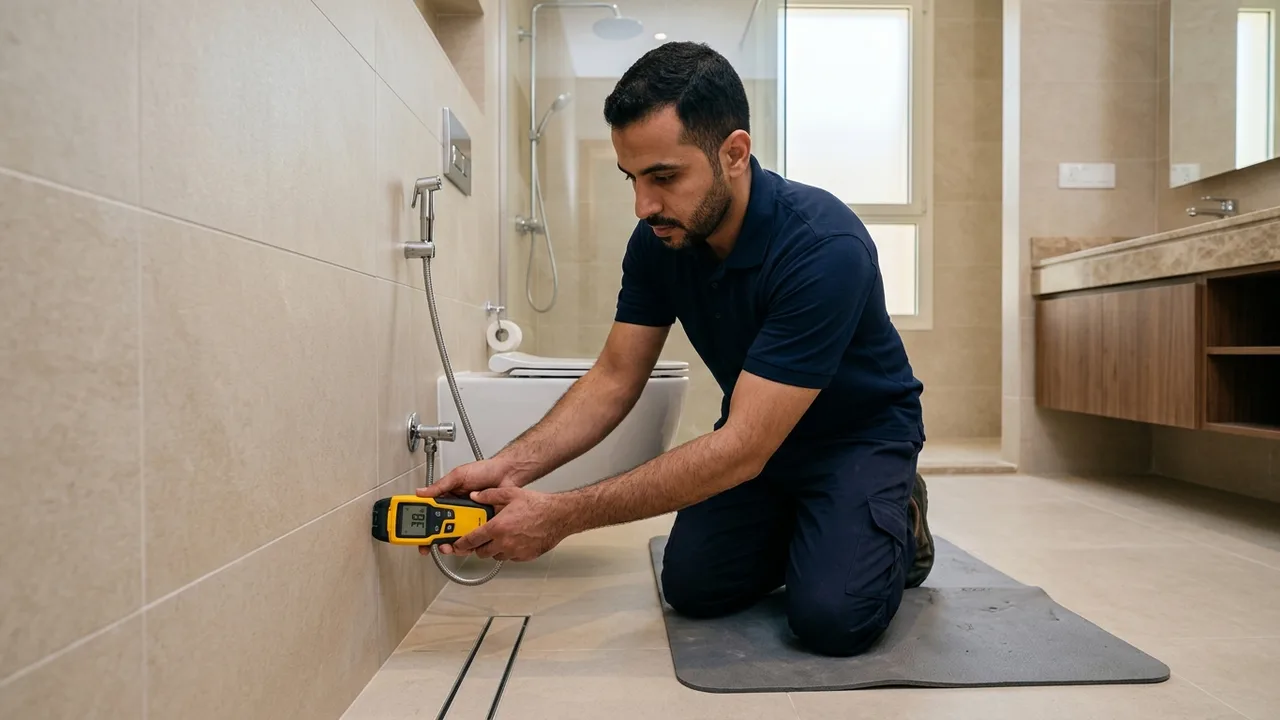
Why Bathroom Leaks Are the Most Complex Residential Diagnostic Challenge
When water drips from a downstairs bathroom ceiling or paint blisters on an adjacent bedroom wall, property owners often face two costly mistakes: either hiring a plumber who demolishes the entire bathroom floor blindly, or applying superficial grout sealant while a pressurized hot-water pipe continues leaking underneath.
Bathroom diagnostics are uniquely complex because three distinct hydraulic systems overlap within a few square meters: (1) 24/7 pressurized hot and cold supply pipes, (2) unpressurized gravity waste lines active only during fixture use, and (3) surface tile grout, sand bedding, and the underlying waterproofing membrane.
At Bashaer Al Khair, we audit each of these three layers sequentially—giving you certainty on whether the fault requires a localized plumbing fitting repair or non-destructive grout and drain sealing.
Key Field Symptoms & Physical Indicators Requiring Inspection:
Water dripping through the downstairs bathroom ceiling or rusting suspended ceiling frames
Physical Mechanism: Water pooling on top of the structural slab beneath the upper bathroom tiles and penetrating through pipe sleeves or concrete micro-cracks.
Peeling paint and crumbling plaster on the bedroom or hallway wall behind the shower or vanity
Physical Mechanism: Seepage from a concealed shower mixer elbow, angle valve thread, or open wall-tile grout joints saturating the shared masonry partition.
Darkened or missing tile grout, hollow tile sounds, or water squeezing up between floor tiles
Physical Mechanism: Complete saturation of the mortar/sand bed trapped between the structural slab waterproofing and the ceramic floor tiles.
Continuous faint water trickle inside the toilet bowl or dampness around the toilet base
Physical Mechanism: A worn cistern flapper wastes clean supply water into the drain, while a failed wax/rubber pan connector leaks waste water beneath the floor tiles.
The 6 Technical Causes of Bathroom Leaks & How We Verify Each One
During our on-site bathroom inspection, our technician tests these six potential sources in strict engineering order:
1. Pressurized Hot or Cold Supply Pipes & Concealed Brass Elbows
Extension nipples on concealed mixers, angle valve threads, and PPR hot-water welds experience thermal cycling and torque stress that cause continuous in-wall or sub-floor leaks.
2. Floor Drain Throat (Gully Trap) Collar Gaps
Mortar around the floor drain riser ring frequently erodes between the tile surface and the PVC trap body, allowing shower water to bypass the drain directly into the sand bed.
3. Deteriorated Tile Grout in Shower Zones & Wall-to-Floor Corners
Acidic bathroom cleaners dissolve conventional cement grout, creating open channels for daily shower water to saturate the sub-tile bedding.
4. Toilet Pan Connector Seal, Eastern Squat Trap, or Concealed Cistern Leak
Misaligned rubber pan connectors beneath Western toilets, perimeter cracks around squat toilets, or leaking flush-pipe seals on concealed wall cisterns.
5. Sub-Floor PVC Waste Branch Leaks (Lavatory, Washing Machine, or Bathtub)
Unbonded PVC solvent joints beneath the floor or partial blockages causing waste water to back up and seep through slip joints.
6. Failure of the Primary Slab Waterproofing Membrane Beneath the Sand Bed
When sub-tile sand becomes waterlogged and the underlying bitumen/cementitious slab membrane is punctured or lacks proper threshold upturns, water escapes into the ceiling below and hallway floors.
When to Request Urgent Bathroom Leak Inspection & Safety Alerts
When Should You Schedule Inspection Immediately?
- At the first sign of a yellowish water ring or paint bubble on the ceiling below, before concrete spalling or rebar rust develops.
- When a musty smell or dampness appears inside bedroom wardrobes mounted against a bathroom wall.
- When floor tiles discolor or white salt deposits form along shower grout lines.
- Prior to remodeling an older bathroom so you know whether concealed pipes are sound or require replacement.
How Leaked Water Migrates Beneath Tiles & Inside Walls in Makkah Buildings
Illustrative engineering diagram only — exact leak coordinates and remediation scope are confirmed following on-site instrument inspection.
How We Execute Bathroom Leak Detection in Makkah Across 7 Structured Steps
Inquiry Intake & Initial Symptom Triage
We document the observed symptoms (bill spike, ceiling drip, peeling paint, or tank drop), property type in Jeddah or Makkah, and approximate plumbing age to prepare the right diagnostic kit.
Site Walkthrough & Safety Verification
The technician inspects visible dampness zones and checks that moisture has not compromised electrical panels, wall switches, or structural ceiling slab integrity.
Network Isolation, Meter & Pressure Testing
We isolate cold and hot supply branches and tank lines, monitoring pressure gauges and meter flow to determine whether the fault lies in a pressurized line or unpressurized drainage/grout.
Multi-Instrument Acoustic, Thermal & Moisture Mapping
We deploy the appropriate instruments (acoustic sensors for pressurized lines, thermal cameras for ΔT mapping, and dielectric moisture meters for saturation peaks) to narrow the fault to the smallest footprint.
Cross-Verification & Differential Diagnosis
We cross-check instrument readings to rule out non-pipe causes such as AC duct condensation, coastal capillary rising damp in Jeddah, or degraded shower tile grout.
Transparent On-Site Findings Briefing
We walk the client through the exact fault location, root cause, and whether remediation requires localized plumbing access (e.g., 1–2 tiles) or surface waterproofing treatment.
Actionable Remediation & Waterproofing Roadmap
We outline a prioritized remediation plan: stopping the active water source first, allowing substrate drying where required, and applying targeted waterproofing or plumbing repair.
Engineering Technologies Deployed for Bathroom Leak Detection in Makkah
In bathroom inspections, we always begin by testing hot and cold supply pressure—proving supply lines hold tight immediately rules out major wall demolition and focuses the audit on drains, traps, and grout.
Hydrostatic & Pneumatic Line Pressure Testing
Scientific Principle: A specific supply branch (cold, hot, or pool circulation line) is isolated and capped, then pressurized with a calibrated manometer gauge; any pressure decay over the holding period confirms a breach in that exact circuit.
- • Definitively separating pressurized supply pipe failures from drainage or grout seepage in bathrooms and kitchens
- • Verifying the integrity of the main buried line between the water meter and underground tank
- • Independently testing swimming pool skimmer, return, and main drain lines apart from the concrete shell
- • Test pressure must never exceed safe operating limits for aging pipes to avoid stressing intact joints
- • Worn angle valves or mixer cartridges can cause false pressure drops unless outlets are properly plugged during the test
Dielectric & Pin Moisture Meters
Scientific Principle: Non-invasive dielectric meters measure changes in the electrical permittivity of building materials (concrete, plaster, gypsum, tile beds) up to 20–40 mm deep to quantify relative moisture saturation against dry baseline zones.
- • Locating the highest moisture concentration point along peeling lower walls and skirting boards
- • Distinguishing historic dried stains from active ongoing leaks in ceilings
- • Checking sub-tile saturation around shower drains, bathtubs, and bathroom thresholds
- • Dense steel rebar or shallow electrical conduits can influence capacitance readings, requiring dry-wall baseline calibration
- • Confirms moisture presence and gradient direction, but must be paired with line isolation to distinguish supply vs. drainage sources
Infrared Thermal Imaging (ΔT Mapping)
Scientific Principle: Infrared cameras measure surface temperature differentials (ΔT) across walls, ceilings, and floors caused by evaporative cooling of moisture or heat transfer from hot water lines—they do not "see water through solid concrete" like X-rays.
- • Tracing concealed hot water supply lines beneath tiles or inside plastered walls
- • Mapping the spatial spread of evaporative dampness across ceilings and walls
- • Identifying moisture-cooled zones prior to pinpointed dielectric moisture readings
- • If leaking water is at thermal equilibrium with the surrounding slab, thermal contrast is minimal unless hot water flow is induced
- • Polished porcelain, marble, or glass surfaces reflect ambient radiation and require careful emissivity interpretation
- • Thermal imaging serves as a spatial mapping tool and must always be confirmed with moisture meters or pressure gauges
Acoustic Listening & Ground Microphones
Scientific Principle: Ground microphones and contact acoustic sensors amplify specific frequency vibrations generated when pressurized water escapes through a pipe crack or fitting joint, filtering ambient noise to locate the peak decibel point.
- • Pressurized water supply lines beneath ceramic and porcelain floor tiles
- • Buried external supply pipes under courtyard pavers and walkways
- • Pinpointing active leaks in pressurized PPR and metallic pipes inside walls
- • Requires sufficient internal line pressure to generate acoustic turbulence; it cannot detect unpressurized gravity drainage leaks on its own
- • Ambient noise from booster pumps, AC compressors, or street traffic must be isolated during measurement
- • Deep burial or thick insulation layers can attenuate acoustic signals, requiring correlation with pressure testing
Engineering Visual Inspection, Borescope & Flood Testing
Scientific Principle: Combines systematic inspection of grout joints, drain throats, tank necks, and plumbing shafts with flexible borescope cameras for concealed cavities and controlled flood/dye testing for unpressurized floor drains.
- • Inspecting above suspended gypsum ceilings and inside narrow pipe chases without demolition
- • Testing shower pan grout, floor drain seals, and toilet base connections
- • Examining concrete cracks, honeycombing, and neck joints inside water tanks and pools
- • Borescope cameras require an existing small aperture (e.g., spotlight cutout or access hatch) and cannot penetrate solid mortar
- • Controlled flood testing of wet-area floors requires sufficient observation time to confirm seepage migration
Bathroom Service Scope: Diagnostics vs. Plumbing Repair vs. Waterproofing
Bathroom Leak Diagnostics: Identifying which of the 6 wet-area components is causing the ceiling drip or wall dampness and pinpointing its location.
Plumbing Repair: Replacing a leaking mixer adapter, repairing a pipe elbow, resetting a toilet pan seal, or fixing a localized drain joint.
Bathroom Waterproofing: Sealing grout joints and drain collars (post-tiling) for surface seepage, or applying full sub-tile membrane waterproofing during bathroom renovation.
Remediation Pathways After Bathroom Leak Detection
Finding 1: Degraded shower floor grout and unsealed floor drain collar
Zero tile removal required.Recommended Action: Remove degraded grout, seal the drain riser collar with waterproof mortar/sealant, and apply chemical-resistant epoxy grout.
Finding 2: Leak at the concealed shower mixer adapter or angle valve thread
0 to 1 tile behind the mixer plate.Recommended Action: Remove mixer trim to inspect extension threads; if the rear PPR elbow is cracked, open only the single tile behind the mixer escutcheon.
Finding 3: Complete membrane failure in an aging bathroom with hollow tiles and saturated sand bed
Requires floor refurbishment in cases of total legacy membrane failure.Recommended Action: When the primary slab membrane in an old bathroom has failed and tiles are debonded, we recommend stripping the floor to install a new sub-tile waterproofing system.
Differentiating Bathroom Supply Leaks from Drainage and Grout Seepage
The matrix below shows how Bashaer Al Khair engineers distinguish bathroom leak mechanisms on site:
| Condition / Fault Type | Physical & Visual Signs | Instrument Reading Pattern | Correct Engineering Fix |
|---|---|---|---|
| Pressurized Hot/Cold Supply Pipe Leak | Steady 24/7 dripping or wall dampness that continues unabated even when the bathroom is unused for days. | Manometer pressure drop on the isolated bathroom manifold + clear acoustic signal at the leaking fitting. | Localized single-tile access to repair the supply fitting. |
| Shower Floor Grout or Drain Collar Seepage | Ceiling dampness or threshold efflorescence spikes after showering or floor washing and diminishes when dry. | Supply pressure holds 100% steady + dielectric moisture meter peaks along shower grout lines and drain collar. | Non-destructive grout renewal and drain throat sealing. |
| Toilet Pan Seal or Concealed Cistern Leak | Dampness concentrated around the toilet base or beneath the concealed cistern wall, often with slight odor. | Localized moisture peak around the pan connector or visible seepage inside the cistern frame via borescope. | Reset toilet pan with a new connector seal or service the concealed cistern through its flush-plate access. |
In Makkah, bathrooms in multi-story buildings face high booster-pump operating pressures and heavy usage cycles that stress concealed fittings and floor drains.
In multi-story buildings across Al-Aziziyah, Al-Shawqiyah, Al-Naseem, Al-Zahir, and Al-Maabdah, vertically stacked bathrooms share deep plumbing shafts requiring separation of internal branch leaks from shaft riser leaks.
Properties combining Western and Eastern squat toilets in Makkah often experience sub-slab saturation around squat-pan traps and flush pipes.
High booster-pump pressures in Makkah buildings frequently overload water heater unions, bidet sprayer hoses, and concealed mixer elbows.
Extremely hot water arriving from sun-exposed rooftop tanks in Makkah summers accelerates degradation of rubber gaskets and plastic fittings.
Common Property Scenarios We Inspect Across Makkah:
- Multi-Story Residential Buildings in Al-Aziziyah, Al-Shawqiyah & Al-Shara’i: Water dripping through the bathroom ceiling slab or blistering paint along the corridor wall. — Hydrostatic testing of hot and cold lines paired with toilet trap and floor drain inspection to isolate upper-flat vs. shaft issues.
- Villas in Batha Quraish, Al-Awali & Wali Al-Ahd: Dampness behind the vanity or shower wall spreading into bedrooms with darkened porcelain grout. — Thermal ΔT scanning of hot water pipes and dielectric moisture mapping across the shower pan and threshold.
Makkah Field Scenario: Bedroom Wall Dampness Next to a Bathroom in Batha Quraish
Severe dampness appeared behind a master bedroom wardrobe in Batha Quraish, leading the owner to fear the entire bathroom floor waterproofing had failed.
Our engineer scanned the wall with a moisture meter and thermal camera; readings peaked sharply 90 cm above the floor directly behind the shower mixer, and pressure testing confirmed a leaking brass extension nipple.
The mixer faceplate was removed and the leaking brass extension nipple was replaced and sealed without breaking a single wall or floor tile.
District Clusters Served for Bathroom Leak Detection in Makkah:
Bathroom Leak Inspection Cost Factors in Jeddah & Makkah
Bathroom diagnostic pricing depends on the following technical variables:
- Number of bathrooms inspected during the visit (single bathroom vs. multiple stacked or adjacent wet rooms).
- Whether inter-floor coordination across two apartments (upstairs source and downstairs ceiling) is required.
- Fixture complexity (standard bathroom vs. multi-outlet concealed rain showers, jacuzzi tubs, and in-wall cisterns).
- Requirement for dual hot/cold hydrostatic manifold testing alongside thermal and moisture mapping.
Preparing Your Bathroom Before the Technician Arrives
Following these simple preparation steps helps our field engineer complete accurate readings faster:
- 1Avoid flooding or washing the bathroom floor for at least 2 hours before the visit so natural moisture gradients remain clear.
- 2Turn on the bathroom water heater 30 minutes prior to arrival to create clear thermal contrast in hot supply lines.
- 3If water is dripping into a lower apartment ceiling, coordinate access to both the upper and lower apartments for a complete test.
- 4Clear toiletries and storage items from beneath the vanity sink and around the toilet base and floor drain.
What If Diagnostics Confirm Waterproofing Is Needed?
Once inspection confirms your bathroom pipes are sound and seepage stems from porous grout or floor membrane defects, we provide targeted bathroom waterproofing solutions (pre- or post-tiling).
Related Leak Detection Services in Makkah:
Common Questions About Bathroom Leak Detection in Makkah
How do you resolve bathroom leak disputes between two apartments in Makkah?
We perform an objective two-stage audit: mapping the lower ceiling’s moisture epicenter against the upstairs fixture layout, then testing upstairs supply pressure, drains, and grout to identify the exact fault.
What causes leaks around Eastern squat toilets or Western toilets in Makkah bathrooms?
For Western toilets, leaks typically stem from a degraded rubber pan connector or bidet/cistern hose; for Eastern squat pans, seepage usually occurs through perimeter tile joints or the buried flush-pipe coupling.
Does high booster-pump pressure in Makkah buildings cause leaks inside bathroom walls?
Yes. High pump discharge pressure stresses threaded brass shower mixer adapters, angle valves, and heater connections—which we verify using manometers, acoustic sensors, and thermal imaging.
Must all bathroom tiles be demolished if a pipe inside the wall is leaking in Makkah?
Certainly not. Precision instrument pinpointing locates the exact leaking elbow or adapter so only the 1–2 tiles covering that fitting need to be opened.
Why does a bathroom ceiling continue dripping for several days even after shutting off the upstairs valve?
Because the sand bed beneath the upstairs bathroom tiles acts like a sponge holding dozens of liters of previously leaked water, which continues draining slowly through the slab for several days after the source is shut off.
How do I book a bathroom leak detection inspection in Makkah?
Submit the quick inspection request form on this page or reach us via our verified contact channels to schedule a field technician in your Makkah neighborhood.
Diagnostic & Engineering Comparison Guides to Help You Decide
Water Leaking from the Bathroom Ceiling: How to Pinpoint the Exact Source Upstairs Without Random Demolition
When yellow stains or active water drops appear on your bathroom ceiling or gypsum soffit, the source lies in the wet area directly above—but is the culprit a pressurized supply pipe, a drainage elbow, eroded tile grout, or a breached slab membrane?
AC Condensate & Concealed HVAC Drain Line Leaks in Jeddah & Makkah: How to Diagnose Hidden Wall & Ceiling Moisture Without Breaking
A single air conditioning unit operating in Jeddah’s coastal humidity and Makkah’s intense summer heat generates 15 to 35 liters of condensate water per day. When a concealed UPVC drain elbow cracks inside the blockwork or bio-slime blocks the line, wall blistering and gypsum ceiling stains mimic pressurized plumbing leaks.
Lower Wall Dampness & Peeling Paint Causes: How to Distinguish Plumbing Leaks from Rising Damp
Paint blistering or white crystalline salt deposits 15 to 60 cm above floor skirting boards are never a cosmetic issue solved by repainting—they are physical indicators of active moisture migration that must be traced at the source.
Sudden High Water Bill Causes in Jeddah & Makkah: Step-by-Step Meter, Float Valve & Underground Tank Diagnostic Guide
When your monthly water bill doubles or triples with no change in household occupancy and zero visible dampness indoors, water is almost certainly escaping silently underground or directly into a drain line—here is how to isolate the culprit step by step.
Bathroom Leak Detection in Jeddah
View our dedicated Bathroom Leak Detection guide tailored to Jeddah properties.
View Jeddah PageAll Leak Detection Services in Makkah:
Submit Your Issue Details to Coordinate an Inspection or Quote
Complete the fields below accurately. Your submission is validated and assigned a unique reference ID, with a ready-to-share technical summary.