
Kitchen Water Leak Detection in Jeddah — Precision Diagnostics Protecting Cabinets & Floors
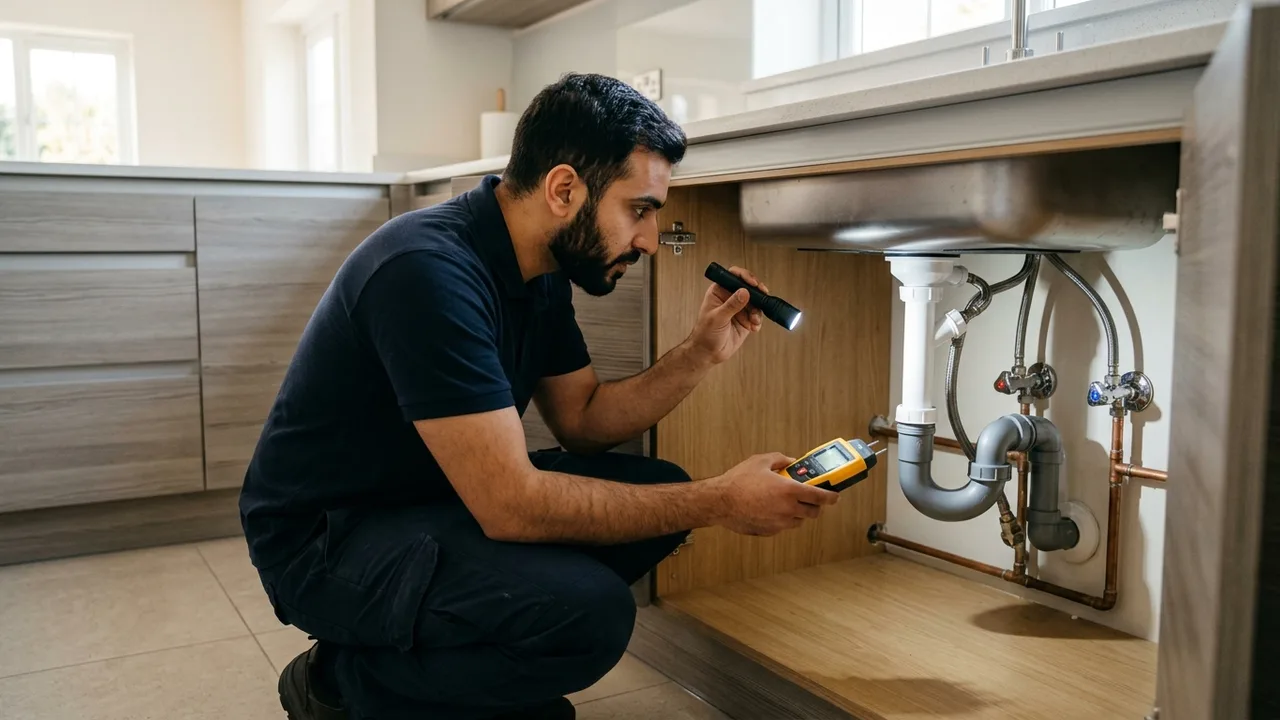
Fitted aluminum, wood, and marble kitchen cabinets conceal a dense network of supply lines, water heaters, RO filters, and dishwasher drains. In Jeddah, we pinpoint kitchen leaks using thermal, acoustic, and pressure testing without tearing out cabinetry.
Why Kitchen Leaks Often Go Unnoticed Until Cabinets and Walls Are Damaged
Unlike bathrooms where walls and floors are fully visible, fitted kitchen base cabinets and kickboards (plinths) conceal the majority of wall penetrations and floor drains. As a result, a slow leak behind a cabinet can persist for months unnoticed.
Homeowners typically discover the problem only when water seeps out from beneath the cabinet kickboard, wood panels swell and warp, musty odors or insects appear, or paint peels on the dining room wall behind the kitchen.
Bashaer Al Khair inspects the entire kitchen hydraulic system step by step—distinguishing simple under-sink valve/filter leaks (fixed with zero breaking) from concealed in-wall supply pipes or sub-floor drainage backups.
Key Field Symptoms & Physical Indicators Requiring Inspection:
Water pooling outside the bottom kickboard of kitchen cabinets while the under-sink shelf looks dry
Physical Mechanism: Indicates the leak is occurring behind the cabinet back panel (at the wall union), from a concealed floor drain beneath the plinth, or from a sub-tile pipe.
Peeling paint and dampness on the living/dining room wall directly behind the kitchen sink
Physical Mechanism: Seepage from hot/cold supply pipes embedded in the kitchen wall or an unsealed angle valve thread wicking into the masonry block.
Persistent musty odor, cabinet floor warping, or dampness near the dishwasher and RO filter
Physical Mechanism: Slow micro-dripping from high-pressure RO filter push-fittings, dishwasher drain hoses, or the sink basket strainer putty seal.
Water dripping through the downstairs kitchen ceiling in multi-story buildings
Physical Mechanism: Seepage from the upstairs kitchen floor drain or sub-floor waste pipe saturating the concrete slab.
Primary Causes of Residential Kitchen Water Leaks
Our kitchen diagnostic protocol systematically evaluates 5 core failure points:
Under-Sink Appliances (RO Water Filters, Dishwashers & Instant Heaters)
Under-sink reverse osmosis (RO) systems contain multiple push-fit plastic elbows and booster pumps prone to pinhole leaks, alongside pressurized dishwasher and heater hoses.
Failed Sink Undermount Silicone Seal or Strainer Basket Assembly
Detachment of undermount stainless sinks from quartz/granite countertops or degraded strainer gaskets allows dishwashing water to run down inside the cabinet walls.
Grease Accumulation & Backflow in Sub-Cabinet Floor Drains
Solidified cooking grease narrows PVC waste pipes, causing greywater to back up silently through the floor drain hidden beneath base cabinets.
Concealed Hot & Cold Supply Pipes Inside Kitchen Walls or Beneath Tiles
Concealed PPR supply lines feeding the sink mixer and appliances can crack at thermal welds or suffer accidental drill punctures during cabinet installation.
When to Request Kitchen Leak Inspection & Electrical Safety Guidelines
When Should You Schedule Inspection Immediately?
- As soon as moisture appears along the base of kitchen cabinets before wood swells or marble countertops sag.
- When paint blisters on the reverse side of the kitchen wall in the hallway or dining room.
- After installing new kitchen cabinets or an RO filter if the water meter or pump begins cycling.
- When a persistent damp odor emanates from the sink cabinet despite dry visible shelves.
How We Isolate the Exact Leak Source in Jeddah During One Structured Visit
Manometer Line Isolation
Isolating and pressure-testing cold, hot, or pool circulation lines independently.
Drain & Joint Verification
Testing floor traps, P-traps, tile grout, and skimmers via dye & moisture probes.
Thermal & Moisture Mapping
Mapping subsurface moisture pockets and ΔT thermal anomalies across walls/slabs.
Acoustic Pinpointing & Report
Locking onto the exact fault coordinate acoustically and issuing the remediation plan.
Illustrative engineering diagram only — exact leak coordinates and remediation scope are confirmed following on-site instrument inspection.
How We Execute Kitchen Leak Detection in Jeddah Across 7 Structured Steps
Inquiry Intake & Initial Symptom Triage
We document the observed symptoms (bill spike, ceiling drip, peeling paint, or tank drop), property type in Jeddah or Makkah, and approximate plumbing age to prepare the right diagnostic kit.
Site Walkthrough & Safety Verification
The technician inspects visible dampness zones and checks that moisture has not compromised electrical panels, wall switches, or structural ceiling slab integrity.
Network Isolation, Meter & Pressure Testing
We isolate cold and hot supply branches and tank lines, monitoring pressure gauges and meter flow to determine whether the fault lies in a pressurized line or unpressurized drainage/grout.
Multi-Instrument Acoustic, Thermal & Moisture Mapping
We deploy the appropriate instruments (acoustic sensors for pressurized lines, thermal cameras for ΔT mapping, and dielectric moisture meters for saturation peaks) to narrow the fault to the smallest footprint.
Cross-Verification & Differential Diagnosis
We cross-check instrument readings to rule out non-pipe causes such as AC duct condensation, coastal capillary rising damp in Jeddah, or degraded shower tile grout.
Transparent On-Site Findings Briefing
We walk the client through the exact fault location, root cause, and whether remediation requires localized plumbing access (e.g., 1–2 tiles) or surface waterproofing treatment.
Actionable Remediation & Waterproofing Roadmap
We outline a prioritized remediation plan: stopping the active water source first, allowing substrate drying where required, and applying targeted waterproofing or plumbing repair.
Engineering Technologies Deployed for Kitchen Leak Detection in Jeddah
Our kitchen inspection leverages flexible borescopes and moisture sensors to inspect beneath cabinet kickboards and behind back panels—preventing unnecessary dismantling of fitted cabinetry.
Hydrostatic & Pneumatic Line Pressure Testing
Scientific Principle: A specific supply branch (cold, hot, or pool circulation line) is isolated and capped, then pressurized with a calibrated manometer gauge; any pressure decay over the holding period confirms a breach in that exact circuit.
- • Definitively separating pressurized supply pipe failures from drainage or grout seepage in bathrooms and kitchens
- • Verifying the integrity of the main buried line between the water meter and underground tank
- • Independently testing swimming pool skimmer, return, and main drain lines apart from the concrete shell
- • Test pressure must never exceed safe operating limits for aging pipes to avoid stressing intact joints
- • Worn angle valves or mixer cartridges can cause false pressure drops unless outlets are properly plugged during the test
Dielectric & Pin Moisture Meters
Scientific Principle: Non-invasive dielectric meters measure changes in the electrical permittivity of building materials (concrete, plaster, gypsum, tile beds) up to 20–40 mm deep to quantify relative moisture saturation against dry baseline zones.
- • Locating the highest moisture concentration point along peeling lower walls and skirting boards
- • Distinguishing historic dried stains from active ongoing leaks in ceilings
- • Checking sub-tile saturation around shower drains, bathtubs, and bathroom thresholds
- • Dense steel rebar or shallow electrical conduits can influence capacitance readings, requiring dry-wall baseline calibration
- • Confirms moisture presence and gradient direction, but must be paired with line isolation to distinguish supply vs. drainage sources
Infrared Thermal Imaging (ΔT Mapping)
Scientific Principle: Infrared cameras measure surface temperature differentials (ΔT) across walls, ceilings, and floors caused by evaporative cooling of moisture or heat transfer from hot water lines—they do not "see water through solid concrete" like X-rays.
- • Tracing concealed hot water supply lines beneath tiles or inside plastered walls
- • Mapping the spatial spread of evaporative dampness across ceilings and walls
- • Identifying moisture-cooled zones prior to pinpointed dielectric moisture readings
- • If leaking water is at thermal equilibrium with the surrounding slab, thermal contrast is minimal unless hot water flow is induced
- • Polished porcelain, marble, or glass surfaces reflect ambient radiation and require careful emissivity interpretation
- • Thermal imaging serves as a spatial mapping tool and must always be confirmed with moisture meters or pressure gauges
Engineering Visual Inspection, Borescope & Flood Testing
Scientific Principle: Combines systematic inspection of grout joints, drain throats, tank necks, and plumbing shafts with flexible borescope cameras for concealed cavities and controlled flood/dye testing for unpressurized floor drains.
- • Inspecting above suspended gypsum ceilings and inside narrow pipe chases without demolition
- • Testing shower pan grout, floor drain seals, and toilet base connections
- • Examining concrete cracks, honeycombing, and neck joints inside water tanks and pools
- • Borescope cameras require an existing small aperture (e.g., spotlight cutout or access hatch) and cannot penetrate solid mortar
- • Controlled flood testing of wet-area floors requires sufficient observation time to confirm seepage migration
Acoustic Listening & Ground Microphones
Scientific Principle: Ground microphones and contact acoustic sensors amplify specific frequency vibrations generated when pressurized water escapes through a pipe crack or fitting joint, filtering ambient noise to locate the peak decibel point.
- • Pressurized water supply lines beneath ceramic and porcelain floor tiles
- • Buried external supply pipes under courtyard pavers and walkways
- • Pinpointing active leaks in pressurized PPR and metallic pipes inside walls
- • Requires sufficient internal line pressure to generate acoustic turbulence; it cannot detect unpressurized gravity drainage leaks on its own
- • Ambient noise from booster pumps, AC compressors, or street traffic must be isolated during measurement
- • Deep burial or thick insulation layers can attenuate acoustic signals, requiring correlation with pressure testing
Kitchen Service Scope: Diagnostics vs. Plumbing Repair vs. Waterproofing
Kitchen Leak Detection: Pinpointing whether moisture originates from under-sink fittings/RO filters, a backed-up floor drain beneath cabinets, or a concealed pipe in the wall/floor.
Kitchen Plumbing Repair: Replacing faulty angle valves, resealing sink strainers, fixing RO/dishwasher connections, or repairing a pinpointed concealed pipe joint.
Kitchen Waterproofing: Sealing countertop-to-wall joints, waterproofing floor drain collars, or applying sub-tile slab waterproofing during kitchen remodeling.
Remediation Steps Following Kitchen Leak Detection
Finding 1: Leak in angle valves, RO filter tubing, dishwasher hose, or sink strainer
Zero tile breaking or cabinet removal.Recommended Action: Replace the defective valve, fitting, or gasket and test under full operating flow.
Finding 2: Backflow or seepage from the floor drain hidden beneath base cabinets
No tile demolition required.Recommended Action: Temporarily unclip the cabinet kickboard, clear grease blockage from the waste line, and seal the drain collar.
Finding 3: Crack in a pressurized hot or cold pipe behind a cabinet or under kitchen tiles
Localized access at the exact pipe fault only.Recommended Action: Detach only the single cabinet module (or lift the single floor tile) at the pinpointed spot to repair the pipe and re-test pressure.
Differential Diagnosis for Kitchen Water Leaks
How our technicians separate overlapping water sources inside the kitchen:
| Condition / Fault Type | Physical & Visual Signs | Instrument Reading Pattern | Correct Engineering Fix |
|---|---|---|---|
| Pressurized Supply Line or RO Filter Leak | Continuous water accumulation or expanding wall dampness even when the kitchen sink is not in use. | Pressure decay on the kitchen manifold + acoustic/thermal localization. | Repair the RO/valve fitting or perform localized pipe repair. |
| Unpressurized Sink Strainer or Waste Line Seepage | Water appears beneath cabinets only during or right after washing dishes or running the dishwasher. | Supply pipes hold full pressure + seepage observed during controlled basin discharge test. | Reseal strainer/P-trap, clear the drain line, and seal the floor trap collar. |
| Refrigerator Defrost / Condensate Pan Overflow | Localized water puddle directly beneath or beside the refrigerator with dry sink plumbing. | All wall and floor plumbing circuits test 100% tight. | Clear the appliance defrost drain tube and check the ice-maker supply line. |
In Jeddah, widespread use of under-sink reverse osmosis (RO) desalination filters combined with automated booster pumps and coastal humidity makes under-cabinet leaks particularly common.
Modern Jeddah villas (Obhur, Al-Marjan, Al-Basateen, Al-Zahra, Al-Salamah, Al-Rawdah) typically feature both an open show/prep kitchen and a heavy-duty kitchen—where leaks in the open kitchen directly threaten adjacent living room marble or parquet.
Sealing kitchen cabinet kickboards with silicone traps leaking drain or filter water beneath the cabinets until the entire sub-floor sand bed saturates.
High booster-pump pressure spikes in Jeddah properties frequently blow off plastic RO filter tubing or wear out angle valves.
Coastal salinity and humidity in Jeddah accelerate corrosion of braided stainless-steel supply hoses under the sink.
Common Property Scenarios We Inspect Across Jeddah:
- North Jeddah Villas (Main & Prep Kitchens): Water seeping from beneath the cabinet plinth accompanied by peeling paint on the adjacent dining wall. — Auditing the RO filter, dishwasher, and sink trap, followed by hydrostatic pressure testing and borescope inspection of the hidden floor drain.
- Apartments in Central & East Jeddah: Dripping in the downstairs neighbor’s kitchen ceiling or dampness along the corridor wall. — Isolating the kitchen supply manifold and testing sink/washing-machine drain flow to separate supply leaks from drain backflow.
Jeddah Field Scenario: Water Pooling Beneath Kitchen Cabinets in Al-Zahra
A villa owner in Al-Zahra noticed water pooling daily in front of the sink cabinet even though the cabinet interior was dry, fearing the entire fitted kitchen had to be dismantled.
Pressure testing proved supply pipes were intact; unclipping only the bottom kickboard and inspecting with a borescope revealed the RO filter reject-water tube had slipped out of the hidden floor drain.
The drain tube was secured into the trap and the drain collar was sealed without removing a single cabinet or tile.
District Clusters Served for Kitchen Leak Detection in Jeddah:
Kitchen Leak Inspection Pricing Factors in Jeddah & Makkah
Kitchen diagnostic inspection costs are based on the following factors:
- Kitchen size and fixture count (large villa main kitchen + dirty/prep kitchen vs. standard apartment kitchen).
- Connected appliances (multi-stage RO filters, dishwashers, washing machines, concealed heaters).
- Whether the inspection covers a single kitchen or includes downstairs ceiling moisture mapping.
- Accessibility of concealed floor drains and shut-off valves behind cabinetry.
How to Prepare Your Kitchen Before the Inspection Visit
Following these simple preparation steps helps our field engineer complete accurate readings faster:
- 1Clear cleaning supplies and stored items from the cabinet directly beneath the kitchen sink for clear access to valves and traps.
- 2Do not dismantle kitchen cabinets before the technician arrives—our instruments locate faults without full cabinet removal.
- 3Switch on the kitchen water heater 20–30 minutes before the visit if a hot-water pipe leak is suspected.
- 4Wipe away standing surface water on the kitchen floor 30 minutes prior so fresh seepage entry points can be observed.
What If Diagnostics Confirm Waterproofing Is Needed?
If diagnostics show kitchen seepage stems from failed floor waterproofing or drain collar gaps beneath cabinets, we provide targeted drain/grout sealing or complete wet-area waterproofing.
Related Leak Detection Services in Jeddah:
Common Questions About Kitchen Leak Detection in Jeddah
Do you have to dismantle all my kitchen cabinets to find a leak in Jeddah?
No. We inspect under-sink connections first, unclip only the removable bottom kickboard to scan beneath cabinets with a borescope and moisture meter, and perform thermal/acoustic scans. A cabinet module is only detached if a confirmed pipe breach lies directly behind it.
Can an under-sink RO water filter cause major kitchen leaks in Jeddah?
Yes. Under-sink RO filters are one of the leading causes of kitchen leaks in Jeddah because they remain under continuous line pressure, feature numerous small push-fit elbows, and have a reject-water drain tube that can slip out of the floor trap.
Why does water and odor come from under the kitchen cabinets when running the dishwasher or sink?
This is typically caused by partial grease buildup in the sub-floor waste pipe; high-volume discharge from the dishwasher or sink backs up and overflows out of the floor drain concealed beneath the base cabinets.
How do I know if my kitchen leak in Jeddah is from a supply pipe or a drain line?
We determine this definitively by pressure-testing the kitchen’s hot and cold supply branches. If manometer pressure holds steady, the leak is in the drainage/strainer/trap system; if pressure drops, a supply pipe or fitting is breached.
Dampness appeared on the living room wall behind my kitchen in Jeddah—what is the likely cause?
The primary suspects are a leaking wall-mounted mixer adapter or angle valve thread, water seeping behind an unsealed countertop backsplash, or sub-cabinet floor drain water wicking into the shared masonry wall.
Do you inspect kitchen leaks for restaurants and cafes in Jeddah?
Yes, we inspect supply manifolds, floor drains, and wet-area substrates for both residential villa/apartment kitchens and commercial kitchens in Jeddah.
Diagnostic & Engineering Comparison Guides to Help You Decide
Lower Wall Dampness & Peeling Paint Causes: How to Distinguish Plumbing Leaks from Rising Damp
Paint blistering or white crystalline salt deposits 15 to 60 cm above floor skirting boards are never a cosmetic issue solved by repainting—they are physical indicators of active moisture migration that must be traced at the source.
Water Leaking from the Bathroom Ceiling: How to Pinpoint the Exact Source Upstairs Without Random Demolition
When yellow stains or active water drops appear on your bathroom ceiling or gypsum soffit, the source lies in the wet area directly above—but is the culprit a pressurized supply pipe, a drainage elbow, eroded tile grout, or a breached slab membrane?
Sudden High Water Bill Causes in Jeddah & Makkah: Step-by-Step Meter, Float Valve & Underground Tank Diagnostic Guide
When your monthly water bill doubles or triples with no change in household occupancy and zero visible dampness indoors, water is almost certainly escaping silently underground or directly into a drain line—here is how to isolate the culprit step by step.
Swimming Pool Water Level Drop in Jeddah & Makkah: How to Scientifically Separate Evaporation from Plumbing & Shell Leaks
Every outdoor pool loses water to evaporation under the intense heat of Jeddah and Makkah—but when does daily water loss cross the engineering threshold into an active skimmer, light conduit, filtration pipe, or structural shell leak?
Kitchen Leak Detection in Makkah
View our dedicated Kitchen Leak Detection guide tailored to Makkah properties.
View Makkah PageAll Leak Detection Services in Jeddah:
Submit Your Issue Details to Coordinate an Inspection or Quote
Complete the fields below accurately. Your submission is validated and assigned a unique reference ID, with a ready-to-share technical summary.