
Sudden High Water Bill Causes in Jeddah & Makkah: Step-by-Step Meter, Float Valve & Underground Tank Diagnostic Guide
When your monthly water bill doubles or triples with no change in household occupancy and zero visible dampness indoors, water is almost certainly escaping silently underground or directly into a drain line—here is how to isolate the culprit step by step.
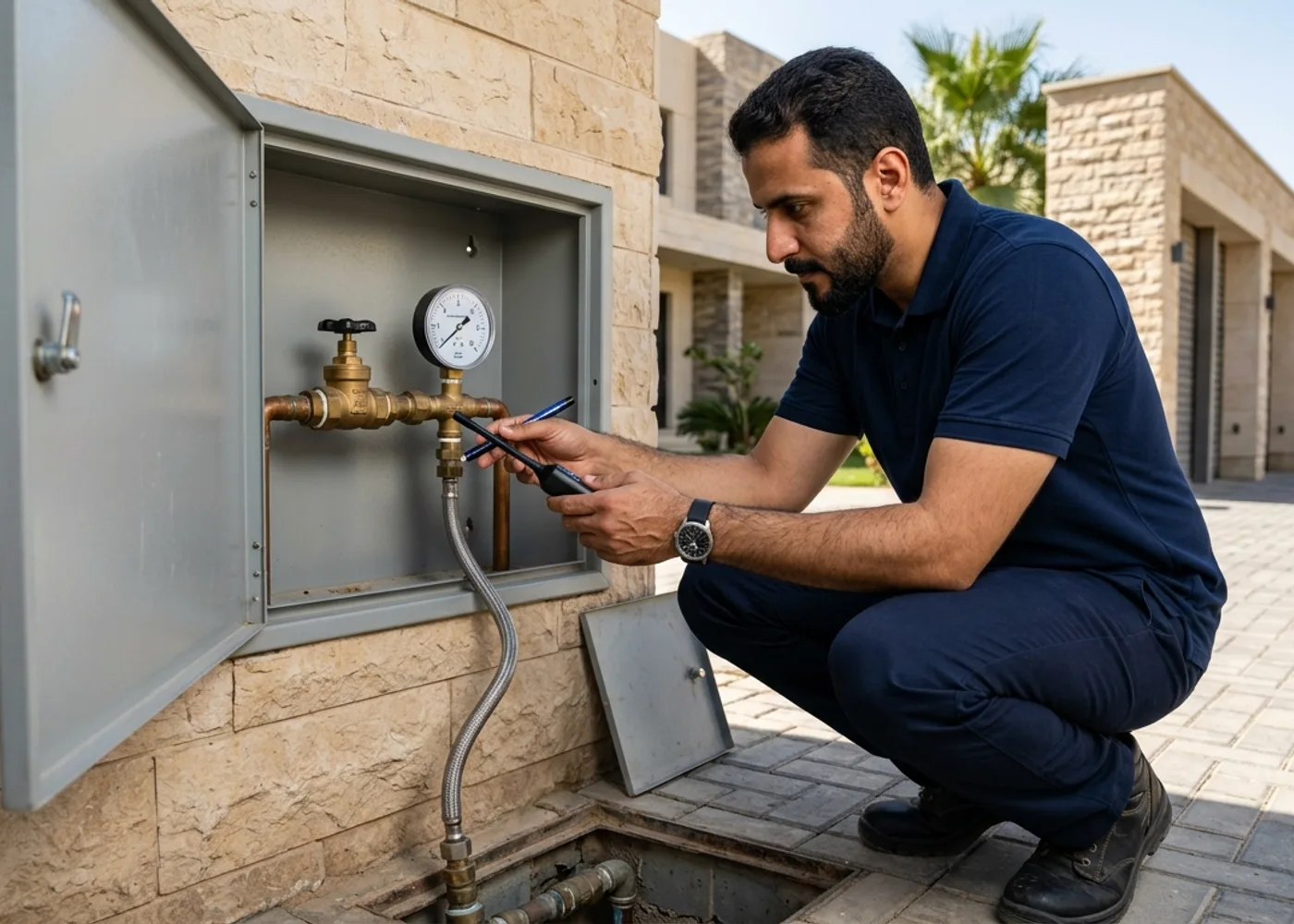
Important Technical Note: A sudden high water bill may result from a physical underground tank or pipe leak, a faulty float valve or toilet flapper, or occasionally billing-cycle duration changes or unupdated multi-unit meter registration. Systematic diagnosis isolates each variable in order.
Executive Engineering Summary
Residential water tariffs in Saudi Arabia operate on progressive consumption brackets. Consequently, a seemingly minor silent leak of just 2 to 3 liters per minute (thinner than a pencil lead inside a toilet cistern or tank float valve) wastes 3,000 to 4,300 liters per day—90 to 130 cubic meters per month—pushing household consumption into the highest billing tiers.
Because over 80% of bill-spiking leaks in Jeddah and Makkah leave zero visible damp patches indoors—escaping directly into the soil from an underground tank or courtyard pipe, or flowing straight down a toilet bowl—this guide walks you through safe homeowner isolation checks and explains when instrumented field diagnostics are required.
High Water Bill Diagnostic Path: From Municipal Meter to Roof Tank
Silent water-loss checkpoints that spike bills with zero indoor dampness
Digital Water Meter (L/hr Flow)
Instantaneous flow rate check under zero household demand
Buried Courtyard Feed Pipe
Isolated by closing float valve and testing line pressure/acoustics
Ground Tank Float, Neck & Shell
#1 cause of silent subsurface overflow or structural leakage
Toilet Cistern Flappers & Roof Float
Silent 24/7 trickle discharging straight into the sewer line
Illustrative engineering diagram only — final technical diagnosis and remediation scope are determined following on-site property inspection.
Plausible Engineering Causes & How We Verify Each On-Site
Cause 1: Faulty Underground Tank Float Valve & Neck Overflow Beneath Tiles
#1Engineering Mechanism: When the mechanical brass ball-valve or electric float switch inside the underground tank fails to shut off at full capacity, municipal water continues flowing 24/7. The water level rises into the unsealed masonry tank neck and escapes silently into the courtyard sand bed beneath the tiles.
Key Indicators & Clues: Opening the ground tank manhole reveals water filled all the way up to the cast-iron cover rim, completely submerging the float valve arm with audible continuous inflow.
Verification Method: Testing the float valve shut-off level and inspecting the waterproofing integrity of the tank neck and roof.
Cause 2: Cracks or Waterproofing Failure in Underground Tank Walls & Floor
#2Engineering Mechanism: Cracks in the internal cementitious render or floor-to-wall construction joints allow stored water to bleed into the surrounding soil. As the tank level drops, the float valve continuously opens to replenish the lost water from the meter.
Key Indicators & Clues: Steady drop in the underground tank water level when both the main meter valve and roof booster pump are turned off.
Verification Method: Static water-level drop testing followed by internal structural inspection of tank walls, floor joints, and neck.
Cause 3: Leak in the Buried Feed Pipe Between the Water Meter and Ground Tank
#3Engineering Mechanism: The main feed pipe runs from the NWC meter beneath the courtyard or driveway into the ground tank. If a buried elbow cracks due to slab settlement or vehicle load, metered water escapes straight into the ground before ever reaching the tank.
Key Indicators & Clues: The digital water meter flow indicator continues registering consumption even when the float valve inside the ground tank is tied shut.
Verification Method: Isolating and pressure-testing the meter-to-tank line, then pinpointing the underground break using an acoustic ground geophone.
Cause 4: Silent Toilet Cistern Flapper Leaks or Roof Tank Overflow
#4Engineering Mechanism: When the rubber flapper seal at the bottom of a standard or wall-hung concealed toilet cistern degrades, a thin, silent stream of water trickles down the porcelain bowl directly into the sewer 24/7, causing the booster pump and ground tank to draw constantly from the meter.
Key Indicators & Clues: Faint ripples on the water surface inside the toilet bowl, audible periodic cistern refilling every 15–30 minutes without use, or frequent booster pump cycling.
Verification Method: Food-coloring dye testing inside all toilet cisterns paired with roof tank float valve and internal manifold pressure checks.
Most Frequent High Water Bill Drivers Across Jeddah Districts
Across Jeddah (Al Hamdaniyah, Al Safa, Al Marwah, Al Naeem, Al Salamah, Obhur, and Al Basateen), roughly 65% of sudden high water bill cases trace back to the underground water tank and the meter-to-tank feed line: either a stuck mechanical/electric float valve causing the tank to overflow silently beneath courtyard tiles through the neck joint, or structural cracks in the concrete tank walls allowing water to escape into the sandy soil.
- Al Hamdaniyah, Taibah & Al Sanabel (Meter-to-tank line & tank neck leaks from slab settlement)
- Al Safa, Al Salamah & Al Marwah (Shared tank float valves & multi-unit toilet leaks)
- Obhur, Al Basateen & Al Mohammadiyah (Irrigation networks, pools & large ground tanks)
Most Frequent High Water Bill Drivers Across Makkah Districts
In Makkah (Al Shawqiyah, Batha Quraish, Wali Al Ahd, Al Sharai, Al Awali, and Al Aziziyah), high municipal line pressure and high-head booster pumps frequently wear out float valve seals in both ground and roof tanks, causing silent overflow discharge or subsurface leakage through rock-cut underground tank fissures.
- Al Shawqiyah, Batha Quraish & Al Kakiyah (Ground tank leaks & roof tank float valves)
- Wali Al Ahd, Al Sharai & Al Rashidiyah (Underground tank cracks & buried courtyard lines)
- Al Awali, Al Naseem & Al Aziziyah (Silent cistern leaks & pressurized supply risers)
Safe Initial Homeowner Checks Before the Engineer Arrives
Practical, non-invasive steps to gather helpful observations safely
Read the Digital Water Meter Flow Rate Indicator (L/hr)
Ensure no taps are running inside the house, then look at your exterior NWC digital water meter display, which cycles between total volume (m³) and instantaneous flow rate (L/hr). When the underground tank is completely full and no water is being used, the flow rate should read exactly 0.0 L/hr.
Tie Up the Ground Tank Float Arm to Isolate the Courtyard Line
Open the ground tank cover and gently lift the float valve arm upward by hand (or tie it up temporarily for 10 minutes so the float valve closes completely), then immediately check the exterior water meter screen.
Perform the Food-Coloring Dye Test in All Toilet Cisterns
Drop 5 drops of blue or red food coloring inside the cistern tank of every toilet in the house, and wait 20 minutes without flushing.
Situations Requiring Urgent Professional High-Bill Diagnostics
- Receiving an NWC SMS alert warning that daily water consumption has jumped by 50% to 100%+ above historical averages.
- Water overflowing from the underground tank neck or noticeable settlement and hollow tiles across the courtyard.
- The domestic booster pump cycling on every few minutes day and night with no fixtures in use.
What Bashaer Al Khair’s Accredited Field Investigation Delivers
- End-to-end diagnostic inspection covering the exterior meter, courtyard line, ground tank structure/neck/float, booster pump, roof tank, and all indoor wet areas.
- Pinpointing any buried courtyard pipe break using acoustic ground microphones and tracer gas without digging up the entire yard.
- Issuing a detailed water leak inspection and repair verification report documenting the root cause of high consumption and completed remedial actions.
Tariff Engineering: Why a Single Small Leak Jumps a Water Bill from 80 SAR to Over 1,200 SAR
Many property owners wonder how a single faulty float valve or tank crack can multiply a water bill tenfold in one month. The explanation lies in progressive tariff brackets: while initial household consumption (Bracket 1: 0–15 m³ and Bracket 2: 16–30 m³) is billed at a very low base rate, a 24/7 leak easily adds 80 to 150 m³ per month, pushing all excess cubic meters into the highest water and wastewater surcharge brackets.
Delaying a professional leak inspection by even a single billing cycle often costs more in wasted water charges than the entire diagnostic and permanent repair procedure.
Detailed Engineering Protocol for Sudden High Water Bill Causes in Jeddah & Makkah: Field Workflow from Diagnosis to Root-Cause Resolution
When a property owner in Jeddah or Makkah contacts Bashaer Al Khair regarding sudden high water bill causes, our engineering team approaches the issue as an interconnected building-physics system rather than an isolated surface blemish. The diagnostic workflow begins by auditing the building’s operational profile: structural age, supply pipe material (heat-fused PPR, UPVC/CPVC, or legacy galvanized lines), existing waterproofing membrane history across roofs, tanks, and wet areas, domestic booster-pump pressure ratings, and the trailing six-month NWC meter consumption trend.
In the second stage of our field protocol, engineers execute Systematic Isolation and Elimination. Rather than stopping at the first visible damp spot or initial sensor reading, our team verifies all parallel pathways. In many residential buildings, eroded tile grout or aged roof flashing coexists with a weeping hot-water adapter or a maladjusted tank float valve; fixing only one while overlooking the secondary source guarantees recurring moisture damage within weeks.
In the third stage, quantitative instrument logs—deep dielectric moisture percentages, infrared thermal gradient captures, and manometer pressure-decay curves measured in bar—are translated into a clear, written remedial specification. This gives the property owner the least invasive, highest-reliability path forward, complete with exact material chemistries, required dry-film thicknesses, and post-execution verification testing.
- Comprehensive non-destructive baseline audit correlating meter flow, manifold pressure, and waterproofing integrity.
- Strict avoidance of cosmetic cover-ups (painting over damp plaster or surface patching without substrate prep) that compound structural damage.
- Adapting diagnostic thresholds and waterproofing chemistries to the distinct micro-climates of coastal Jeddah and mountainous Makkah.
Every technical recommendation we issue in Jeddah and Makkah is backed by verifiable on-site physical measurements to ensure first-time root-cause resolution.
Structural & Financial Consequences of Delayed Diagnosis in Jeddah & Makkah
Escaping water migrates silently through reinforced concrete elements, accelerating chemical and mechanical degradation every week it remains untreated. Once moisture carrying dissolved chlorides and sulfates penetrates the concrete cover of ceiling slabs, ground beams, or underground tank walls, it lowers concrete alkalinity and initiates reinforcement steel passivation breakdown. Corroding rebar expands up to six times its original volume, generating immense internal tensile stress that cracks and spalls the surrounding concrete.
Financially, intervening as soon as early symptoms of sudden high water bill causes appear typically restricts the scope to a non-destructive diagnostic check and a localized plumbing repair or straightforward membrane application. Allowing moisture migration to continue for months transforms a routine maintenance task into an expensive structural restoration involving rebar treatment, plaster replacement, re-tiling, and compounded utility bills.
- Protecting structural reinforcement steel in slabs, ground beams, and tanks against oxidation and concrete spalling.
- Preserving indoor air quality across bedrooms and living areas by eliminating hidden black mold and fungal spores.
- Stopping continuous financial drain from high-bracket NWC water bills and excessive summer HVAC electricity consumption.
Preventive Maintenance Checklist for Villa & Building Owners in Jeddah & Makkah
To safeguard your property’s plumbing and building envelope against sudden emergencies, Bashaer Al Khair engineers recommend a bi-annual preventive checkup—scheduled prior to the winter rainy season and ahead of peak summer heat—covering the following key checkpoints:
- Inspect the underground water tank, mechanical/electric float valves, and manhole neck every 6 months to prevent silent overflow or groundwater seepage.
- Monitor the instantaneous flow rate (L/hr) on your NWC digital water meter and dye-test toilet cisterns periodically to catch silent flapper leaks early.
- Clear roof rainwater drain strainers and inspect tile expansion joints, parapet skirting, and UV acrylic topcoats ahead of seasonal rainstorms.
- Inspect and renew tile grout and silicone seals around bathroom floor drains and shower enclosures to prevent sub-tile sand bed saturation.
Related Engineering & Diagnostic Guides
Underground Water Tank Level Drop & Salinity Intrusion in Jeddah & Makkah: Engineering Diagnosis & Permanent Remediation
Whether your underground tank empties rapidly forcing frequent water-tanker deliveries, or your household tap water in coastal Jeddah suddenly turns brackish and corrodes fixtures—the root cause lies in underground tank structural cracks and waterproofing failure.
Non-Destructive Water Leak Detection Methods Guide: Engineering Principles, Capabilities & Honest Technical Boundaries
Engineering transparency requires stating a vital truth: no single "magic device" detects every type of water leak at the push of a button. Accurate non-destructive diagnosis relies on combining 5 complementary physical technologies.
Water Leak Detection & Waterproofing Cost Guide in Jeddah & Makkah: How Engineering Quotes Are Transparently Calculated
Why do blind over-the-phone flat prices almost always lead to poor workmanship or surprise add-ons? This guide explains the 8 concrete engineering variables that determine accurate leak detection and waterproofing costs in Jeddah and Makkah.
Frequently Asked Questions
Can my water bill skyrocket even if there isn’t a single damp spot inside the house?
Yes—in fact, that is the most common scenario. Leaks from an underground tank or courtyard pipe escape downward into the soil beneath the tiles, while toilet flapper leaks and tank overflows drain straight into the sewer line without ever wetting an interior wall or ceiling.
What is the difference between the mechanical float valve and the electric float switch in an underground tank?
The mechanical float valve (ballcock on the municipal inlet pipe) shuts off incoming city water when the ground tank is full; its failure causes tank overflow and high water bills. The electric float switch controls the booster pump so it stops pumping when the roof tank is full or the ground tank runs dry.
Is tile or wall demolition required to diagnose sudden high water bill causes in Jeddah and Makkah?
No; Bashaer Al Khair relies on a 100% non-destructive diagnostic protocol combining manometer pressure isolation, infrared thermography, digital acoustic listening, and dielectric moisture profiling to pinpoint the exact root cause prior to any repair.
When should leak detection precede waterproofing when addressing sudden high water bill causes?
Leak detection must always come first whenever a pressurized supply line, gravity drain, or float valve leak is suspected; applying waterproofing over an active plumbing leak traps pressurized moisture inside the slab and causes premature membrane failure.
How is the final engineering cost for inspection or waterproofing determined in Jeddah and Makkah?
Pricing is determined transparently based on property location (Jeddah or Makkah), building type, surface area and substrate condition, and the specific material system engineered in accordance with Saudi Building Code principles and manufacturer TDS.
Submit Your Issue Details to Coordinate an Inspection or Quote
Complete the fields below accurately. Your submission is validated and assigned a unique reference ID, with a ready-to-share technical summary.