
Hidden Water Leak Detection in Makkah — Multi-Instrument Concealed Plumbing Diagnostics
We pinpoint concealed water leaks across Makkah villas and multi-story buildings by testing high-pressure risers, horizontal sub-floor branches, and rock-shelf moisture migration using non-destructive instruments.
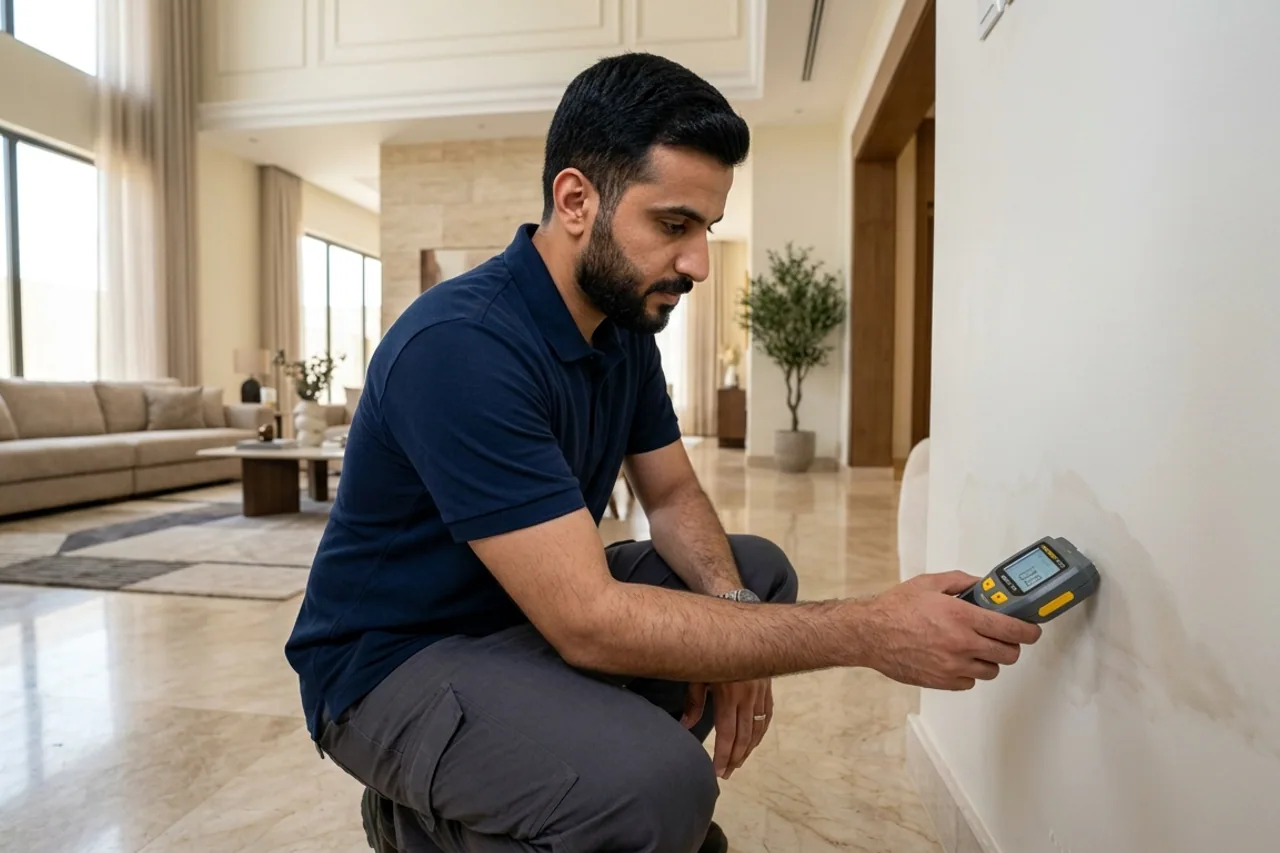
How Hidden Leaks Develop and Why Delayed Diagnosis Threatens Your Property
The most damaging water leaks are those that occur silently behind plastered masonry walls, beneath sub-tile sand beds, or along buried exterior supply pipes. A concealed leak can run for weeks or months before liquid water ever appears on an interior surface.
By the time a homeowner notices a musty odor, paint blistering above the skirting board, efflorescence along tile joints, or a spinning water meter with all fixtures closed, the underlying substrate is already saturated. Resorting to guesswork and blind floor demolition destroys expensive finishes and drives up renovation costs.
Bashaer Al Khair’s Hidden Leak Detection service establishes a rigorous engineering diagnostic stage prior to any repair work—reading line pressure stability, acoustic frequency signatures, thermal differentials, and dielectric moisture gradients to locate the true source.
Key Field Symptoms & Physical Indicators Requiring Inspection:
Water meter spinning or booster pump cycling intermittently with all taps closed
Physical Mechanism: Indicates continuous pressure loss downstream of the meter or booster pump caused by a concealed pipe breach, float valve, or cistern leak.
Blistering paint and white salt efflorescence 15–50 cm above floor skirting boards
Physical Mechanism: Sub-tile sand beds become waterlogged, driving moisture upward by capillary action through masonry blocks and plaster, depositing dissolved salts as it evaporates.
Faint hissing or running-water sound inside walls during quiet nighttime hours
Physical Mechanism: Pressurized water escaping through a pinhole crack in a concealed PPR elbow or brass fitting creates high-frequency turbulence transmitted along the pipe wall.
Localized warm spot on floor tiles or persistent darkening of grout lines
Physical Mechanism: A breach in a buried hot-water supply line heats the surrounding sand bed and ceramic tile directly above the leak point.
Engineering Root Causes of Concealed Water Leaks
We never guess before testing. During on-site diagnostics, our engineers evaluate the primary mechanical and structural causes of concealed leaks:
Imperfect PPR Thermal Fusion Welds or Corroded Concealed Brass Inserts
Cold or misaligned thermal fusion joints in PPR piping—or dezincification of threaded brass female adapters—gradually open under cyclic pump pressure and thermal expansion.
Unpressurized Seepage from Concealed Drainage Joints or Floor Drain Throats
Failed solvent welds in PVC waste pipes or unsealed gaps around floor drain collars allow greywater to seep into the sub-tile sand bed whenever fixtures are used.
Sub-Slab Backfill Settlement Beneath Ground Floors and Courtyards
Soil consolidation beneath ground slabs or courtyard pavers creates shear stress where pipes pass through rigid concrete grade beams.
Capillary Ground Moisture or Failed Substrate Waterproofing
In many properties, no pipe is broken at all; instead, subsurface moisture migrates through uninsulated grade beams or adjacent underground tank walls.
When to Request Hidden Leak Diagnostics & Critical Safety Precautions
When Should You Schedule Inspection Immediately?
- As soon as a damp patch on a wall or ceiling begins expanding, even before active water dripping starts.
- Prior to repainting, installing gypsum wall panels, or laying parquet flooring over previously damp zones.
- When your automated pressure pump cycles every few minutes despite all faucets and appliances being off.
- Before purchasing or taking handover of a villa or apartment to verify concealed plumbing and tank integrity.
Comparison of Leak Detection Instruments & Why We Combine Them in Makkah
| Diagnostic Instrument | Primary Target | Effective Depth / Scope | Why We Pair It With Other Tools |
|---|---|---|---|
| Digital Acoustic Ground Sensor | Pressurized supply pipes beneath tiles & courtyards | Up to 1.5–2.0 m through screed & soil | Cannot hear non-pressurized gravity drains; paired with pressure & borescope. |
| Thermal Imaging Camera (ΔT) | Hot-water PPR lines, ceiling ingress & sub-tile dampness | Surface thermal profile & immediate sub-tile zone | Reads surface ΔT rather than deep buried water; verified with moisture & pressure gauges. |
| Dielectric Moisture Meter | Locating peak moisture saturation behind tiles & paint | Up to 40–50 mm into plaster, screed & concrete | Quantifies dampness but not which pipe is leaking; combined with line isolation. |
| Hydrostatic Pressure Manometer | Proving tightness of cold, hot & pool pipe circuits | Tests the entire isolated pipe run regardless of depth | Proves a line is leaking; acoustic & thermal tools then pinpoint the exact coordinate. |
Illustrative engineering diagram only — exact leak coordinates and remediation scope are confirmed following on-site instrument inspection.
How We Execute Hidden & Non-Invasive Leak Detection in Makkah Across 7 Structured Steps
Inquiry Intake & Initial Symptom Triage
We document the observed symptoms (bill spike, ceiling drip, peeling paint, or tank drop), property type in Jeddah or Makkah, and approximate plumbing age to prepare the right diagnostic kit.
Site Walkthrough & Safety Verification
The technician inspects visible dampness zones and checks that moisture has not compromised electrical panels, wall switches, or structural ceiling slab integrity.
Network Isolation, Meter & Pressure Testing
We isolate cold and hot supply branches and tank lines, monitoring pressure gauges and meter flow to determine whether the fault lies in a pressurized line or unpressurized drainage/grout.
Multi-Instrument Acoustic, Thermal & Moisture Mapping
We deploy the appropriate instruments (acoustic sensors for pressurized lines, thermal cameras for ΔT mapping, and dielectric moisture meters for saturation peaks) to narrow the fault to the smallest footprint.
Cross-Verification & Differential Diagnosis
We cross-check instrument readings to rule out non-pipe causes such as AC duct condensation, coastal capillary rising damp in Jeddah, or degraded shower tile grout.
Transparent On-Site Findings Briefing
We walk the client through the exact fault location, root cause, and whether remediation requires localized plumbing access (e.g., 1–2 tiles) or surface waterproofing treatment.
Actionable Remediation & Waterproofing Roadmap
We outline a prioritized remediation plan: stopping the active water source first, allowing substrate drying where required, and applying targeted waterproofing or plumbing repair.
Engineering Technologies Deployed for Hidden & Non-Invasive Leak Detection in Makkah
We never rely on a single gadget for hidden leaks: thermal imaging and moisture meters map the dampness footprint, while hydrostatic pressure testing and acoustic sensors confirm whether a pressurized pipe is breached and pinpoint its exact location.
Hydrostatic & Pneumatic Line Pressure Testing
Scientific Principle: A specific supply branch (cold, hot, or pool circulation line) is isolated and capped, then pressurized with a calibrated manometer gauge; any pressure decay over the holding period confirms a breach in that exact circuit.
- • Definitively separating pressurized supply pipe failures from drainage or grout seepage in bathrooms and kitchens
- • Verifying the integrity of the main buried line between the water meter and underground tank
- • Independently testing swimming pool skimmer, return, and main drain lines apart from the concrete shell
- • Test pressure must never exceed safe operating limits for aging pipes to avoid stressing intact joints
- • Worn angle valves or mixer cartridges can cause false pressure drops unless outlets are properly plugged during the test
Acoustic Listening & Ground Microphones
Scientific Principle: Ground microphones and contact acoustic sensors amplify specific frequency vibrations generated when pressurized water escapes through a pipe crack or fitting joint, filtering ambient noise to locate the peak decibel point.
- • Pressurized water supply lines beneath ceramic and porcelain floor tiles
- • Buried external supply pipes under courtyard pavers and walkways
- • Pinpointing active leaks in pressurized PPR and metallic pipes inside walls
- • Requires sufficient internal line pressure to generate acoustic turbulence; it cannot detect unpressurized gravity drainage leaks on its own
- • Ambient noise from booster pumps, AC compressors, or street traffic must be isolated during measurement
- • Deep burial or thick insulation layers can attenuate acoustic signals, requiring correlation with pressure testing
Infrared Thermal Imaging (ΔT Mapping)
Scientific Principle: Infrared cameras measure surface temperature differentials (ΔT) across walls, ceilings, and floors caused by evaporative cooling of moisture or heat transfer from hot water lines—they do not "see water through solid concrete" like X-rays.
- • Tracing concealed hot water supply lines beneath tiles or inside plastered walls
- • Mapping the spatial spread of evaporative dampness across ceilings and walls
- • Identifying moisture-cooled zones prior to pinpointed dielectric moisture readings
- • If leaking water is at thermal equilibrium with the surrounding slab, thermal contrast is minimal unless hot water flow is induced
- • Polished porcelain, marble, or glass surfaces reflect ambient radiation and require careful emissivity interpretation
- • Thermal imaging serves as a spatial mapping tool and must always be confirmed with moisture meters or pressure gauges
Dielectric & Pin Moisture Meters
Scientific Principle: Non-invasive dielectric meters measure changes in the electrical permittivity of building materials (concrete, plaster, gypsum, tile beds) up to 20–40 mm deep to quantify relative moisture saturation against dry baseline zones.
- • Locating the highest moisture concentration point along peeling lower walls and skirting boards
- • Distinguishing historic dried stains from active ongoing leaks in ceilings
- • Checking sub-tile saturation around shower drains, bathtubs, and bathroom thresholds
- • Dense steel rebar or shallow electrical conduits can influence capacitance readings, requiring dry-wall baseline calibration
- • Confirms moisture presence and gradient direction, but must be paired with line isolation to distinguish supply vs. drainage sources
Water Meter Flow & Staged Valve Isolation Audit
Scientific Principle: Monitors the low-flow indicator on the water meter while sequentially closing isolation valves (main tank inlet, float valve, booster pump, floor manifolds) to isolate silent consumption to a specific building zone.
- • Investigating sudden high water bill spikes where no indoor dampness is visible
- • Detecting underground leaks in the service pipe between the external meter and ground tank
- • Identifying silent continuous overflow from tank float valves and toilet cisterns
- • Requires temporary cessation of household water use during the isolation window
- • Leaks occurring through the concrete walls of the ground tank after the float valve require static water-level drop measurement inside the tank itself
Clear Engineering Boundaries: Leak Detection vs. Plumbing Repair vs. Waterproofing
Leak Detection (Core Scope of This Service): A non-destructive diagnostic investigation that identifies the exact water source (supply pipe, drain line, tile grout, tank, or ground moisture) and narrows the fault location to the smallest possible area.
Localized Plumbing Repair: Follows detection when testing confirms a cracked pipe, leaking elbow, or faulty valve—replacing only the defective component at the pinpointed spot.
Remedial Waterproofing: Applied when diagnostics show the root cause is failed tank lining, porous bathroom/roof grout and membranes, or when resealing a wet area after mechanical pipe repair.
What Happens After Hidden Leak Detection? (Outcome-Based Pathways)
Finding 1: Pinhole or crack in a pressurized PPR/copper fitting beneath tiles or inside a wall
Strictly localized access (1–2 tiles at the pinpointed fault only).Recommended Action: Mark the exact 1–2 tile access square, cut out the defective fitting, fuse a new section, and re-verify pressure stability before retiling.
Finding 2: Seepage through degraded shower grout or drain collar while supply pipes hold pressure
No tile demolition required if tiles remain firmly bonded.Recommended Action: Rake out deteriorated grout lines, seal the drain throat collar, and apply water-resistant epoxy/polymer joint treatment.
Finding 3: Silent continuous leak from underground tank float valve or toilet cisterns
Zero tile or wall breaking required.Recommended Action: Replace or recalibrate the float valve / cistern flapper mechanism and re-check the water meter flow indicator.
Differential Diagnosis: Separating Pipe Leaks from Look-Alike Moisture Issues
Not every damp stain means a burst pipe. Our technicians apply systematic criteria to distinguish true plumbing leaks from other moisture phenomena:
| Condition / Fault Type | Physical & Visual Signs | Instrument Reading Pattern | Correct Engineering Fix |
|---|---|---|---|
| Active Pressurized Supply Pipe Leak (Hot or Cold) | Continuous, expanding dampness concentrated near a pipe path even when drains are unused; localized warmth if on a hot line. | Measurable manometer pressure drop + concentrated acoustic decibel peak + sharp dielectric moisture spike. | Localized access at the pinpointed spot, pipe repair, and pressure re-test. |
| Unpressurized Drainage or Tile Grout Seepage | Dampness or ceiling dripping intensifies after shower/fixture use and subsides when the wet area is left dry. | Supply pipes hold steady pressure + elevated moisture gradient radiating from floor drains and grout joints. | Repair the drain joint or reseal grout/waterproofing without disturbing pressurized supply lines. |
| Surface or AC Duct Condensation | Surface droplets or mildew near AC diffusers, chilled pipes, or uninsulated cold surfaces during humid summer weather. | Zero plumbing pressure loss + thermal camera shows surface temperature at/below dew point while deep masonry remains dry. | Clear the AC condensate drain line and restore thermal insulation around chilled ducts. |
| Capillary Rising Ground Dampness | A uniform horizontal band of salt efflorescence and flaking paint across multiple ground-floor walls. | Water meter and pipe pressure remain completely stable + moisture readings peak at slab level and taper off uniformly upward. | Apply negative-side damp-proofing/waterproofing and address perimeter drainage. |
In Makkah, hidden leak detection focuses on high booster-pump pressures in multi-story buildings and lateral moisture migration across impervious rocky foundations.
Makkah’s impervious rock foundations (across Al-Aziziyah, Al-Shawqiyah, Al-Awali, Al-Zahir, and Al-Shara’i) prevent downward drainage, forcing leaked water to travel laterally toward basements and retaining walls.
Multi-story residential buildings with tall vertical plumbing shafts require systematic floor-by-floor valve isolation to trace hidden inter-apartment leaks.
Rock-cut underground concrete tanks in Makkah frequently develop concealed seepage at the masonry neck-to-slab transition joint.
High booster-pump discharge pressures required for upper floors in Makkah increase mechanical stress on concealed wall fittings.
Extreme summer temperatures in Makkah intensify thermal expansion stresses on rooftop manifolds and hot water lines.
Common Property Scenarios We Inspect Across Makkah:
- Multi-Story Buildings in Al-Aziziyah, Al-Shawqiyah & Al-Naseem: Concealed dampness appearing on a corridor wall or lower ceiling with ambiguity over which apartment or riser is leaking. — Sequentially isolating apartment manifolds with manometer testing and acoustic/thermal shaft scanning to identify the exact leaking branch.
- Residential Villas in Batha Quraish, Al-Awali & Al-Shara’i: Continuous booster pump cycling accompanied by dampness along the courtyard boundary wall or lower villa facade. — Pressure-testing the buried courtyard supply line and scanning with ground microphones to pinpoint the breach above the rock shelf.
Makkah Field Scenario: Concealed Wall Dampness in an Al-Shawqiyah Building
An expanding damp patch appeared on a second-floor living room wall in an Al-Shawqiyah apartment building; residents assumed the third-floor bathroom drain was leaking.
Our technician pressure-tested both second- and third-floor manifolds; the third floor held steady, while the second floor’s concealed cold-water wall line showed rapid pressure drop under booster pump load.
Acoustic listening pinpointed a cracked brass adapter inside the second-floor wall; it was repaired locally and a pressure regulator was recommended, avoiding unnecessary work in the upstairs flat.
District Clusters Served for Hidden & Non-Invasive Leak Detection in Makkah:
Factors Determining Hidden Leak Inspection Cost in Jeddah & Makkah
Diagnostic inspection fees are structured transparently around the physical scope and complexity of the plumbing systems tested:
- Inspection Scope: Single targeted zone (e.g., one bathroom or wall) versus a full-property diagnostic audit (meter, ground tank, and internal manifolds).
- Property Type & Scale: Residential apartment, standalone villa, multi-story building, or commercial facility.
- Number of Isolated Circuits: Quantity of wet zones, risers, tanks, or courtyard lines requiring individual pressure testing.
- Specialized Instrumentation: Standard multi-instrument check (pressure, acoustic, thermal, moisture) vs. deep buried line tracer testing.
How to Prepare Your Property Before the Leak Detection Engineer Arrives
Following these simple preparation steps helps our field engineer complete accurate readings faster:
- 1Do not scrape, repaint, or artificially dry the damp spot before the visit—preserving the natural moisture gradient helps our meters and thermal camera locate the epicenter.
- 2Ensure clear physical access to the external water meter box, underground tank hatch, booster pump, and main shut-off valves.
- 3Keep the water heater switched on for 30 minutes prior to arrival if a hot-water line leak is suspected, ensuring a clear thermal differential (ΔT).
- 4Note whether the dampness is constant 24/7 or intensifies after specific events (showering, AC operation, or tank filling).
What If Diagnostics Confirm Waterproofing Is Needed?
If hidden leak diagnostics confirm your pipes are intact and moisture originates from failed floor, tank, or roof membranes, our team guides you directly to the appropriate waterproofing solution.
Related Leak Detection Services in Makkah:
Common Questions About Hidden & Non-Invasive Leak Detection in Makkah
How do you identify the source of a hidden leak between apartments in Makkah buildings?
We map the moisture gradient on the affected lower ceiling, then isolate and pressure-test the upper apartment’s hot and cold manifolds, followed by drain and grout checks—pinpointing whether the fault lies in the upper flat or the shared vertical riser shaft.
Why does hidden moisture travel far across ground floors or basements in Makkah?
Because Makkah’s underlying rock strata are non-porous, leaking water cannot drain downward; instead, it flows laterally along the rock contour and emerges at the lowest structural point several meters away.
Does Makkah’s intense summer heat affect thermal imaging accuracy during leak detection?
Direct midday solar heating on exterior surfaces can mask subtle thermal differences, which is why we pair pressure testing and acoustic sensors outdoors, while inside air-conditioned Makkah interiors thermal ΔT imaging remains highly precise.
Do you inspect hidden leaks in rock-cut underground water tanks in Makkah?
Yes. We inspect the meter-to-tank supply line, float valve assembly, masonry tank neck, and concrete wall-to-floor joints to pinpoint water loss in rock-cut Makkah tanks.
Can you locate a hidden leak in a main courtyard pipe in Makkah without trenching the entire yard?
Yes. Once manometer testing confirms pressure loss in the line, we use ground microphones (and safe tracer gas where needed) to locate the breach so excavation is limited to the exact fault point.
How can I schedule a hidden leak detection inspection in Makkah?
You can submit the quick inspection request form on this page or use our verified contact channels to share your Makkah district and symptoms for scheduling.
Diagnostic & Engineering Comparison Guides to Help You Decide
Non-Destructive Water Leak Detection Methods Guide: Engineering Principles, Capabilities & Honest Technical Boundaries
Engineering transparency requires stating a vital truth: no single "magic device" detects every type of water leak at the push of a button. Accurate non-destructive diagnosis relies on combining 5 complementary physical technologies.
Hyperlocal Engineering Guide to Jeddah & Makkah Districts: How Soil Geology, Groundwater & Climate Shape Your Building’s Leak & Waterproofing Needs
A coastal villa in North Obhur faces completely different geotechnical and hydraulic forces than a duplex in Al Hamdaniyah or a mountainside building in Makkah’s Al Awali. This reference maps 42 districts across Jeddah and Makkah to their specific diagnostic and waterproofing requirements.
Water Leak Detection vs. Plumbing Repair vs. Waterproofing vs. Thermal Insulation: Which Service Do You Need First?
Property owners frequently confuse applying waterproofing with fixing a leaking pipe. Coating over a burst pressurized pipe will never stop the leak, and fixing a pipe fitting without restoring a failed wet-area membrane won’t stop shower seepage.
Water Leak Detection & Waterproofing Cost Guide in Jeddah & Makkah: How Engineering Quotes Are Transparently Calculated
Why do blind over-the-phone flat prices almost always lead to poor workmanship or surprise add-ons? This guide explains the 8 concrete engineering variables that determine accurate leak detection and waterproofing costs in Jeddah and Makkah.
Hidden & Non-Invasive Leak Detection in Jeddah
View our dedicated Hidden & Non-Invasive Leak Detection guide tailored to Jeddah properties.
View Jeddah PageAll Leak Detection Services in Makkah:
Submit Your Issue Details to Coordinate an Inspection or Quote
Complete the fields below accurately. Your submission is validated and assigned a unique reference ID, with a ready-to-share technical summary.